
In May 2024, Curiosity accidentally cracked a lump in Gediz Vallis and exposed bright yellow crystals of elemental sulfur — the first confirmed occurrence of pure sulfur on Mars. Nearby stones that look similar raise the possibility of local sulfur abundance, challenging current geological models because elemental sulfur forms under narrow conditions not thought present there. Curiosity’s instruments confirmed the composition, and scientists will model formation scenarios while the rover continues to investigate the channel.
Curiosity Cracked a Martian Rock — and Uncovered the First Pure Sulfur on Mars
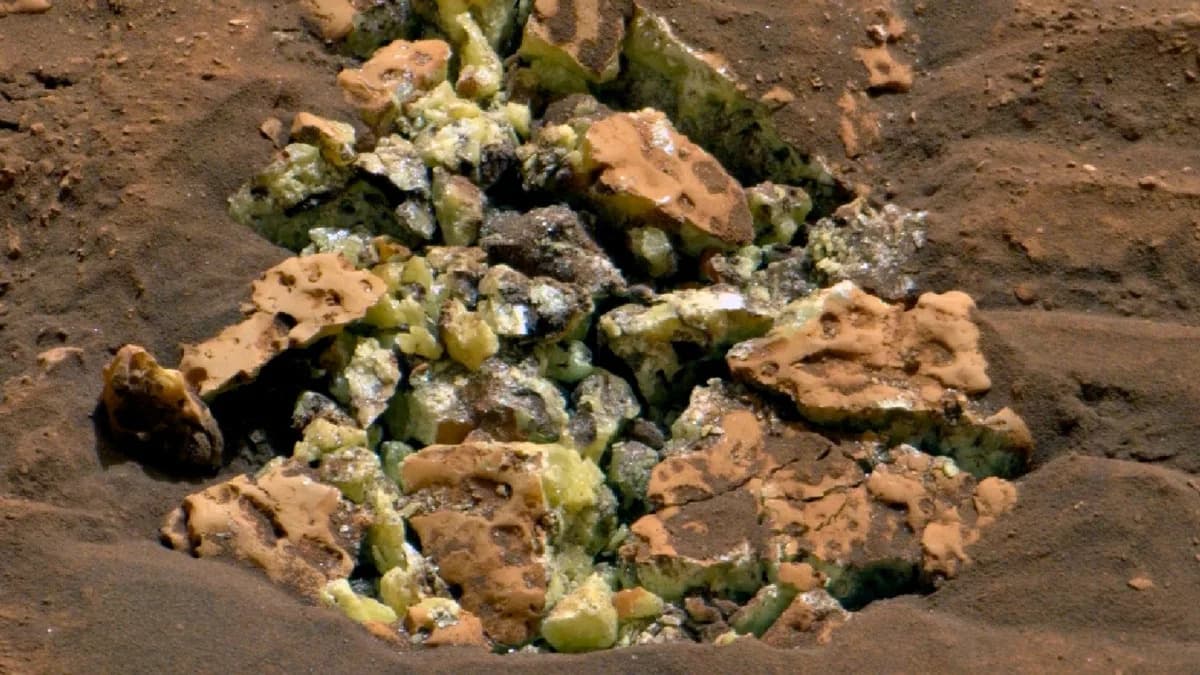
An accident on Mars revealed the surprising contents of an otherwise unremarkable rock. (NASA/JPL-Caltech/MSSS)
In May 2024, NASA's Curiosity rover accidentally fractured an unremarkable lump in the Gediz Vallis Channel and exposed bright yellow crystals of elemental sulfur — commonly known as brimstone. The 899-kilogram (1,982-pound) rover’s wheel pressure split the fragile deposit and revealed sulfur in its pure elemental form, a substance not previously confirmed on Mars.
YouTube Thumbnail
What Was Found
While sulfate minerals (sulfur bound to oxygen and other elements) are well documented across Mars, this is the first confirmed detection of sulfur as the element itself. Many nearby stones visually resemble the crushed specimen, raising the possibility that elemental sulfur may occur in pockets across Gediz Vallis.
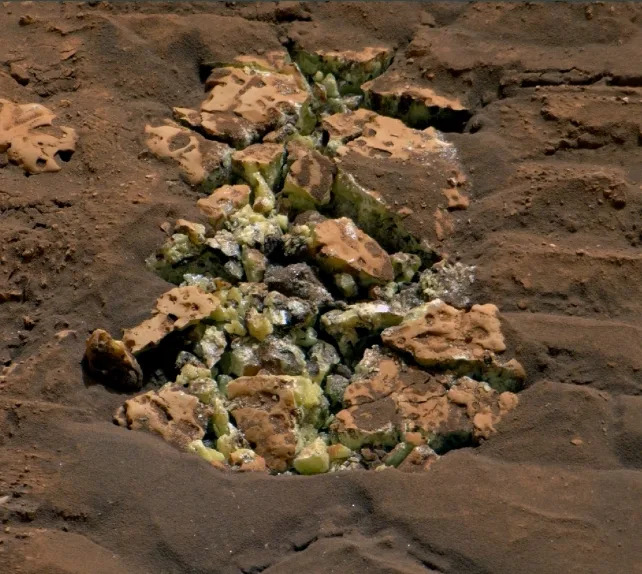
The sulfur Curiosity found on Mars. (NASA/JPL-Caltech/MSSS)
Why This Matters
Elemental sulfur forms only under a narrow set of conditions that are not currently accounted for in geological models of the region. Its presence on loose surface fragments suggests a formation or preservation pathway that scientists do not yet understand, prompting new geological and geochemical investigations.

Subscribe to ScienceAlert's free fact-checked newsletter
"Finding a field of stones made of pure sulfur is like finding an oasis in the desert," said Curiosity project scientist Ashwin Vasavada of NASA's Jet Propulsion Laboratory in July 2024. "It shouldn't be there, so now we have to explain it. Discovering strange and unexpected things is what makes planetary exploration so exciting."
Scientific Context
Sulfates form when sulfur in compound form mixes with other dissolved minerals in water and later crystallizes as the water evaporates. Because sulfates preserve evidence of past water, they have been key to reconstructing Mars’ wet history. By contrast, free elemental sulfur typically requires specific redox or hydrothermal conditions to form and remain stable on the surface.
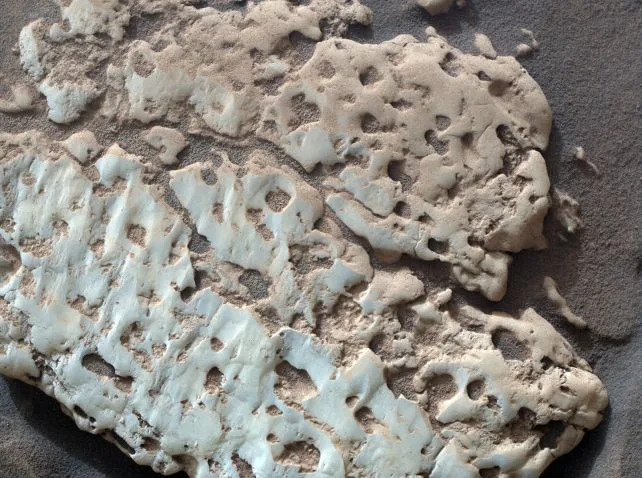
A rock very similar to the one broken by Curiosity, photographed nine days after the sulfur discovery. (NASA/JPL-Caltech/MSSS)
Elemental sulfur is also biologically relevant: sulfur is an essential element for life and is commonly assimilated as sulfates to build amino acids and other biomolecules. However, the discovery of elemental sulfur alone is not evidence of life; it does expand the catalog of surface chemistries that future missions may investigate for habitability clues.
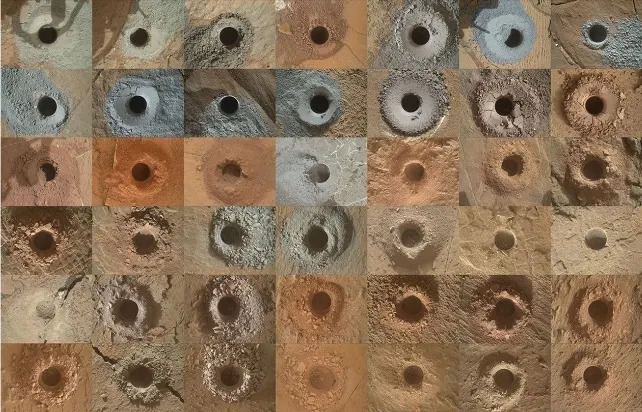
Curiosity has collected 42 powderized rock samples with the drill on the end of its robotic arm. All 42 holes made by the drill are shown here. (NASA/JPL-Caltech/MSSS)
Next Steps
Curiosity’s onboard instruments analyzed the crushed sample and confirmed its sulfurous composition. Scientists now plan to model plausible formation pathways in the context of Gediz Vallis’ geology and to search for additional occurrences as Curiosity continues traversing the ancient channel. Detailed geological modeling and further in-situ observations will be required to explain how elemental sulfur formed and persisted there.
Broader Exploration
Meanwhile, NASA’s Perseverance rover remains active elsewhere on Mars. On June 19, 2025, Perseverance set a record by driving 411 meters in a single session — the longest single drive of any robotic vehicle on another planet — highlighting how different rovers contribute complementary strengths to Martian exploration.
An earlier version of this article was published in July 2024.
Help us improve.





















