
The Sun may have migrated outward as part of a large cohort of solar twins rather than moving alone. Researchers compiled a catalogue of 6,594 solar-type stars and used Gaia astrometry to find a clear age peak at 4–6 billion years that includes the Sun (~4.5–4.6 Gyr). The pattern suggests these stars formed together and drifted outward—possibly while the Milky Way's central bar was still forming—helping relocate the Solar System to a quieter, life-friendly region.
The Sun May Have Migrated Outward With Thousands of Solar Twins — New Gaia Study
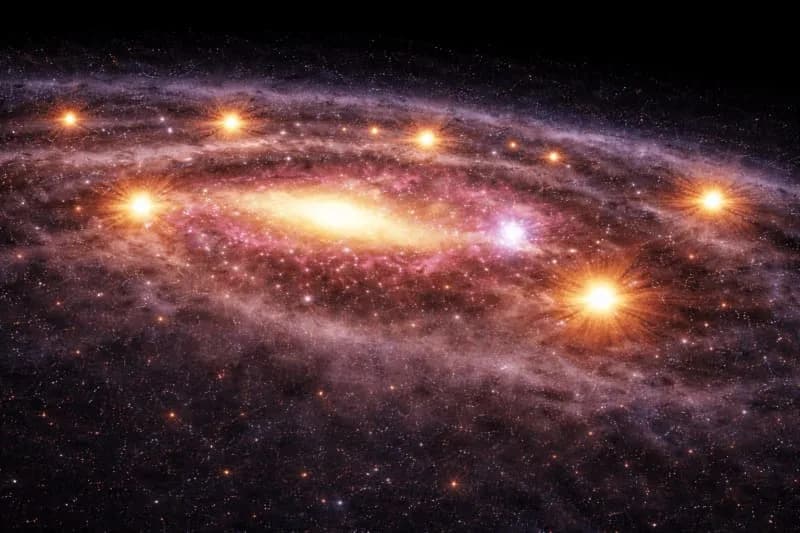
Study of 6,594 solar twins suggests the Sun migrated outward from the Milky Way’s center 4–6 billion years ago. (CREDIT: AI-generated image / The Brighter Side of News)
For billions of years before arriving at its present orbit, the Sun may have been part of a vast cohort — a "wave" — of stars that slowly drifted outward from the Milky Way's inner regions. Astronomers now suggest this collective migration could explain how the Sun moved from a denser, more hazardous environment near the Galactic Centre to the calmer neighbourhood it occupies today.
Assistant Professors Daisuke Taniguchi (Tokyo Metropolitan University) and Takuji Tsujimoto (National Astronomical Observatory of Japan) led an analysis that finds many stars nearly identical to the Sun — so-called solar twins — appear to share common ages and orbital characteristics, consistent with having migrated together billions of years ago.
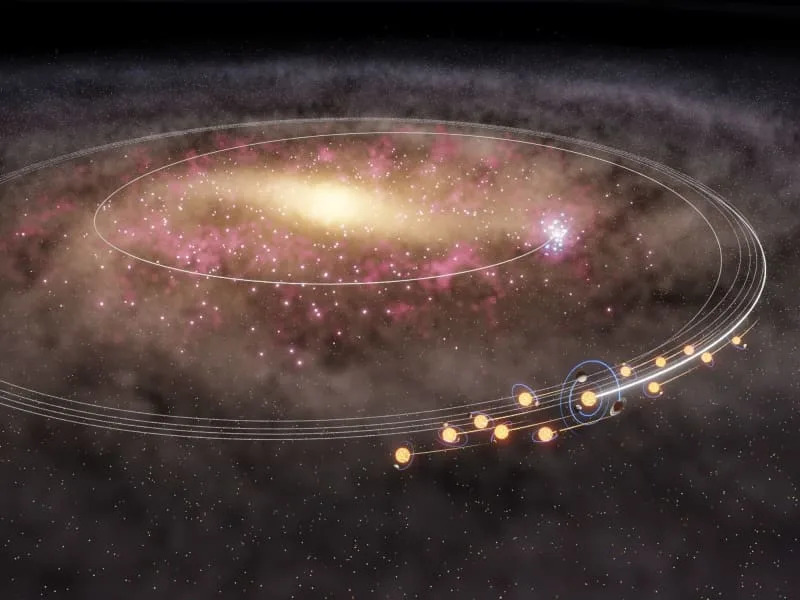
A mass migration of stellar twins. Stars similar to our Sun form a mass migration from the center of the Milky Way, occurring approximately 4 to 6 billion years ago. (CREDIT: NAOJ)
How the Catalogue Was Built
The researchers assembled the largest catalogue of solar twins to date, containing 6,594 stars. They started with astrometric and photometric data from the European Space Agency's Gaia mission, which has measured properties for roughly 2 billion stars. Candidates were selected by matching temperature, metallicity and surface gravity to solar values. Objects with uncertain measurements or confirmed binaries were removed to produce a clean sample for precise age and orbital analysis.
What They Found
When the team examined the age distribution of the solar twins, a clear and broad peak appears between 4 and 6 billion years. The Sun, which formed about 4.5–4.6 billion years ago, lies within that peak. That clustering suggests many of these stars were born in the same region of the Galaxy and gradually dispersed outward together rather than moving individually at random.
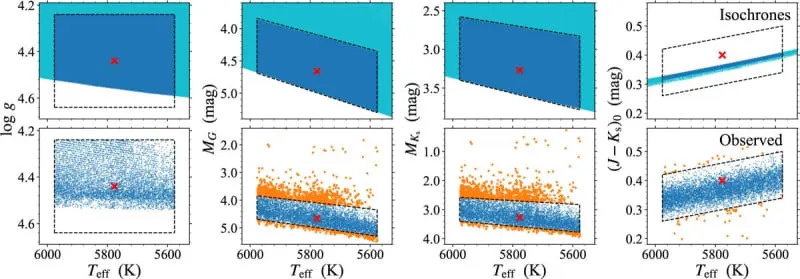
Some parameters of theoretical isochrones (top) and observed solar twin candidates (bottom). The horizontal axes in all the panels represent Teff, while the vertical axes represent some other parameters (log g, MG, MKs, and (J – Ks)⊙). (CREDIT: Astronomy and Astrophysics)
How Migration Could Have Happened
One longstanding puzzle is that the Milky Way's central bar creates a corotation barrier that can trap stars and inhibit large-scale radial migration. Previous work indicates the Sun may have formed roughly 10,000 light-years closer to the Galactic Centre than its current orbit. The new study offers a plausible explanation: the group migration may have occurred while the galactic bar was still forming, when the corotation barrier was weaker and larger groups of stars could slip outward as a unit.
Why This Matters
This collective migration scenario has important implications. The inner Galaxy is a harsher environment — with higher stellar densities, stronger high-energy radiation fields, and more frequent supernovae — than the Sun’s present neighborhood. If the Solar System moved outward along with thousands of similar stars, that journey could have helped place Earth in a more stable, life-friendly region.
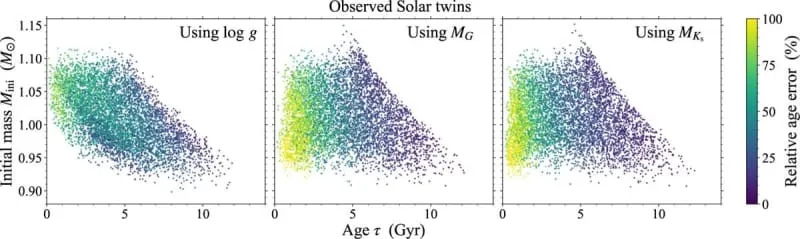
Recovered parameters in the resulting observed solar twin catalog. Each panel shows a scatter plot between the determined age, τ, and initial mass, Mini, color coded by the relative age error. (CREDIT: Astronomy and Astrophysics)
Galactic Archaeology and Next Steps
Researchers call this kind of work galactic archaeology: using stellar ages, chemical compositions and orbital motions to reconstruct the Milky Way's evolution. Solar twins are particularly valuable because their near-identical properties reduce systematic errors, enabling more precise age estimates via isochrone models. Combined with Gaia’s orbits, the new catalogue is a powerful statistical tool to study stellar migration, chemical evolution, and the formation history of the Galaxy’s central structures.
The team’s results are published online in Astronomy & Astrophysics. The findings also appeared in summary form at The Brighter Side of News.
Help us improve.





















