
JWST has imaged PMR 1, a planetary nebula in Vela whose filamentary folds and vertical dark lane create an uncanny brain-like appearance. Located about 5,000 light-years away and spanning ~3.2 light-years, the nebula is produced by a star shedding mass. Spectra from a 2001 study show Wolf–Rayet–like features, but other evidence suggests a Sun-like progenitor — an ambiguity that makes PMR 1 a compelling subject for follow-up observations.
JWST Reveals PMR 1: The ‘Exposed Cranium’ Nebula That Looks Like a Giant Brain
(NASA, ESA, CSA, STScI; Image Processing: Joseph DePasquale)
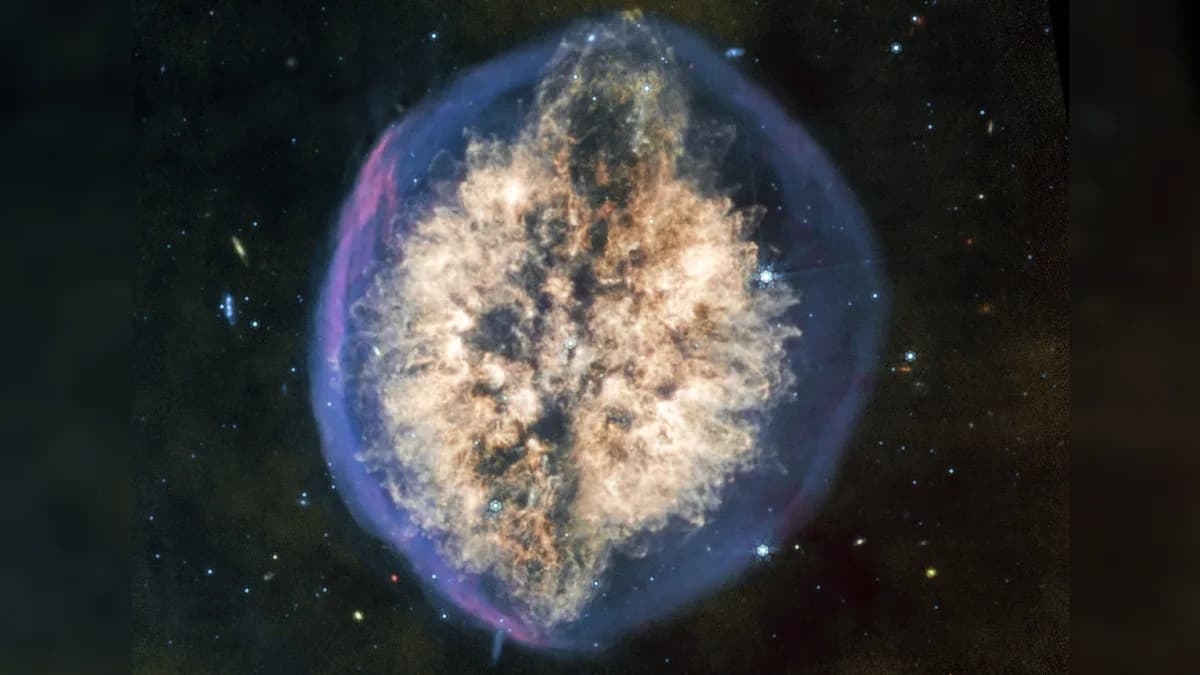
The James Webb Space Telescope (JWST) has captured one of its most striking images yet: PMR 1, a glowing cloud of gas and dust whose folds and a dark central lane make it look uncannily like a giant brain suspended inside a translucent skull.
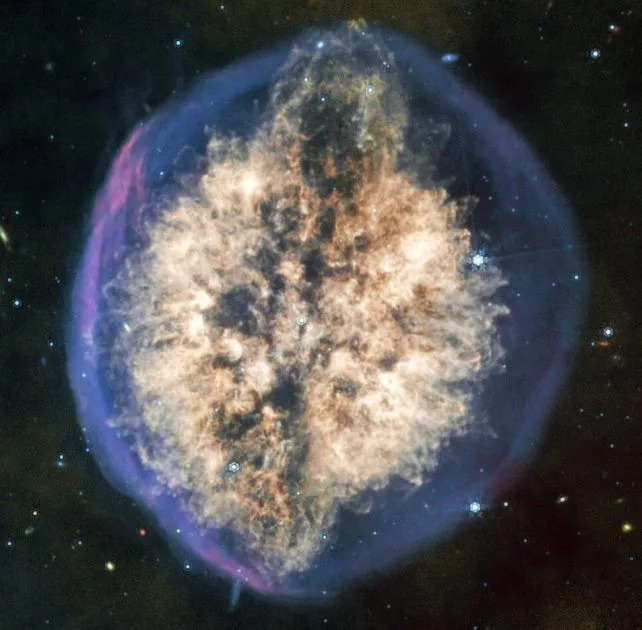
The Exposed Cranium nebula in mid-infrared wavelengths. (NASA, ESA, CSA, STScI; Image Processing: Joseph DePasquale)
What We See
Formally catalogued as PMR 1, the object is a planetary nebula — the expanding envelope cast off by a star nearing the end of its life. JWST's infrared instruments reveal delicate filaments, intricate folds and a vertical dark lane that gives the impression of two cerebral hemispheres split by a sulcus-like groove.
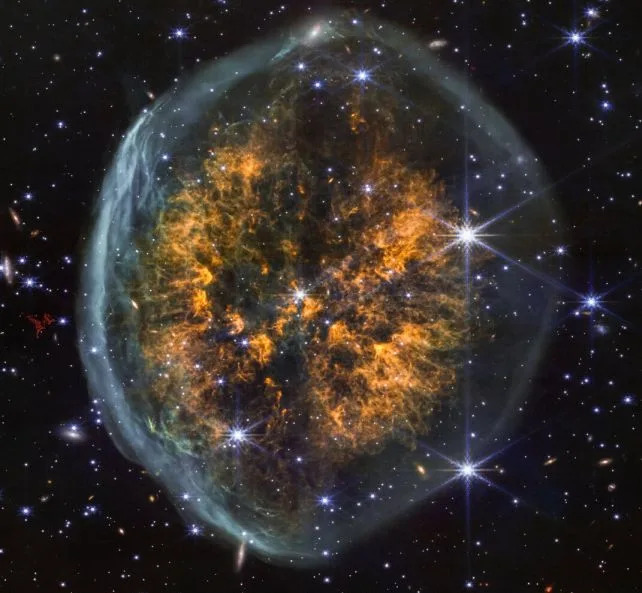
The Exposed Cranium nebula in near-infrared wavelengths. (NASA, ESA, CSA, STScI; Image Processing: Joseph DePasquale)
Where It Is And How Big
PMR 1 lies in the constellation Vela at roughly 5,000 light-years from Earth and spans about 3.2 light-years across — a scale comparable to the size of the Solar System if measured out to the outer edge of the Oort Cloud.

Subscribe to ScienceAlert's free fact-checked newsletter
What Might Be Happening
A star at the nebula's center is rapidly losing mass, producing turbulent outflows and apparent jets that may have carved the dark vertical lane. A 2001 spectroscopic study reported features resembling Wolf–Rayet stars — very hot, massive stars known for strong, broad emission lines and intense mass loss via powerful winds.
But other observational clues point to a different origin: the central object may instead be a lower-mass, Sun-like star that will shed its outer layers and leave behind a white dwarf. There is also a middle possibility: PMR 1 could host a rare class of planetary nebula central stars that spectrally mimic massive Wolf–Rayet stars while actually being the exposed cores of lower-mass stars.
Why It Matters
That ambiguity — whether PMR 1 is driven by a Wolf–Rayet–like progenitor or by a Sun-like core masquerading as one — makes the nebula an intriguing target for further study. Beyond its eerie appearance, the JWST image highlights how infrared observations can reveal fine structure in nebulae and improve our understanding of the late stages of stellar evolution.
For a touch of whimsy, some viewers have nicknamed it the “Exposed Cranium” nebula or joked that it resembles a drifting "Brain Spawn" — a reminder that even technical images can capture the imagination.
Help us improve.





















