
Alon‑Lee Green of Standing Together says anti‑war activists in Tel Aviv have faced police ID checks and right‑wing intimidation while trying to protest Israel's campaign against Iran. A recent Israel Democracy Institute poll found 93% of Jewish respondents support the attack, and most mainstream parties (except Palestinian parties) have rallied behind the war. Analysts attribute support to wartime psychology, long‑standing fears about Iran and limited media criticism, though doubts are emerging after contradictory battlefield claims and renewed rocket attacks.
Why Most Israelis Back a 'Heroic' War With Iran — And Why Doubts Are Growing
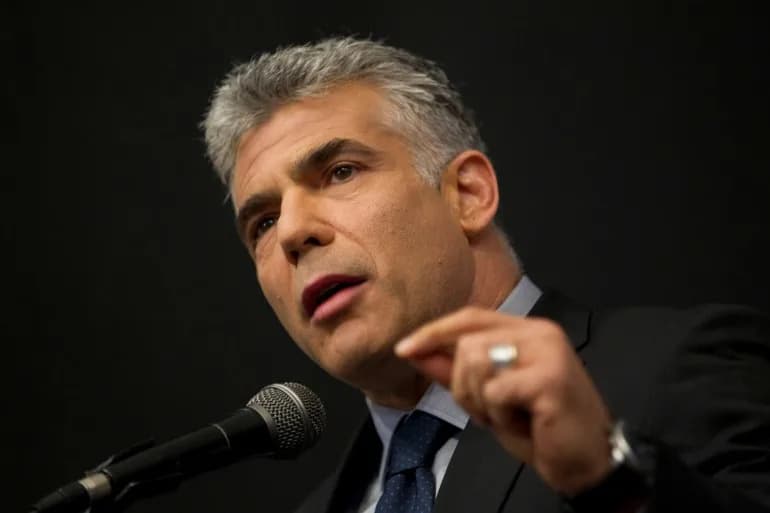
Israel’s opposition leader Yair Lapid said he will no longer back motions of no confidence against the government amid a ‘just war’ [Ariel Schalit/AP]
Alon‑Lee Green, co‑founder of the Palestinian‑Jewish activist group Standing Together, said he tried to organise a protest in Tel Aviv against Israel's campaign targeting Iran, only to be met with police ID checks and right‑wing counter‑protesters. Green described a second attempt after an earlier demonstration was dispersed by police.
Organising Under Pressure
Anticipating official restrictions on public gatherings, organisers booked an underground theatre that could double as a shelter. Green called it imperfect but necessary in the current climate. He said officers told demonstrators they were there to "monitor" and ensure participants did not "say anything we weren't allowed to," a presence he called clearly intimidating.
Broad Public Support — And Political Paradoxes
A recent Israel Democracy Institute poll found that 93% of Jewish respondents supported the attack on Iran. Many analysts and activists say this level of backing echoes the near‑unanimous support Israel saw for its campaign in Gaza after the October 7 attacks.
"Apart from the Palestinian parties, all of the opposition are united behind the war," Green told Al Jazeera. "On one hand they say they support the war but oppose [Prime Minister Benjamin] Netanyahu. At the same time they refuse to acknowledge that the war is bolstering Netanyahu. It's a complete failure of politics."
Rallying Psychology, Media, And Framing
Prime Minister Benjamin Netanyahu framed the campaign in sweeping terms, saying the conflict would be "recorded in the annals of Israel" and fought for "future generations" and "the future of humanity." Chatham House analyst Yossi Mekelberg described a predictable rally‑round‑the‑flag effect in the early days of conflict and noted that long‑running Israeli perceptions of Iran as an existential threat make consolidated support easier.
London‑based media analyst Ayala Panievsky said mainstream Israeli outlets have offered little sustained criticism and that the post‑October 7 environment made it easier to argue that a pre‑emptive strike is necessary. Analysts also say complex issues — negotiations, sanctions, and the status of the 2015 nuclear agreement — have largely been crowded out by the urgency of war rhetoric.
Emerging Doubts
Critics point to contradictory public claims and battlefield realities as a source of rising scepticism. Green noted that authorities claimed to have neutralised Iran's missile threat during a 12‑day confrontation in June 2025, yet cross‑border violence and recent Hezbollah rocket barrages show persistent vulnerabilities. Mekelberg added that the killings of thousands in Iran in January have led some Israelis to view the campaign as "heroic" and supportive of Iranian dissenters — a framing not universally accepted by opponents of the war.
Looking Ahead
While many Israelis currently back the operation, analysts and activists say that durable public support will depend on clear objectives and an exit strategy — neither of which have been broadly articulated. As Green put it, "People are beginning to question and criticise, and I think that's going to increase."
Help us improve.





















