
Researchers led by Flinders University discovered a trisulfide metathesis reaction that lets R–S–S–S–R fragments swap end groups spontaneously at room temperature in certain solvents (for example, DMF). The exchange can reach equilibrium in seconds without heat, light, or catalysts—a major departure from prior trisulfide chemistry that required high temperatures and long times. The team demonstrated practical uses, including selective modification of the anti-tumor agent calicheamicin and a recyclable trisulfide-linked polymer. The findings are published in Nature Chemistry.
Scientists Discover Fast, Reversible Trisulfide Metathesis — Sulfur Chains Swap at Room Temperature
Laboratory equipment used in chemistry research. (Rapeepong Puttakumwong/Moment/Getty Images)
A chance observation in a polymer laboratory has led an interdisciplinary team led by Flinders University to announce a major chemical discovery: a previously unknown trisulfide metathesis reaction in which chains of three sulfur atoms (R–S–S–S–R) exchange end groups spontaneously at room temperature in certain solvents.
What the Team Observed
Unlike typical sulfur–sulfur rearrangements that require heat, light, or catalysts, this trisulfide metathesis proceeds without added reagents or external activation. In solvents such as dimethylformamide (DMF), some trisulfide-containing molecules begin swapping their terminal fragments in seconds at ambient conditions, and the process is readily reversible.
How the Reaction Works
Mechanistically, two trisulfide molecules can exchange the groups attached to their ends, so a pair like:
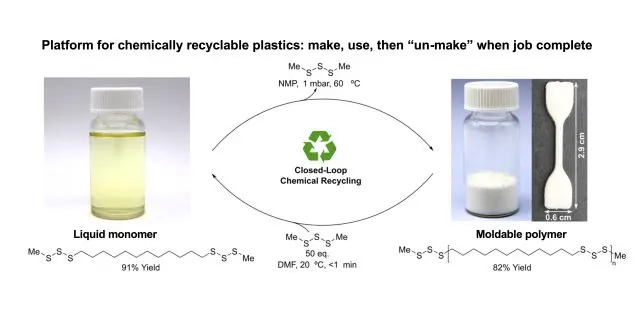
A diagram illustrating the application of the trisulfide metathesis reaction for recyclable plastic. (Flinders University)
R1–S–S–S–R1
R2–S–S–S–R2
becomes
R1–S–S–S–R2
R2–S–S–S–R1

Subscribe to ScienceAlert's free fact-checked newsletter
Under favorable conditions the exchange can reach equilibrium in seconds at room temperature. This contrasts with previously reported trisulfide exchanges that typically required 80–150°C and hours or days to equilibrate.
Demonstrated Applications
The researchers used the reaction to selectively modify the anti-tumor agent calicheamicin and to build a polymer whose trisulfide linkages enable controlled disassembly back into constituent building blocks for recycling. These demonstrations highlight possible uses in medicinal chemistry, recyclable materials, and adaptive polymers.
Who Did the Work and Where It Was Published
The interdisciplinary team was led by chemist Justin Chalker at Flinders University, with contributions from Harshal Patel (Chalker Lab) and collaborators including Tom Hasell (University of Liverpool). The results appear in the journal Nature Chemistry.
Potential Impact
Because the reaction is fast, selective, and reversible under mild conditions, it could provide new strategies for constructing molecules and materials that rearrange, repair, or recycle themselves. Immediate implications include new approaches to drug modification and more sustainable polymer design; broader applications may emerge as other groups explore and adapt the chemistry.
Note: The discovery does not imply that all trisulfides behave identically—reaction rates and selectivity depend on the specific molecular fragments (R groups) and solvent conditions.
Help us improve.





















