
Astronomers have found strong evidence that two planets collided around the Sun-like star Gaia20ehk, about 11,000 light-years away. Visible light dimmed beginning in 2016 while infrared emission spiked, indicating hot debris from a catastrophic impact. The debris orbits at roughly 93 million miles and could — over millions of years — coalesce into an exomoon. The work, led by Anastasios Tzanidakis, appears in The Astrophysical Journal Letters.
“Completely Bonkers”: Evidence Two Exoplanets Collided Around Gaia20ehk
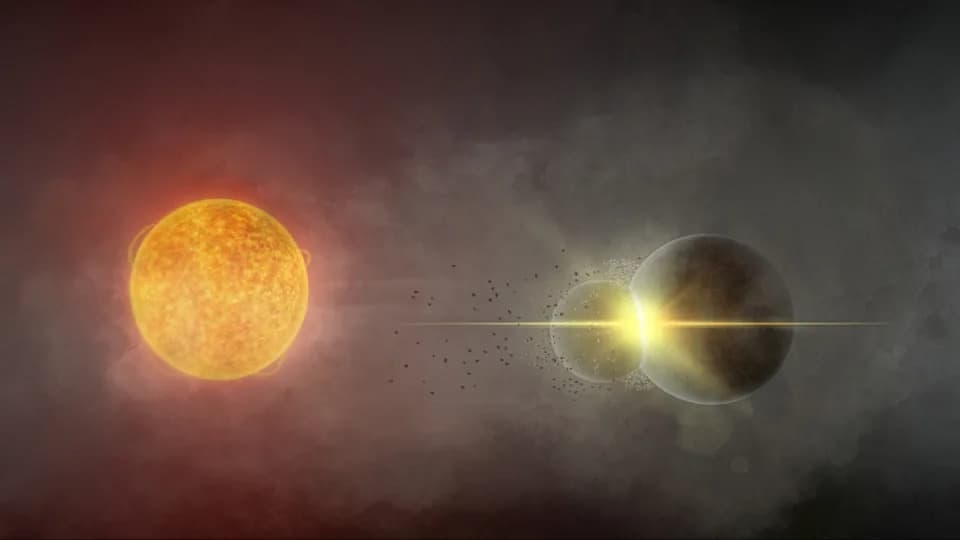
An illustration shows two planets colliding around the star Gaia20ehk. | Credit: Andy Tzanidakis
A team of astronomers reports compelling evidence that two planets smashed together in orbit around a distant Sun-like star, producing a cloud of hot rock and dust that changed the star’s observed brightness. The star, designated Gaia20ehk, lies roughly 11,000 light-years from Earth and behaved in an unusual way beginning in 2016 and becoming dramatically erratic by 2021.
What Observers Saw
For years Gaia20ehk showed a steady, Sun-like light output. Beginning in 2016 the visible-light record developed a series of dips, and by about 2021 the star’s brightness pattern became chaotic. The team led by Anastasios Tzanidakis (University of Washington) found these variations were not intrinsic to the star but instead caused by large amounts of debris — rock, dust and molten material — passing between the star and observers on Earth.
“The star's light output was nice and flat, but starting in 2016, it had these three dips in brightness. And then, right around 2021, it went completely bonkers,” said Tzanidakis. “I can't emphasize enough that stars like our Sun don't do that.”
Infrared Clues Point To A Collision
Follow-up observations in the infrared provided a critical clue: while visible light dimmed, infrared emission rose sharply. That anti-correlated behavior indicates the obscuring material was hot enough to glow in the infrared — exactly what would be expected if two planets experienced energetic impacts that vaporized or melted surface material.
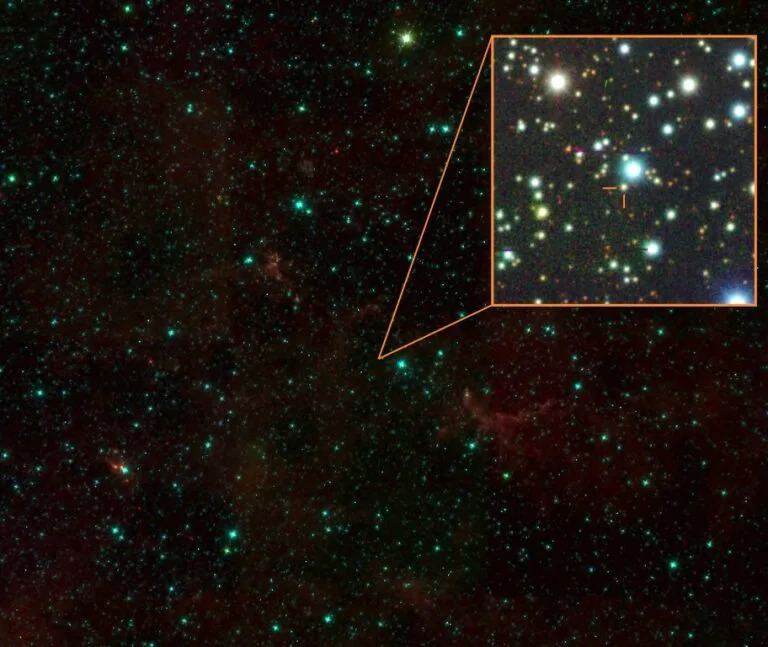
The location of Gaia20ehk, host to the wreckage of two colliding planets. | Credit: NASA/NSF NOIRLab
Tzanidakis and colleagues propose the collision began with grazing encounters that produced modest heating and dust, then culminated in a catastrophic impact that released much more hot debris. The debris cloud now orbits the star at roughly 93 million miles — a distance comparable to Earth's average distance from the Sun — and could, over millions of years, cool and reassemble into larger bodies such as moons.
Why This Matters
Planetary collisions were common in the early Solar System and are thought to have driven the formation of the Moon after a giant impact with the proto-Earth about 4.5 billion years ago. Directly observing a likely planet–planet collision elsewhere gives astronomers a rare opportunity to study the dynamics, timing and debris-production processes that shape planetary systems.
Such events are difficult to catch because they require a favorable alignment — debris must pass between the star and Earth — and can unfold over many years. The team credits long-term data mining for spotting this slow, decade-scale phenomenon. The study was published March 11 in The Astrophysical Journal Letters.
Researchers
The analysis was led by Anastasios Tzanidakis with collaborators including James Davenport and other members of the University of Washington team, using multiple telescopes and datasets spanning visible and infrared wavelengths.
Help us improve.





















