The United States and China both aim to establish sustainable, crewed lunar bases but pursue different strategies. China targets a 2030 landing and plans the International Lunar Research Station (ILRS) with Russia, beginning with Chang'e robotic missions to scout resources and test construction techniques. NASA seeks a 2028 landing focused on the resource-rich south pole and plans an Artemis Base Camp built in phases with international and commercial partners; recent U.S. legislation explicitly directs NASA to establish a lunar base. Experts say permanence will require distributed infrastructure, in situ resource use and new governance to manage scarce polar sites.
Race to the Moon: How the U.S. and China Plan Permanent Lunar Bases
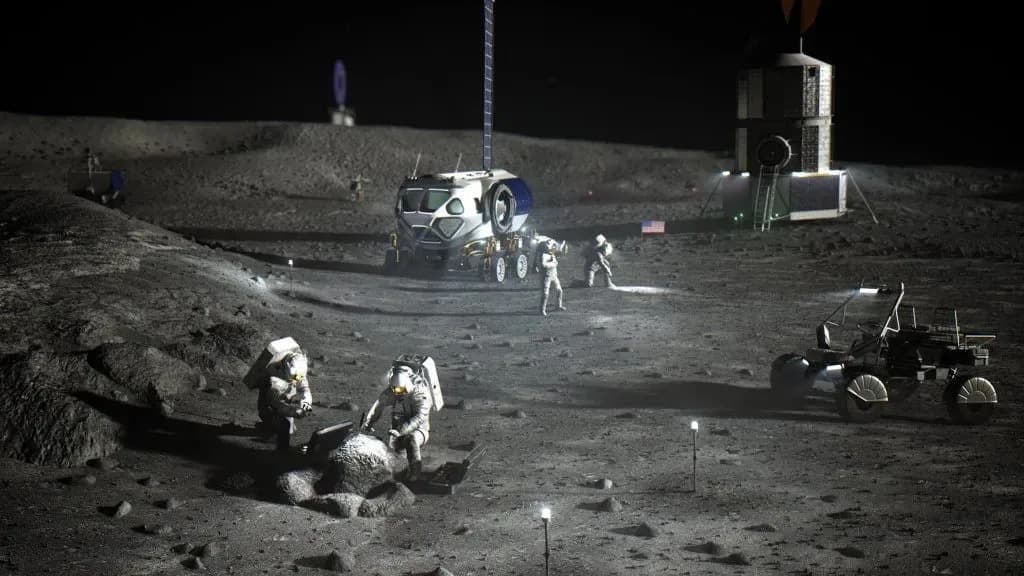
An artist’s concept shows NASA astronauts at work near a habitat near the moon’s south pole.(NASA)
In the renewed space race, the United States and China share a long-term objective: building sustainable, crewed lunar bases. Their approaches, timelines and landing-site choices differ sharply, and those differences could determine which nation establishes a permanent foothold on the moon.
Timelines and Approaches
China. The China Manned Space Agency (CMSA) is aiming for a crewed lunar landing by 2030 at the latest. Its plan calls for separate launches of a Mengzhou crew capsule and a Lanyue lunar lander aboard Long March 10 rockets. Officials have not finalized a touchdown site, but public signals point to a relatively low-risk equatorial landing on the moon's near side—an approach that echoes the site-selection prudence used during NASA's Apollo era.
United States. NASA is targeting a crewed lunar landing as early as 2028. Under current plans, astronauts would travel in an Orion capsule launched on a Space Launch System (SLS) rocket and then transfer to a commercial lunar lander (for example, a Starship-derived vehicle or Blue Origin's Blue Moon) to descend to the surface as part of Artemis missions. The U.S. strategy emphasizes the resource-rich but more hazardous lunar south pole.
Phased Bases: ILRS and Artemis Base Camp
China's long-term vision is the International Lunar Research Station (ILRS), a two-phase program developed in cooperation with Russia's Roscosmos. The ILRS begins with uncrewed reconnaissance and technology demonstrations and would later transition to human-tended operations.
Uncrewed missions led by the China National Space Administration (CNSA) will pave the way: Chang'e 7 is expected to survey the Shackleton Crater region for polar ice and other resources, while Chang'e 8 (planned for 2029) aims to demonstrate in situ resource utilization techniques such as manufacturing bricks from lunar regolith. Those capabilities could eventually enable production of drinking water or propellant from polar ice.
NASA's proposed outpost, provisionally called Artemis Base Camp, is intended to be U.S.-led but internationally and commercially supported. It would be built in stages using robots and crews. Early operations may appear cluttered—assembled from numerous landers, habitats and rovers—before a more organized, capable infrastructure emerges.
Infrastructure, Habitats and Resources
Experts agree that a truly "permanent" lunar presence will require integrated, repeatable infrastructure: dedicated landing and launch pads, reliable power (NASA has discussed a small fission reactor by about 2030), logistics and surface mobility systems, resource-processing facilities and robust habitats. Habitats will likely require shielding—often by burying modules under regolith—to protect occupants from cosmic radiation, micrometeoroids and extreme temperature swings during the long lunar day-night cycle.
In situ resource utilization (ISRU) is central to sustainability: extracting water ice from permanently shadowed craters at the poles and converting it to drinkable water, oxygen and fuel would reduce the need to haul everything from Earth.
Law, Governance and Competition
The legal foundation for lunar activity is the 1967 Outer Space Treaty, which prohibits national appropriation of celestial bodies and promotes use for the benefit of all humankind. While the treaty bars territorial claims, it permits operational measures such as "safety zones" to protect ongoing work—measures that could nonetheless function in an exclusionary way if used competitively.
"It will be a governance test," says legal expert Michelle Hanlon. "The key question is whether multiple nations can operate side-by-side at the most valuable places on the moon without turning operational safety into geopolitical exclusion."
Geography Limits Where Bases Can Thrive
The lunar south pole is rugged and remote, and only a few spots combine the conditions needed for sustained operations: safe terrain for landing, near-continuous sunlight for power, access to permanently shadowed regions that may contain ice, and line-of-sight communications with Earth. Those factors mean the practical competition centers on a handful of strategically valuable sites.
Political Momentum
U.S. policy is evolving: the NASA Authorization Act of 2026—moved forward by the Senate Committee on Commerce, Science, and Transportation—explicitly calls for NASA to establish a lunar base. Committee leaders framed the directive in geopolitical terms: accelerating U.S. efforts so the nation moves before rival powers. Whether that legislative mandate will translate into specific facilities and dates remains to be seen.
Ultimately, establishing a continuous human presence on the moon will be a technical and political marathon: staged infrastructure, international partnerships and clear governance rules will determine whether the moon becomes a shared scientific commons or a new arena of strategic competition.
Help us improve.