
NASA has ruled out impacts by asteroid 2024 YR4 on Dec. 22, 2032, for both the Moon and Earth. New James Webb Space Telescope observations from Feb. 18 and 26, 2026, allowed CNEOS at JPL to refine the asteroid's orbit and calculate a closest lunar approach of about 13,200 miles (21,200 km). Earlier estimates gave the object a 4.3% chance of striking the Moon; those odds are now eliminated. Scientists stress many large near-Earth asteroids remain undetected and that active deflection capability like DART is not yet an operational, on‑call defense.
NASA: 'City-Killer' Asteroid 2024 YR4 Will Miss the Moon and Earth in 2032
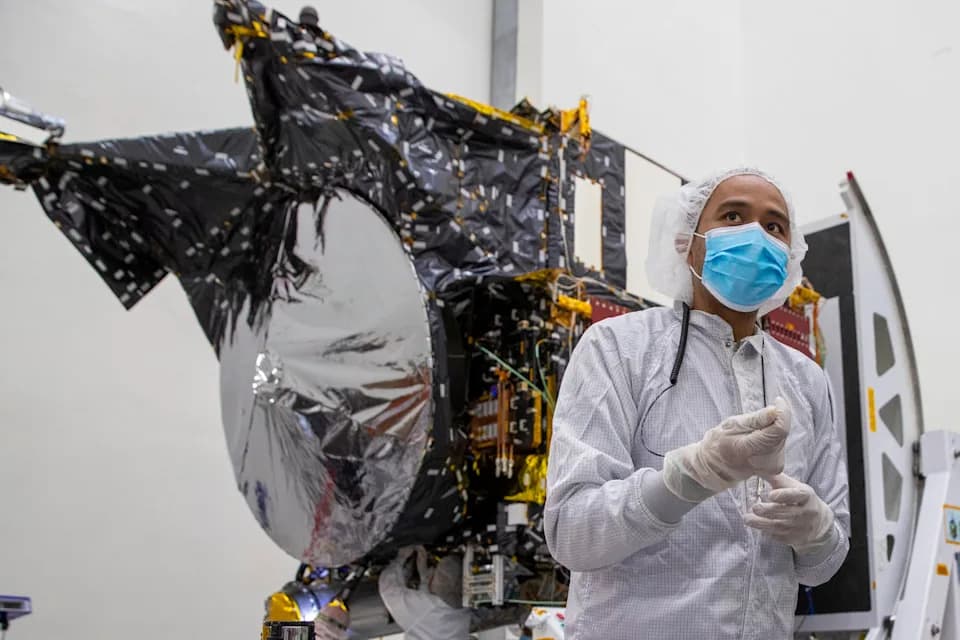
NASA systems engineer Luis Dominguez is a team leader working on the Psyche spacecraft that will study a metal rich asteroid located between Mars and Jupiter.(Robert Gauthier/Los Angeles Times via Getty Images)((Robert Gauthier/Los Angeles Times via Getty Images))
Asteroid 2024 YR4 — once described in media reports as large enough to be a "city killer" — will not strike the Moon or Earth on Dec. 22, 2032, NASA announced after refining the object's orbit with new observations from the James Webb Space Telescope.
What NASA Found
Using Webb observations collected on Feb. 18 and Feb. 26, 2026, specialists at NASA's Center for Near-Earth Object Studies (CNEOS) at JPL refined 2024 YR4’s trajectory and ruled out any chance of lunar impact on Dec. 22, 2032. With the updated orbit, the asteroid is expected to pass about 13,200 miles (21,200 km) from the lunar surface on that date.
"This update reflects improved precision in our understanding of where the asteroid is expected to be in 2032 rather than a shift in its orbital path," NASA said in its March 5, 2026 statement.
How Observations Changed the Picture
Earlier analyses, based on more limited data, gave 2024 YR4 a roughly 4.3% chance of striking the Moon on Dec. 22, 2032, and initially flagged a slim possibility of an Earth impact. The Webb detections — among the faintest asteroid observations Webb has made — were crucial because the object had been unobservable from other ground- and space-based facilities since spring 2025.
Discovery and Follow-Up
The asteroid was discovered in late 2024 by the ATLAS survey station in Chile. In early 2025, preliminary trajectory solutions suggested a small but notable impact probability. As more observations were collected worldwide and Webb data were added, CNEOS concluded the object poses no significant impact risk to Earth on Dec. 22, 2032, or through the remainder of the century.
Context: Remaining Unknowns and Preparedness
Scientists emphasize that many large near-Earth objects remain undetected. Media estimates cited by researchers put the population of asteroids larger than 140 meters at roughly 25,000, with about 40% cataloged so far. That uncertainty is why surveys, sensitive telescopes like Webb, and planetary defense planning remain priorities.
"The asteroid threat keeps me up at night," said Nancy Chabot, a planetary scientist at Johns Hopkins University, to The U.K. Times, underscoring ongoing concerns about undiscovered hazards.
Deflection Capability
NASA researchers point to the DART (Double Asteroid Redirection Test) mission as a successful demonstration that a kinetic impactor can alter an asteroid's path. However, experts also note that an operational fleet of interceptors does not currently exist. "We don’t have another DART just lying around," Chabot told The U.K. Times; if a large object similar to YR4 were detected on an immediate collision course today, active deflection options would be limited.
Bottom line: Improved observations from Webb and coordinated follow-up reduced uncertainty and removed any realistic chance of a Moon or Earth impact from 2024 YR4 on Dec. 22, 2032. Ongoing surveys and technology development remain essential to detecting and, if necessary, deflecting future threats.
Help us improve.





















