
Afghans living in Iran are returning to Afghanistan after US and Israeli strikes triggered wider regional violence that made Iranian cities unsafe. Returnees at the Islam Qala border described queues for food and fuel, missile strikes, explosions and nights of gunfire. More than 1.8 million Afghans returned from Iran last year, and UNHCR warns resources are already strained though it has not yet seen a sharp surge in departures. Aid agencies are preparing contingency plans should returns increase amid ongoing uncertainty.
Afghans Flee Iranian Cities, Return Home After Regional Escalation
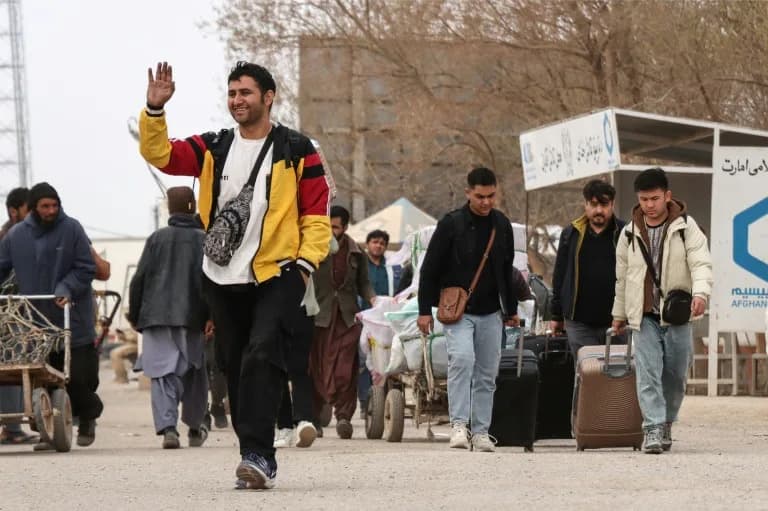
Afghans head home through the country's Islam Qala crossing with Iran (Mohsen KARIMI)(Mohsen KARIMI/AFP/AFP)
With hopes of reaching Turkey dashed by a sudden regional escalation, 20-year-old Rashid Nazari abandoned his journey and retraced his steps back to Afghanistan, describing frantic searches across Iranian cities for food, fuel and safety.
Returnees Describe Panic and Shortages
Nazari told AFP at the Islam Qala border crossing that people were moving toward smaller towns as conditions in major cities deteriorated. He said he witnessed long queues at markets and petrol stations and widespread anxiety among civilians carrying their belongings over the border.
“Most people were going toward smaller towns because the situation in the cities was bad,” Nazari said, a black backpack slung over his shoulder.
Other returnees described explosions, missile strikes and sustained gunfire. At the Islam Qala post, 26-year-old Nematullah Moradi said people had fled Tehran after hearing weapons fire “day and night.” Another returnee, 31-year-old Attaullah Noori, described scenes of panic in Tehran after multiple explosions, with families running and some children briefly abandoned in the chaos as adults tried to escape.
“All the people—women, men and boys—started shouting and crying. Everyone was running in fear with their wives and children,” Noori said.
Scale of Returns and Humanitarian Strain
Despite longstanding cultural and linguistic ties, Iran and Pakistan have in recent years pushed back large numbers of Afghans after hosting millions for decades. The International Organization for Migration (IOM) reports that more than 1.8 million Afghans returned from Iran last year.
The UN refugee agency (UNHCR) said it has not yet observed a sharp surge in departures from Iran since the recent strikes, but warned that resources are already stretched and officials are preparing contingency plans should returns increase.
“Though resources are already significantly stretched amid previous high recent returns and funding shortfalls,” UNHCR spokesperson Charlie Goodlake said, urging readiness for a possible rise in arrivals.
Voices From the Border
Several Afghans said they travelled to Iranian cities such as Isfahan hoping the situation would improve, only to find it untenable and choose to return. One trader, 58-year-old Rahmatullah Sayedzada, said he initially believed “maybe the situation would get better,” but left when conditions worsened.
Returnees also reported seeing symbols of mourning and anger, including a black flag reportedly raised in Iran following the killing of a senior figure, highlighting the tense and unpredictable atmosphere inside the country.
At the border, an anonymous Iranian cargo driver said he felt deeply uncertain about the future after recent events. While Afghans at Islam Qala had managed to cross into Afghanistan, many Iranians remained at risk inside their country and faced shortages and fear of further escalation.
What comes next: Humanitarian agencies and Afghan authorities say they are monitoring the situation and preparing to expand support if cross-border returns rise, even as verification of casualty figures inside Iran remains limited.
Help us improve.





















