
Mexican cartel boss Nemesio Oseguera, "El Mencho," was buried Monday outside Guadalajara in a modest grave under tight security. The ceremony featured trucks full of anonymous floral tributes, a band playing narcocorridos and dozens of masked soldiers in armored vehicles. Oseguera was killed on Feb. 22 in an elite troops' raid; his death triggered reprisals across 20 states that authorities say left 70 people dead.
El Mencho Buried Under Heavy Guard Amid Flowers, Narcocorridos and Armored Vehicles
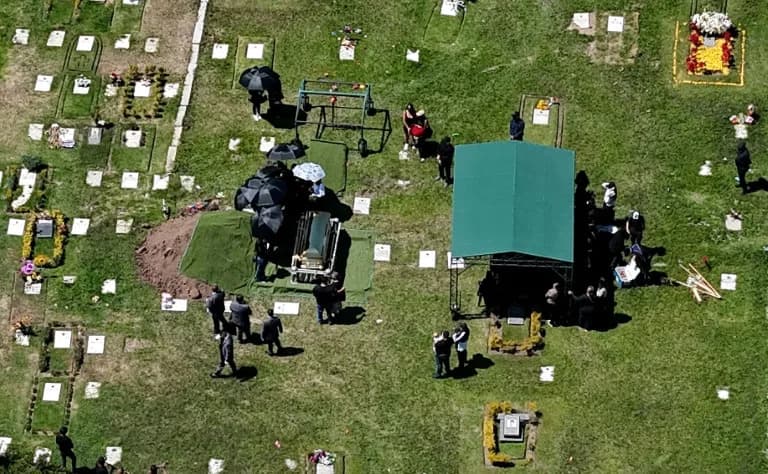
Aerial view of the burial of drug trafficker Nemesio "El Mencho" Oseguera in Zapopan, Mexico, on March 2, 2026 (Ulises RUIZ)(Ulises RUIZ/AFP/AFP)
The notorious Mexican drug lord Nemesio Oseguera, known as "El Mencho," was buried Monday in a modest grave outside Guadalajara in a ceremony marked by overflowing floral tributes, traditional narcocorrido music and a heavy security presence of masked soldiers in armored vehicles.
AFP reporters said the remains of the leader of the Jalisco New Generation Cartel — long listed by U.S. authorities as their most-wanted trafficker with a $15 million reward — appeared to have been placed in a gold-coloured coffin that was visible only through rings of federal security forces at the site.
Unlike some of Mexico’s famed cartel bosses who are interred in lavish mausoleums, Oseguera was laid to rest in a plain plot in a cemetery adjacent to a military post outside Guadalajara. The burial ground sits roughly five kilometres (three miles) from a stadium scheduled to host World Cup matches this summer.
Handed to Family, Moved Under Guard
Federal prosecutors turned Oseguera’s body over to his family on Saturday. Relatives transported the remains from Mexico City to Zapopan, a suburb of Guadalajara, where the burial took place.
Oseguera was fatally wounded on Feb. 22 during a raid by elite Mexican troops at a country club in Jalisco. A soldier who asked not to be named told AFP the body had been guarded around the clock since the operation "so that rival groups do not defile him." Eight of the cartel leader’s escorts were killed during that operation.
Funeral Scenes
From Sunday the funeral home holding the remains was ringed by dozens of soldiers, National Guard members and police who stopped and questioned anyone who approached. Authorities discouraged onlookers but did not prevent a continuous flow of anonymous floral offerings. A local journalist said there were so many arrangements that five trucks were needed to transport them to the cemetery.
Some bouquets were symbolic: one featured angel wings made of red roses and another took the shape of a rooster — a reference to Oseguera’s reported passion for cockfighting. Earlier in the procession, eight people dressed in black, presumed to be family members, followed the white hearse in two cars.
A dozen military and National Guard vehicles, escorted by police motorcycles, led the caravan to the cemetery, which was sealed off by soldiers before the burial. The coffin was brought into a chapel where a band that performs "narcocorridos" — ballads inspired by the lives of drug traffickers — played for those present.
'Now that I'm dead I'm going to go away, no more than a handful of dirt.'
After an hour-long service the coffin was returned to the hearse and taken to the grave, with roughly a dozen mourners walking behind it as the song quoted above was played.
Aftermath And Violence
Following the news of Oseguera’s death, gunmen loyal to the cartel reportedly launched violent reprisals across Mexico, including blocking highways, torching businesses and attacking security forces. Authorities said the unrest spread across 20 of Mexico’s 32 states and left 70 people dead in the wave of violence that followed.
Context: The operation that killed Oseguera was a major action against one of Mexico’s most powerful criminal organizations. The heavy security at the burial and the anonymous tributes reflect both the cartel’s reach and the complex local reactions to its leader’s death.
Help us improve.





















