The University of Illinois Urbana-Champaign and University of Chicago team proposes using the faint gravitational-wave background from countless distant black-hole mergers as a new "stochastic siren" to measure the Hubble constant. Their method links the background amplitude to the cosmic volume available for mergers: a stronger background implies a lower H0, while a weak background suggests a higher H0. Applied as a proof of concept to current LIGO–Virgo–KAGRA data, the analysis favored higher H0 values. The team expects detector upgrades over the next ~six years to make this an accurate, independent way to constrain the universe's expansion rate.
Gravitational-Wave 'Stochastic Sirens' Could Finally Resolve the Hubble Tension
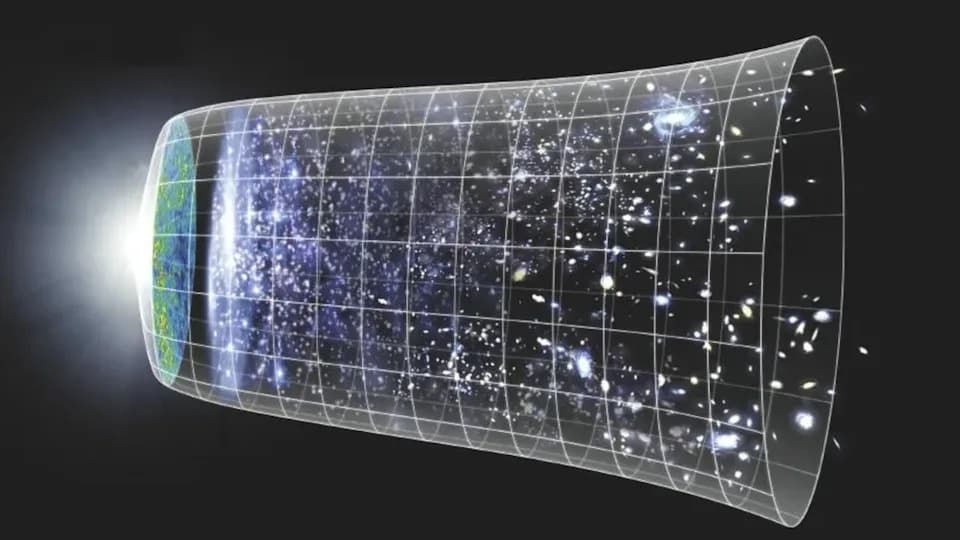
An illustration of the evolution of the universe from the Big Bang (left) to today (right). | Credit: NASA
A team from the University of Illinois Urbana-Champaign and the University of Chicago argues that the faint, persistent hum of gravitational waves from countless distant black-hole mergers can become a powerful, independent probe of the universe's expansion rate. Their "stochastic siren" technique links the strength of that gravitational-wave background to the Hubble constant, offering a third method to arbitrate the long-standing discrepancy known as the Hubble tension.
Why the Hubble Tension Matters
Since 1998 astronomers have known the universe is not only expanding but accelerating. Physicists attribute that acceleration to a poorly understood component called dark energy. Yet a more immediate puzzle persists: measurements of the Hubble constant (H0), which quantifies the current expansion rate, disagree depending on the method. Local measurements using Type Ia supernovae produce a higher H0 than estimates inferred from observations of the early universe combined with the standard cosmological model. That disagreement— the Hubble tension—has driven a search for independent measurement techniques.

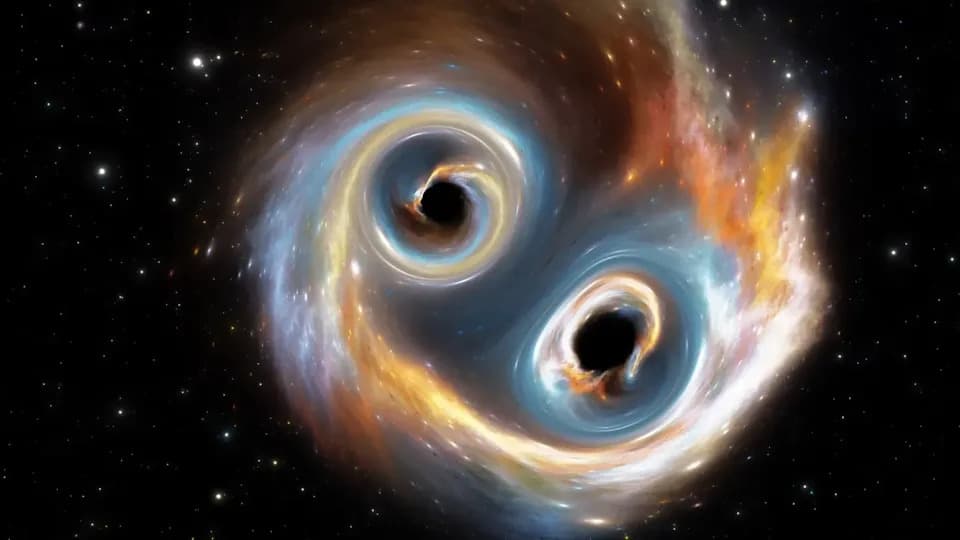
An illustration showing the emission of gravitational waves from the collision of black holes. | Credit: Deborah Ferguson, Karan Jani, Deirdre Shoemaker, Pablo Laguna, Georgia Tech, MAYA Collaboration
Gravitational Waves as an Independent Probe
Gravitational waves—ripples in spacetime predicted by Einstein's general relativity—were first directly detected by LIGO in 2015. Since then, the LIGO–Virgo–KAGRA network has observed mergers of black holes and neutron stars. Gravitational-wave events can be used as "standard sirens" because the waveform encodes the luminosity distance to the source. Pairing that distance with the source redshift (from electromagnetic observations or host-galaxy identification) yields a direct measurement of H0.
The Stochastic Siren Method
Rather than relying only on individually resolved mergers, the new approach uses the gravitational-wave background—the aggregate, unresolved hum from many distant mergers. The team calls this the stochastic siren method. Their key insight is that the amplitude of this background depends on the density of mergers per comoving volume. For a given observed event rate, a lower H0 implies a smaller cosmological volume at a given redshift, which increases the density of sources and strengthens the background. Conversely, a weak or undetected background favors a higher H0.
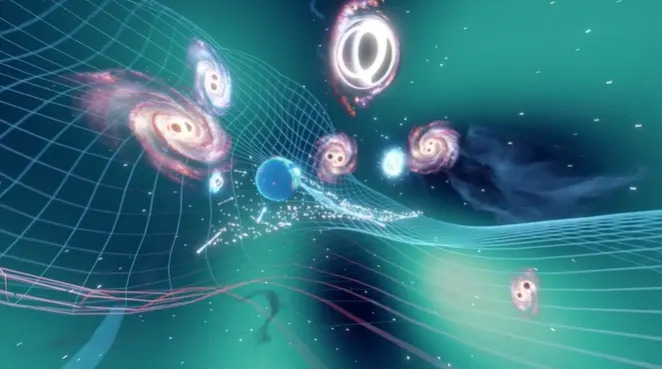
An illustration of the gravitational wave background. | Credit: Carl Knox, OzGrav, Swinburne University of Technology
"This result is very significant—it's important to obtain an independent measurement of the Hubble constant to resolve the current Hubble tension," said Nicolas Yunes, founding director of the Illinois Center for Advanced Studies of the Universe (ICASU). "Our method is an innovative way to enhance the accuracy of Hubble constant inferences using gravitational waves."
Proof of Concept and Future Prospects
The authors applied the stochastic siren method to existing LIGO–Virgo–KAGRA data as a proof of concept. While current detectors are not yet sensitive enough to directly detect the gravitational-wave background, the team's analysis—given their model assumptions—preferred higher values of H0, consistent with a faster present-day expansion rate. They emphasize this is preliminary and model-dependent, but promising.
As detector sensitivity improves (through upgrades to the existing network and future observatories), the stochastic siren method should gain power. The team projects that in roughly six years, instruments may be able to "hear" a large fraction of the gravitational-wave background, tightening constraints on H0 and other cosmological parameters. If successful, this technique would provide an independent cross-check between late-time (local) and early-universe measurements, helping to resolve—or confirm—the Hubble tension.
Implications and Publication
Because stochastic sirens rely on statistical properties of many mergers rather than rare electromagnetic counterparts, the method complements other gravitational-wave cosmology approaches. It also highlights the growing role of multi-messenger and population-statistics techniques in precision cosmology.
The team's results are published in the March 11 edition of Physical Review Letters.
Help us improve.