
The Full Moon occurs when Earth stands nearly between the Sun and Moon, fully illuminating the Moon's near side. The next Full Moon — the Worm Moon — occurs at 6:38 A.M. EST on March 3, 2026, and coincides with a total lunar eclipse visible across much of the world. This guide lists all 2026 Full Moon dates and traditional names, explains lunar phases and special terms (Super Moon, Blue Moon, Black Moon), and provides daily March viewing times for 40° N, 90° W. Check local times and visibility for accurate observing.
2026 Full Moon Calendar — Dates, Traditional Names, and the Worm Moon Total Eclipse (March 3)
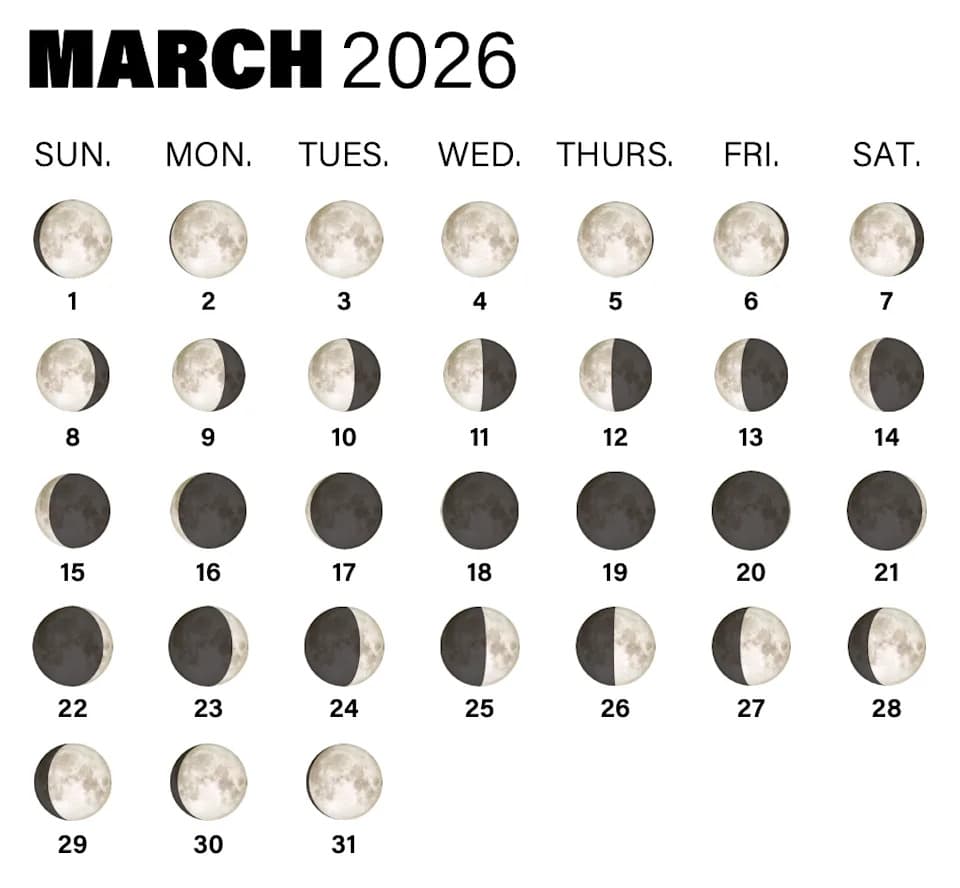
Note: Moon phases in the calendar vary in size due to the distance from Earth and are shown at 0h Universal Time. Credit: Astronomy: Roen Kelly
The Full Moon occurs when Earth is nearly exactly between the Sun and the Moon, lighting the Moon's near side that faces us. As the Moon orbits Earth, the angle of sunlight striking the lunar surface changes, producing the familiar lunar phases.
The next Full Moon is the Worm Moon, at 6:38 A.M. EST on Tuesday, March 3, 2026. That event also includes a total lunar eclipse visible across much of the globe. This guide will be updated several times per week with fresh moonrise/moonset times, Full Moon schedules, and highlights of what to watch in the sky.
Full Moon Dates and Traditional Names (All times Eastern; * = Super Moon)
- Saturday, Jan. 3 — 5:03 A.M. — Wolf Moon*
- Sunday, Feb. 1 — 5:09 P.M. — Snow Moon
- Tuesday, March 3 — 6:38 A.M. — Worm Moon | Total lunar eclipse
- Wednesday, April 1 — 10:12 P.M. — Pink Moon
- Friday, May 1 — 1:23 P.M. — Flower Moon
- Sunday, May 31 — 4:45 A.M. — Blue Moon
- Monday, June 29 — 7:57 P.M. — Strawberry Moon
- Wednesday, July 29 — 10:36 A.M. — Buck Moon
- Friday, Aug. 28 — 12:19 A.M. — Sturgeon Moon | Partial lunar eclipse
- Saturday, Sept. 26 — 12:49 P.M. — Corn Moon
- Monday, Oct. 26 — 12:12 A.M. — Hunter’s Moon
- Tuesday, Nov. 24 — 9:54 A.M. — Beaver Moon*
- Wednesday, Dec. 23 — 8:28 P.M. — Cold Moon*
March Day-by-Day (Local times for 40° N, 90° W)
The following sunrise, sunset, moonrise, moonset and illumination values are given for the reference location 40° N, 90° W. Moon illumination values are given for 10:00 P.M. local time at that location. All other times are Eastern unless otherwise noted. For exact local visibility and timings, check a local almanac or an online observer tool.
Sunday, March 1
Sunrise: 6:33 A.M. | Sunset: 5:52 P.M.
Moonrise: 4:06 P.M. | Moonset: 5:42 A.M.
Moon Phase: Waxing Gibbous (98%)
Monday, March 2
The nearly full Moon passes about 0.4° north of Regulus at 8:00 A.M. EST; the pair will be visible close together in the predawn sky roughly two hours before sunrise, about 20° above the western horizon. Parts of the world (including Hawaii, Japan, and Russia) may see the Moon occult Regulus — visibility and timing are location dependent; see In-The-Sky.org for local details.
Sunrise: 6:31 A.M. | Sunset: 5:53 P.M.
Moonrise: 5:17 P.M. | Moonset: 6:09 A.M.
Moon Phase: Full
Tuesday, March 3 — Worm Moon & Total Lunar Eclipse
The Full Moon occurs at 6:38 A.M. EST. A total lunar eclipse begins its penumbral phase at 3:43 A.M. EST as the Moon moves into Earth's outer shadow; it enters the darker umbral shadow at 4:49 A.M. EST. Totality begins at 6:03 A.M. EST and typically lasts roughly one hour, during which the Moon often takes on an orange to deep red hue as sunlight is refracted through Earth's atmosphere. The exact color and appearance vary with each eclipse and local viewing conditions. The eclipse phases will be visible at different stages around the world; check local eclipse timing and visibility for your location.
Sunrise: 6:30 A.M. | Sunset: 5:54 P.M.
Moonrise: 6:24 P.M. | Moonset: 6:33 A.M.
Moon Phase: Waning Gibbous (99%)
Wednesday, March 4
Sunrise: 6:28 A.M. | Sunset: 5:55 P.M.
Moonrise: 7:31 P.M. | Moonset: 6:55 A.M.
Moon Phase: Waning Gibbous (97%)
Thursday, March 5
Sunrise: 6:27 A.M. | Sunset: 5:56 P.M.
Moonrise: 8:35 P.M. | Moonset: 7:16 A.M.
Moon Phase: Waning Gibbous (92%)
Friday, March 6
Sunrise: 6:25 A.M. | Sunset: 5:58 P.M.
Moonrise: 9:39 P.M. | Moonset: 7:39 A.M.
Moon Phase: Waning Gibbous (86%)
How Lunar Phases Work
Phases progress as New Moon, Waxing Crescent, First Quarter, Waxing Gibbous, Full Moon, Waning Gibbous, Last Quarter, and Waning Crescent. The interval from one Full Moon to the next (the synodic month) is about 29.5 days. Although the Full Moon moment is an exact alignment, the Moon often appears essentially full to the unaided eye for about three days.
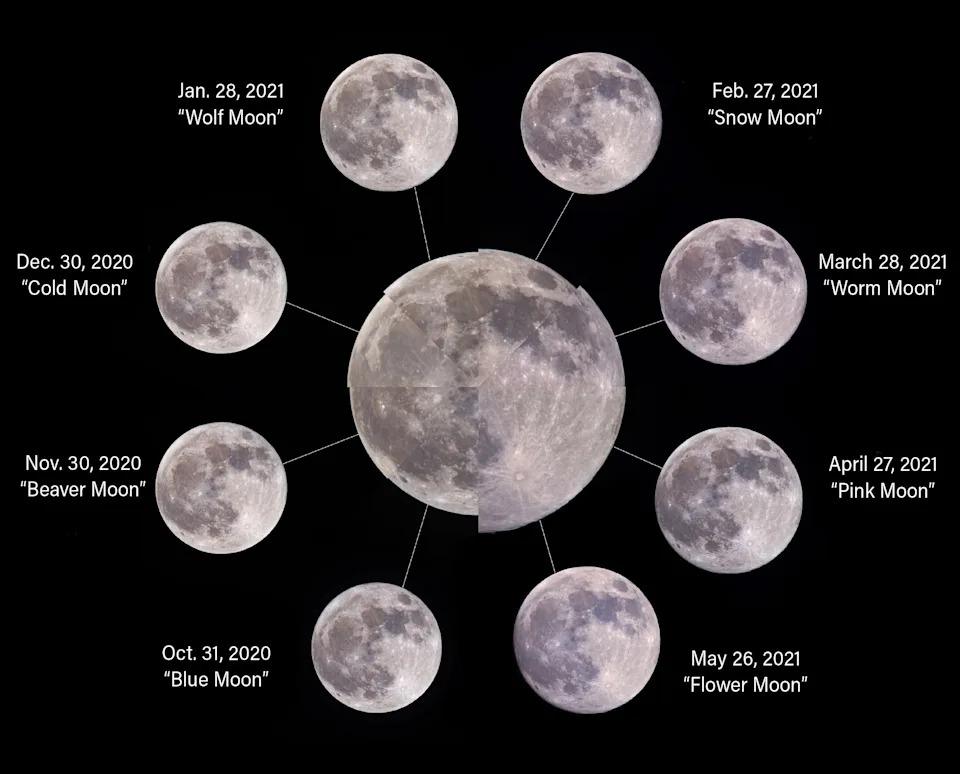
A composite of each month’s Full Moon in 2020 and 2021. Credit: Soumyadeep Mukherjee
Traditional Full Moon Names
Many Full Moon names derive from Native American, Colonial American, and other North American traditions that mark seasonal events. Examples:
- Wolf Moon (January) — Named for wolf howls in winter.
- Snow Moon (February) — Reflecting heavy winter snow.
- Worm Moon (March) — Signaling earthworms and thawing ground.
- Pink Moon (April) — For early pink wildflowers.
- Flower Moon (May) — Celebrating abundant blooms.
- Strawberry Moon (June) — Marks peak strawberry season.
- Buck Moon (July) — When bucks begin growing antlers.
- Sturgeon Moon (August) — For plentiful sturgeon in the lakes.
- Corn Moon (September) — Signifying corn harvest time.
- Hunter’s Moon (October) — Associated with pre-winter hunts.
- Beaver Moon (November) — When beavers prepare winter dams.
- Cold Moon (December) — Evoking winter’s deep chill.
Special Moon Terms
- Super Moon — A Full Moon near lunar perigee (closest approach), appearing larger and brighter. The term is typically applied when the Moon is within roughly 90% of its closest orbital distance.
- Blue Moon — The second Full Moon in a calendar month with two Full Moons (about every 2.7 years). It rarely appears blue; unusual atmospheric particles are required for a true bluish tint.
- Black Moon — An informal label used either for the third New Moon in a season with four New Moons or the second New Moon in a month with two New Moons. A Black Moon is a New Moon and is not visible except during a total solar eclipse.
- Harvest Moon — The Full Moon nearest the autumnal equinox. It often rises near sunset and provides extended evening illumination useful historically for harvest work.
Full Moon vs. New Moon and Tidal Effects
A Full Moon occurs when Earth sits between the Sun and Moon, illuminating the Moon's near side; a New Moon occurs when the Moon lies between Earth and Sun, leaving its Earth-facing side dark. During Full and New Moons the Sun, Earth and Moon align, producing stronger "spring tides" — higher high tides and lower low tides due to the combined gravitational pull.
2026 Lunar Phase Dates (New / First Quarter / Full / Last Quarter)
Jan. 3 / Jan. 10 / Jan. 18 / Jan. 25
Feb. 1 / Feb. 9 / Feb. 17 / Feb. 24
March 3 / March 11 / March 18 / March 25
April 1 / April 10 / April 17 / April 23
May 1 / May 9 / May 16 / May 23
May 31 / June 8 / June 14 / June 21
June 29 / July 7 / July 14 / July 21
July 29 / Aug. 5 / Aug. 12 / Aug. 19
Aug. 28 / Sept. 4 / Sept. 10 / Sept. 18
Sept. 26 / Oct. 3 / Oct. 10 / Oct. 18
Oct. 26 / Nov. 1 / Nov. 9 / Nov. 17
Nov. 24 / Dec. 1 / Dec. 8 / Dec. 17
Dec. 23 / Dec. 30
Planning to observe? Always check local moonrise/moonset and eclipse visibility for your exact location — times and visibility vary by longitude and latitude.
Originally published by Astronomy Magazine; this version has been edited for clarity, consistency, and ease of use for readers looking to observe the 2026 Full Moons and the March 3 total lunar eclipse.
Help us improve.





















