Researchers found that horses produce two simultaneous pitches in their whinny by combining vocal-fold vibration with a laryngeal whistle. Airflow experiments on excised larynges, including tests using air versus helium, confirmed the whistle mechanism for the high-frequency component. This dual production—unique among known mammals—may help horses convey emotion, intensity and messages across different distances.
How Horses Produce Their Strange Two-Tone Whinny: A Laryngeal Whistle Revealed
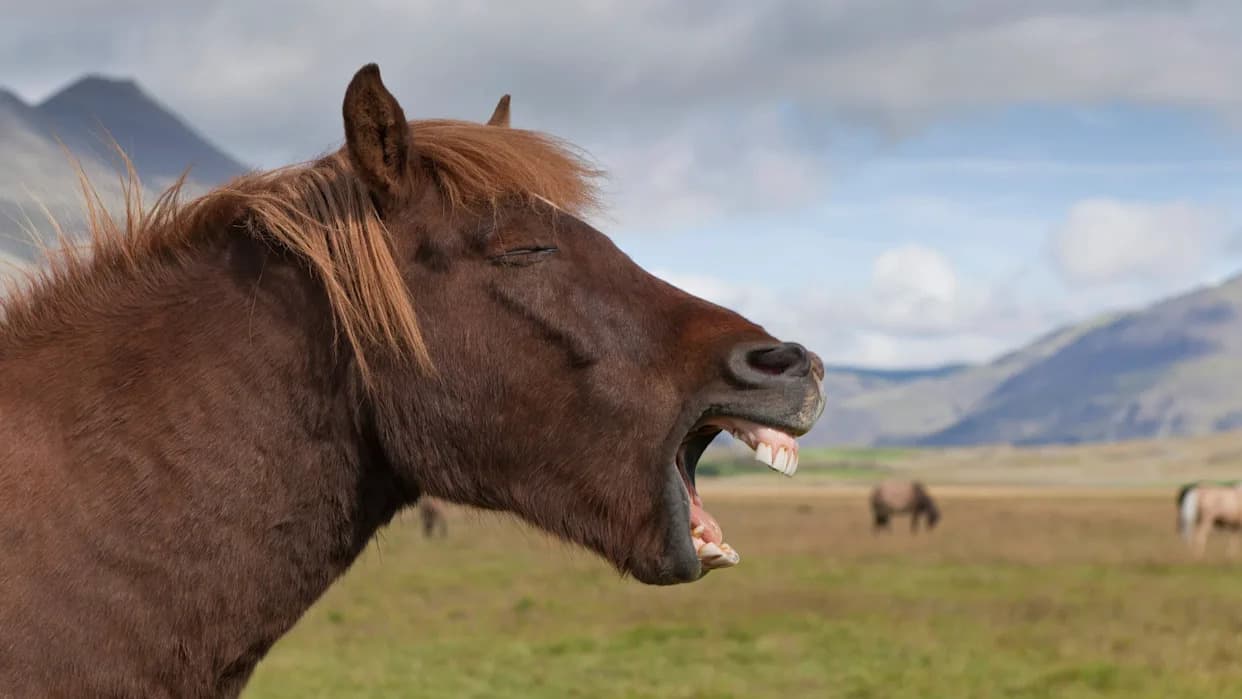
An Icelandic horse showing its teeth.
A horse's whinny is a familiar farmyard signature—on the same level as a cow's moo or a sheep's baa—but scientists have long been puzzled by its unusual acoustic structure. Although listeners can instantly recognize a horse's call, researchers until now did not fully understand how horses generate the whinny's surprisingly high-pitched element alongside a deep tone.
About a decade ago, Elodie Floriane Mandel-Briefer and colleagues identified that horse whinnies combine two overlapping pitches, a phenomenon called biphonation. The low-frequency component is produced conventionally: airflow from the lungs causes the vocal folds to vibrate, the same mechanism that creates voiced sounds in humans and most mammals.
But that normal vocal-fold vibration cannot account for the very high-frequency component, given the size of horse vocal anatomy. In a multidisciplinary study published in Current Biology, Mandel-Briefer and co-authors solved the biomechanical mystery: the high-frequency part of the whinny is produced by a laryngeal whistle formed inside the larynx.
How the Researchers Proved the Whistle
Part of the team’s experimental work involved airflow tests on excised horse larynges obtained for laboratory study. Initially the setup produced only the low-frequency component; after adjustments the high-frequency whistle appeared as well, which showed both sounds originate in the larynx (not from lips, as in human whistling).
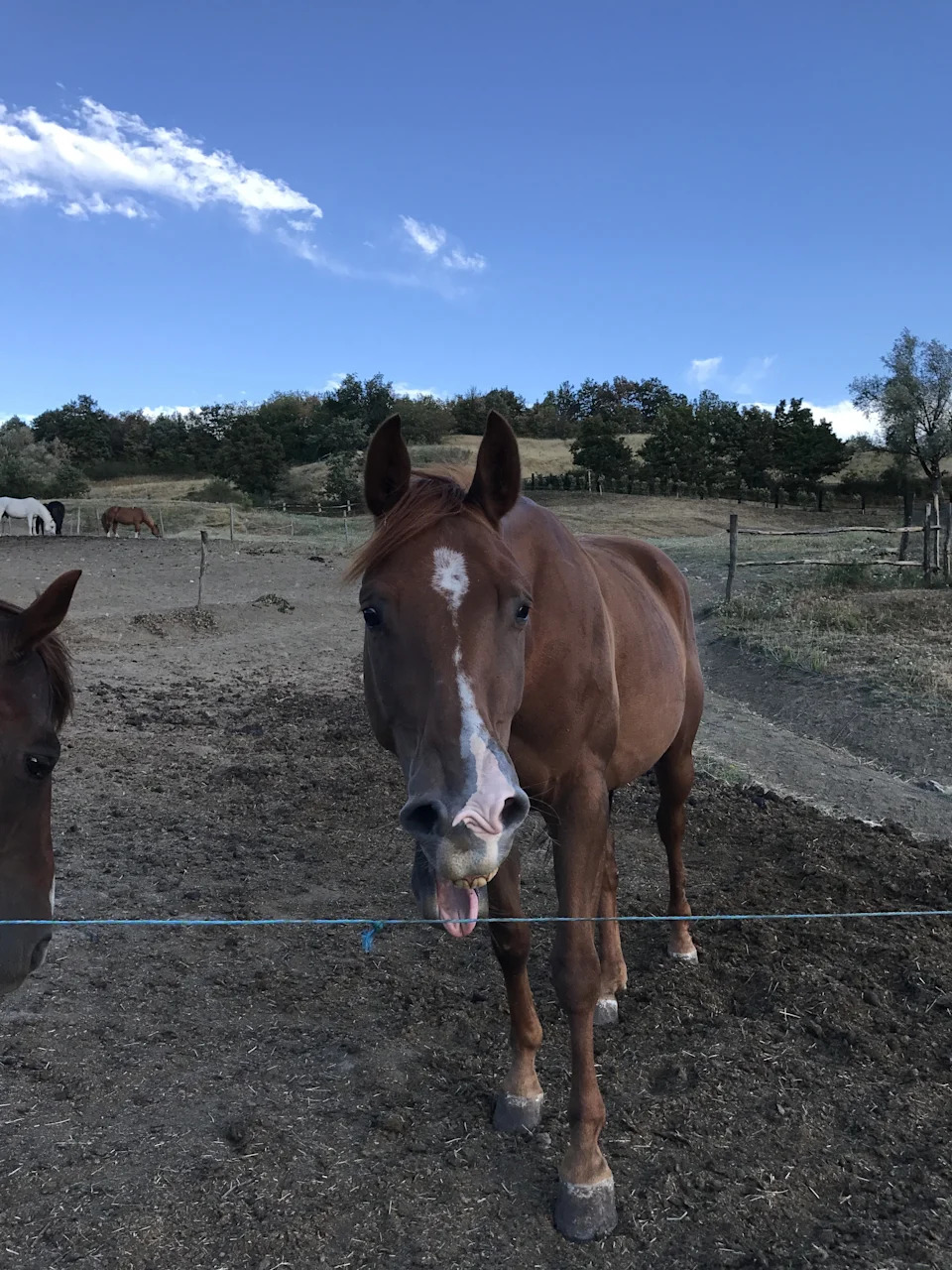
A horse at Le Borre equestrian center in Montecreto, Italy. Horses have a whistle in their larynx behind their whinnies.Image: Margherita Bassi/Popular Science.
“To prove the high component is a laryngeal whistle, they then blew two different gases through: air and helium,” Mandel-Briefer explains. “Helium shifts whistle frequencies upward, while tissue-driven vibrations do not.”
The frequency shift observed when helium replaced air confirmed that the high-frequency sound is a non-tissue whistle produced inside the larynx. The researchers conclude that horses create biphonation by combining simultaneous vocal-fold vibration (low pitch) with laryngeal whistling (high pitch). As far as the authors know, no other mammals use these two mechanisms at the same time.
Why Two Tones Matter
The team proposes this dual mechanism may let horses communicate more information in a single call. In a 2015 study, Mandel-Briefer and colleagues found the high-frequency component conveys valence (whether an emotion is pleasant or unpleasant), while the low-frequency component signals intensity. The two components may also serve different ranges: the high component tends to be louder and can travel farther, helping messages reach distant group members.
Przewalski’s horses—a close wild relative of domestic horses—also produce biphonic whinnies, but more distant relatives such as zebras and donkeys appear to lack the high-frequency element. That pattern suggests horses evolved distinctive vocal adaptations that expand their call repertoire compared with some other equids and mammals.
“The paper highlights the remarkable adaptive flexibility of the mammalian laryngeal vocal production system,” Mandel-Briefer says. Understanding how species produce and use vocal signals helps scientists interpret animal cognition, emotion, and welfare—and gives us a clearer picture of how horses communicate.
Help us improve.