
An Iranian missile strike destroyed a public shelter in Beit Shemesh, central Israel, leaving a crater and devastating the surrounding neighbourhood. Authorities reported at least nine killed, 46 injured and 11 missing as rescue teams worked through the night under floodlights. Survivors described narrow escapes, shattered homes and the limits of air-defence protection. The attack occurred amid wider regional missile barrages, which authorities said were retaliatory.
‘A Terrible Day’: Iranian Missile Obliterates Beit Shemesh Shelter — At Least 9 Dead, Dozens Injured
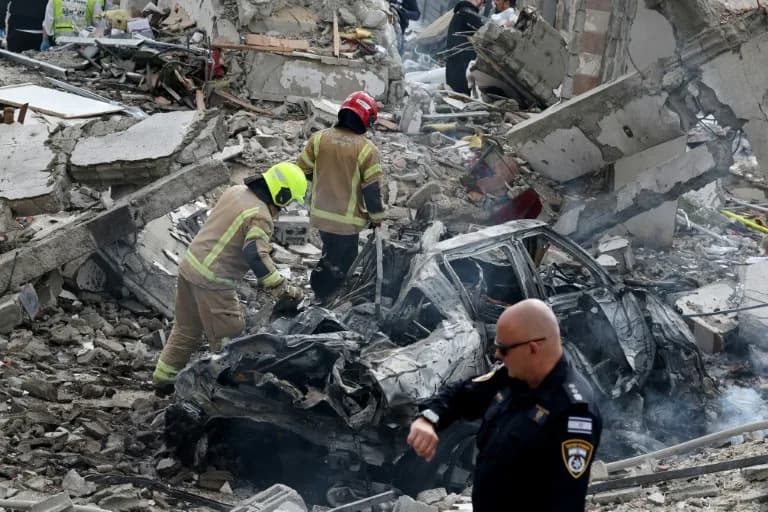
Israeli rescue teams still search for missing people after a deadly Iranian missile strike (Ahmad GHARABLI)(Ahmad GHARABLI/AFP/AFP)
Ilana Malka still does not know whether her three great-nephews survived after an Iranian missile struck a public shelter in Beit Shemesh, a town in central Israel. The strike left a crater where the protection centre once stood and shattered the close-knit neighbourhood.
The building that housed the shelter was effectively destroyed on impact, hurling concrete fragments large enough to damage cars up to 50 metres away, residents said. Authorities put the provisional toll at at least nine dead, 46 wounded and 11 missing.
"I heard my three children, my brother's grandchildren, were there, and they haven't been found yet,"Malka, 65, said, visibly shaken.
Her home, about 100 metres from the destroyed shelter, lost most of its windows and parts of its ceiling; her garden was littered with oranges torn from a tree by the blast. Exhausted from the previous day of fighting, Malka said she had stayed in her private basement shelter — a mamal that does not meet official standards — rather than move to the public shelter. The door of her mamal was blown off by the explosion.
Community Impact
"Beit Shemesh is a small town, so everyone knows everyone," said Moshe Levy, a 52-year-old contractor, whose recently renovated building narrowly avoided the worst of the blast but suffered broken windows and roof damage. "Here it's just material damage, money can fix it all. There, money can't fix life," he added, speaking of neighbours who lost relatives.
Closer to the impact site, streets were strewn with debris from the disintegrated protection centre: shards of tile, splintered wood, chunks of cement and smashed glass. Clay roof tiles on nearby houses were broken or lifted on the sides facing the shelter, a visible clue to the blast's epicentre.
Wider Context and Response
Israel's advanced air-defence systems intercepted many missiles fired from Iran, but Saturday's strike underscored that interceptors cannot guarantee complete protection. The violence began on Saturday and escalated the next day, when Tehran launched missile barrages across the region — at Israel, Gulf countries and US military targets — a move authorities said was retaliation for the killing of a senior Iranian figure.
Ricki Ben David, a 56-year-old nurse, said her first fear was for family members living below her apartment.
"I wasn't panicked about myself. I wasn't afraid for myself as much as I was worried about my family members,"she said. "I know these people — neighbours, like family. It's simply a terrible day."
As night fell, search-and-rescue teams lit large floodlights to continue searching for the missing while police and soldiers dispersed hundreds of onlookers amid fears of further strikes. The scent of crushed evergreen from damaged cypress trees hung in the air, a quiet reminder of the blast's force.
What remains clear: families in Beit Shemesh are grieving and searching, homes and community spaces are damaged, and the attack has raised fresh questions about civilian protection in the face of long-range missile threats.
Help us improve.





















