Seven sets of remains believed to be victims of the Jeju Massacre were identified and returned to families more than 70 years after the killings. The remains, recovered from sites including Jeju International Airport, the Gyeongsan Cobalt Mine and a Daejeon excavation, were welcomed at a ceremony at the Jeju 4.3 Peace Park. DNA matches used about 2,600 donated blood samples, including from collateral relatives, to confirm identities. With these new identifications, 154 of 426 exhumed sets have now been matched to victims.
Seven Jeju Massacre Victims Identified After More Than 70 Years; Remains Returned to Families
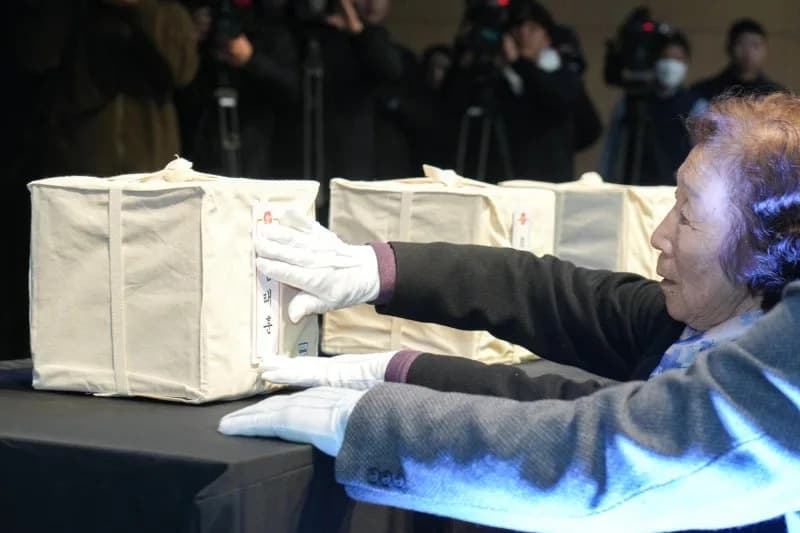
A bereaved family member places a name tag on the remains of a family member who was killed during the Jeju Massacre. Photo courtesy of Jeju Provincial Office
Seven sets of human remains believed to be victims of the Jeju Massacre were identified and returned to relatives on Jeju Island on Tuesday, more than seven decades after they disappeared during South Korea's violent anti-communist crackdowns in the early Cold War period.
The remains arrived at Jeju International Airport from Gimpo at about 2 p.m. and were received by Jeju Gov. Oh Young-hoon, leaders of Jeju 4.3-related organisations and representatives of the bereaved families. The remains were then taken to the Jeju 4.3 Peace Park for a formal return ceremony attended by roughly 200 people.
Gov. Oh offered his condolences in a memorial address, saying he prayed for the repose of the seven victims who 'had to lie without names for so many years' and expressed comfort for families who endured decades of uncertainty.
Historians estimate that roughly 30,000 islanders were killed on Jeju between 1947 and 1954 during the government’s anti-communist eradication campaign. Thousands more disappeared, many presumed buried in mass graves. The Cemetery of the Missing at the Jeju 4.3 Peace Park, just south of Jeju City, carries nearly 4,000 tombstones for people who vanished during the seven-year period.
Where the Remains Were Found and Identified
Since the mid-2000s, Jeju provincial authorities have led systematic excavations to locate and identify missing victims. Teams have exhumed 426 sets of remains to date, including 387 recovered from excavation sites at Jeju International Airport. Of the 426 sets, 154 have now been identified.
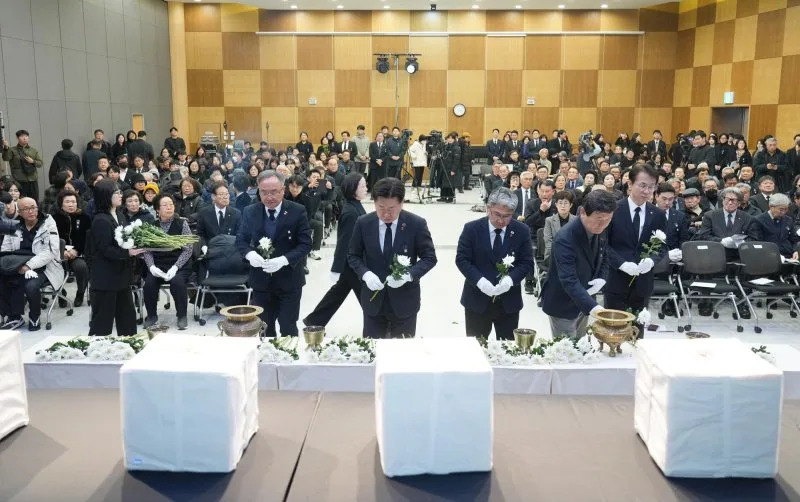
Dignitaries place flowers before the remains of seven sets of remains newly identified as victims of the Jeju Massacre. Photo courtesy of Jeju Provincial Office
The seven newly identified sets came from three locations:
- Golryeonggol (Daejeon site): Kim Sa-rim, Yang Dal-hyo and Kang Du-nam.
- Gyeongsan Cobalt Mine: Im Tae-hoon and Song Du-seon – the first identifications from remains recovered at that site.
- Jeju International Airport excavations: Song Tae-woo and Kang In-gyeong.
Details of Identified Victims
The Jeju 4.3 Peace Foundation provided biographical details for each identified person, including ages and last known circumstances:
- Kim Sa-rim (25, Iho Village) — captured in February 1949 while sheltering on Mt. Halla; family later heard rumors he had been transferred to prison.
- Yang Dal-hyo (26, Doryeon Village) — went missing in June 1948 after being held at the Jeju Distillery detention camp; family visited him once and then lost contact.
- Kang Du-nam (24, Yeongdon Village) — last heard from around October 1948 while a refugee on Mt. Halla; believed imprisoned at Daejeon Prison in 1949.
- Im Tae-hoon (20, Sogil Village) — detained in December 1948, held in Mokpo, transferred to Daegu Prison, and later executed at the cobalt mine.
- Song Du-seon (29, Donghong Village) — arrested in spring 1949 and imprisoned at Daegu Prison by July that year.
- Song Tae-woo (17, Ora Village) — detained in November 1948 while sheltering on Mt. Halla; later accounts said he may have been thrown into the sea or killed at the airport.
- Kang In-gyeong (46, Sangmyeong Village) — detained in June 1950 after the outbreak of the Korean War; long believed to have been killed at an ammunition depot in southern Moseulpo, though his remains were among those excavated at Jeju International Airport.
How Identification Was Achieved
Identification relies on DNA matching between bones recovered during excavations and blood samples donated by Jeju residents. The Jeju 4.3 Peace Foundation said around 2,600 people have provided samples. Collateral relatives’ samples (for example, nephews and grandchildren) have been used successfully: nephews were decisive in confirming Kim Sa-rim and Im Tae-hoon, while samples from grandsons helped identify the other five victims.
The remains had been cremated earlier at Sejong Eunhasu Park on the mainland before being returned to Jeju. Family members expressed relief and long-awaited closure at the ceremony. Kang Jun-ho, grandson of Song Du-seon, said: “We have finally found our family member who was sacrificed without any crime. It is very late, but I am thankful that he has regained his name.” In Jeju dialect he added, “Grandfather, you've come home. Rest easy now.”
Gov. Oh pledged continued efforts to locate and return any remaining victims. A new blood sampling drive is being conducted through Nov. 30 at Halla Hospital in Jeju City and Yeollin Hospital in Seogwipo City to encourage more donations that can assist future identifications.
Help us improve.