
Operation "Absolute Resolve" was a large, carefully planned U.S. raid that captured Venezuelan President Nicolás Maduro and his wife after an assault on his Caracas compound. More than 150 aircraft—from stealth fighters and bombers to drones and helicopters—departed roughly 20 bases to support low‑altitude insertion and air cover. U.S. officials reported no major equipment losses although some personnel injuries were later suggested; Maduro was taken to the USS Iwo Jima. The action represents a major escalation and raises urgent questions about Venezuela's political future and international law.
Inside 'Absolute Resolve': How U.S. Forces Captured Nicolás Maduro in a High‑Risk Night Raid

The US has built up a massive military presence around the Caribbean.Eva Marie Uzcategui/REUTERS
More than 150 U.S. aircraft and months of planning powered a nighttime operation that captured Venezuelan President Nicolás Maduro and his wife, U.S. officials say.
The chairman of the Joint Chiefs of Staff, Dan Caine, described the extraction mission—code-named "Absolute Resolve"—as an audacious, meticulously rehearsed operation that drew forces and intelligence from across the U.S. government. According to Caine, U.S. agencies spent months tracking Maduro's movements and routines and built a replica of his compound to practice the assault, echoing methods used in past high‑profile raids.
How the Operation Unfolded
Shortly before 11 p.m. ET on the night of the raid, after several days of waiting for favorable weather, President Donald Trump authorized the mission to proceed. During the darkest hours, aircraft launched from about 20 bases across the Western Hemisphere—both shore‑based and sea‑based—to form a large, coordinated air package.
Helicopters carrying capture teams—made up of special operations personnel and law enforcement officers—flew at very low altitude (about 100 feet above the water) toward the Venezuelan coast. Marine, Navy, and Air Force aircraft provided protective cover while other aircraft struck selected military sites and defensive positions to shape the battlefield. Trump said U.S. forces also used techniques to extinguish lights, which helped conceal the insertion.
Air Assets and Tactics
Caine listed more than 150 aircraft in the operation, including F‑35 and F‑22 stealth fighters, F/A‑18s, EA‑18 electronic‑attack jets, E‑2 airborne early‑warning planes, B‑1 bombers, numerous drones, and various support aircraft. As helicopter teams neared Caracas, accompanying aircraft targeted air‑defense systems to clear a corridor for low‑flying helicopters. Caine acknowledged some advance warning had reached Venezuelan forces and that they offered meaningful resistance.
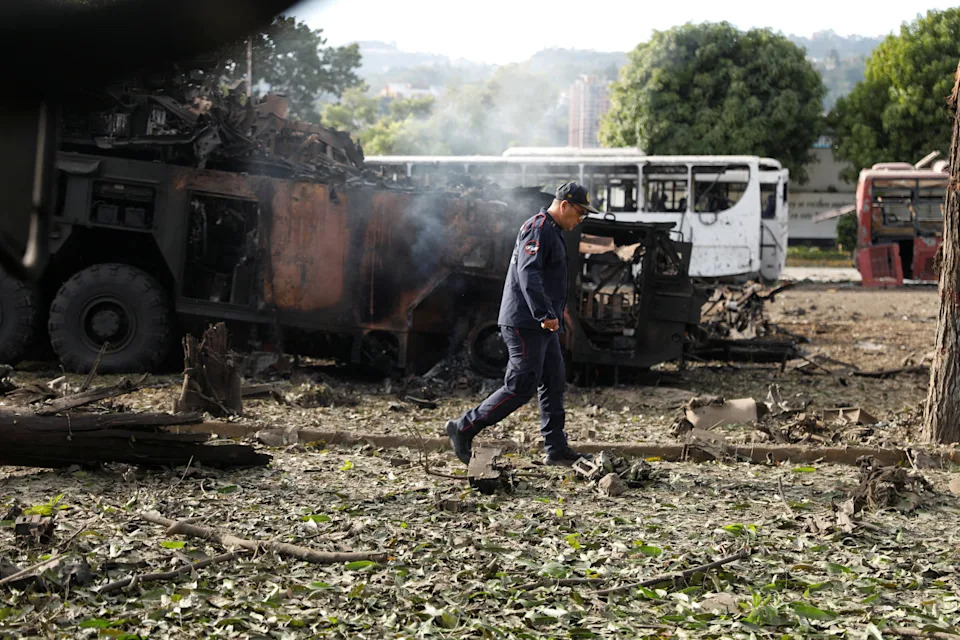
US strikes targeted Venezuela's air defenses.Leonardo Fernandez Viloria/REUTERS
"Those in the air over Caracas last night were willing to give their lives for those on the ground and in the helicopters," Caine said, praising the aviators who provided air cover.
The Capture and Exfiltration
The helicopters reached Maduro's compound shortly after 1 a.m. ET and came under heavy fire. The apprehension team stormed the facility, detained Maduro and his wife, and withdrew under fighter and drone cover. By about 3:30 a.m. ET, U.S. aircraft were over open water. The couple were transported to the amphibious assault ship USS Iwo Jima; the White House later released a photo of Maduro aboard the ship.
U.S. officials reported no major equipment losses. President Trump later said that "a couple of guys were hit" and that one helicopter was damaged but remained flyable; the Pentagon and White House declined to provide further details on injuries.
Context and Consequences
The scale and coordination of the raid — and the emphasis on surprise — drew comparisons to recent U.S. strikes elsewhere. In recent months, the U.S. had increased its military presence in the Caribbean and carried out strikes against vessels it says were smuggling drugs, actions that drew scrutiny from legal experts and lawmakers. The Maduro capture marks a clear escalation and raises immediate questions about Venezuela's political future.
President Trump said the United States will "run the country" temporarily to ensure a secure transition and urged American oil companies to reengage with Venezuela's petroleum sector. Attorney General Pamela Bondi announced that Maduro has been indicted in the Southern District of New York on alleged drug‑related charges.
Note: This article summarizes official accounts given by U.S. leaders and includes claims that Maduro and his government dispute. Additional reporting and independent verification may clarify details—particularly regarding casualties, the precise sequence of events, and longer‑term legal and diplomatic consequences.
Help us improve.


