
On Dec. 26, 1898, Marie and Pierre Curie, with Gustave Bémont, announced the discovery of two intensely radioactive elements in pitchblende: polonium (≈60× more radioactive than uranium) and radium (≈900×). Using a piezoelectric quartz electrometer and spectral separation, they isolated these elements and presented their findings to the French Academy of Sciences. Their work earned Nobel recognition, launched medical advances including radiotherapy and mobile X-rays, and exposed the severe health risks of radiation—Marie Curie likely died from radiation-induced aplastic anemia in 1934.
Dec. 26, 1898 — Curie Team Reveals Radium and Polonium: Breakthroughs That Transformed Medicine and Cost a Life

Marie and Pierre Curie (center and right) in their lab with another unidentified man. | Credit: Marie and Pierre Curie (centre) with a man, using equipment in their laboratory, Paris. Photograph, ca. 1900. Wellcome Collection. Source: Wellcome Collection.
On Dec. 26, 1898, Marie and Pierre Curie, working with Gustave Bémont in Paris, announced the discovery of two previously unknown, intensely radioactive elements—polonium and radium. These findings reshaped physics and medicine, leading to lifesaving techniques such as radiotherapy and mobile X-ray units, even as prolonged exposure to radiation brought serious health consequences for the researchers themselves.
From Curiosity to Discovery
Marie Curie, then a doctoral student at the Sorbonne, chose radiation as the subject of her thesis just as the study of invisible energetic rays was taking off. Wilhelm Röntgen had reported X-rays in 1895, and in 1896 Henri Becquerel found that uranium salts emitted weaker emissions that fogged photographic plates in the dark. Rather than spend months reviewing scattered literature, Curie dove into experiments.
Pierre Curie secured a cramped, damp storeroom at the Paris Municipal School of Industrial Physics and Chemistry where Marie set up her apparatus. Pierre soon laid aside his own research to collaborate with her. Central to their work was the piezoelectric quartz electrometer, invented by Jacques Curie, which could measure the tiny electrical currents produced by radioactive emissions.
How They Found New Elements
Marie discovered that the radiation strength varied with uranium concentration in samples and reasoned that some ores must contain other, stronger sources of radioactivity. Working with Pierre and Gustave Bémont, the team turned to pitchblende, a complex black ore rich in uranium and often associated with silver deposits. By chemically separating the ore into many constituents and analyzing their light spectra, they isolated previously unknown substances.
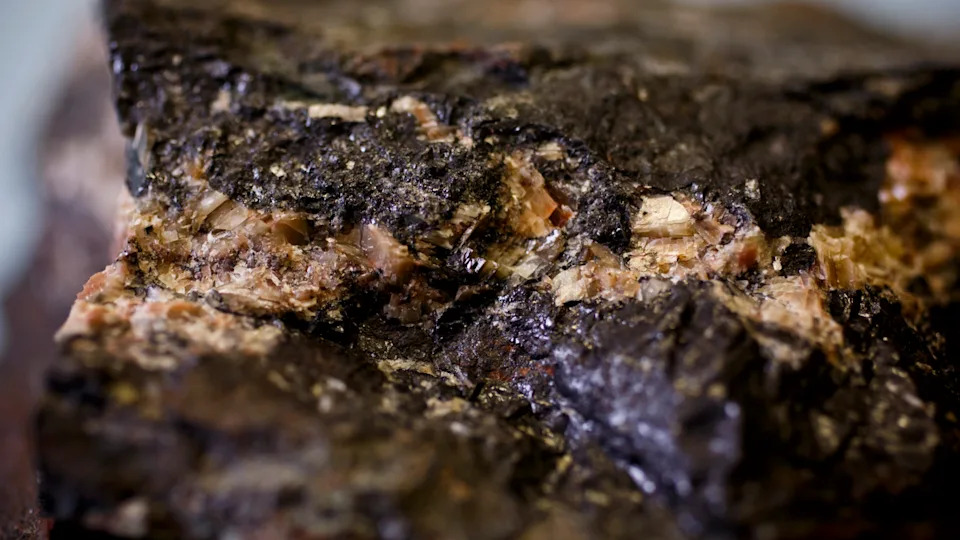
Pitchblende, or uraninite, is a mineral composed of up to 30 different elements. Some of its constituents, including radium and polonium, are highly radioactive. | Credit: Martin Divisek/Bloomberg via Getty Images
"The ore must contain a substance more radioactive than uranium and thorium...and this substance must necessarily be a chemical element as yet unknown," Marie wrote later.
In July 1898 they identified a mineral about 60 times more radioactive than uranium and named it polonium. On Dec. 21, 1898, they isolated another substance—radium—whose radioactivity was roughly 900 times that of uranium. The discoveries were presented to the French Academy of Sciences on Dec. 26, 1898.
Legacy: Science, Medicine, and Sacrifice
The Curies’ meticulous work in low-quality labs and a poorly ventilated shed earned Marie and Pierre Curie and Henri Becquerel the 1903 Nobel Prize in Physics. Marie later received a second Nobel Prize in Chemistry in 1911 for her work on radium.
Pierre Curie died in 1906 after being struck by a horse-drawn carriage, but Marie continued both scientific work and humanitarian efforts. During World War I she promoted and helped develop mobile X-ray units for battlefield diagnosis. Observations that radium could preferentially destroy diseased cells helped inspire the later development of radiotherapy for cancer.
Radiation exposure took a heavy toll: both Marie and Pierre suffered burns and other ailments from long-term exposure. Marie Curie’s cumulative exposure likely led to aplastic anemia, and she died in 1934 at age 66. Artifacts from their work—most notably Marie’s 1898 notebook—remain radioactive today and are preserved in lead-lined storage.
Scientific Impact: The Curie discoveries opened new fields in nuclear physics, chemistry, and medicine, while also teaching a sobering lesson about laboratory safety and the risks of ionizing radiation.


