
Summary: A 2023 Science Advances study finds dogs near the Chernobyl power plant and in Chernobyl City have distinct genome-wide profiles, forming two mostly separate breeding populations. Researchers identified genomic differences in regions linked to DNA repair but found no clear evidence that radiation-induced mutations provided survival advantages. Scientists urge caution and recommend continued genetic and health monitoring to understand long-term effects and inform conservation and public-health research.
Chernobyl Dogs: Radiation Zone May Be Producing A Genetically Distinct Population

A dog on the street in the Chernobyl Exclusion Zone. - Jorge Franganillo/Wikimedia Commons
Researchers studying dogs that live inside the Chernobyl exclusion zone report subtle but notable genomic differences in animals from around the power plant and Chernobyl City. These differences suggest the formation of two largely separated breeding groups rather than the instant, cartoonish mutations often associated with radiation. Scientists stress that the findings point to a unique genomic signature, not a new species or dramatic physical transformations.
What the Research Found
A 2023 study published in Science Advances, titled "The dogs of Chernobyl: Demographic insights into populations inhabiting the nuclear exclusion zone," compared genome-wide profiles from dogs found at the power plant and in Chernobyl City with purebred and other free-breeding dogs worldwide. The authors report that dogs from the power plant and Chernobyl City are genetically distinct, forming two populations with limited interbreeding.

A dog sits on a grassy street corner in the Chernobyl Exclusion Zone. - Jbuket/Wikimedia Commons
Further genomic analysis led by Megan N. Dillon, Matthew Breen and colleagues identified differences in genomic regions associated with DNA damage repair and related functions. That raised the question of whether these dogs might have evolved traits that help them cope with a contaminated environment.
Important Caveats
Despite these differences, researchers did not find clear evidence that radiation-induced mutations have conferred a measurable survival advantage. Matthew Breen of North Carolina State University noted the current population is likely "30 or more generations removed" from dogs present at the time of the 1986 accident; while survival-advantage mutations would likely still be detectable, the team did not find such direct evidence.
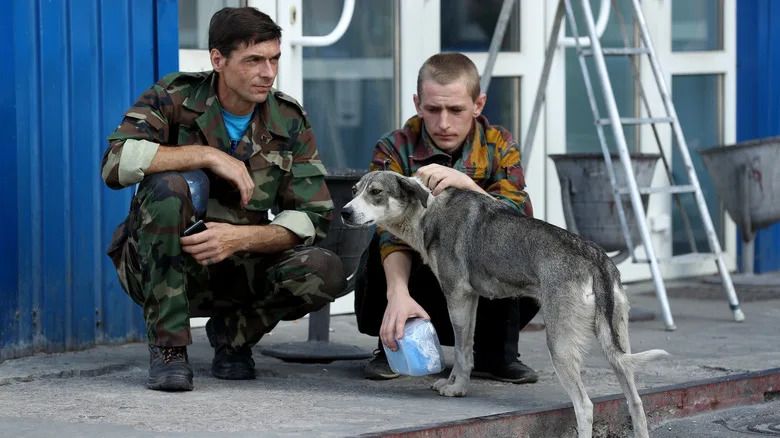
Staff kneel to pet a dog in Chernobyl. - Sean Gallup/Getty Images
Other factors could explain the divergence: early, intense selective pressure on survivors immediately after the disaster; geographic or social separation of groups within the exclusion zone; limited gene flow; and human influences on which animals survive and reproduce. The authors emphasize caution against sensationalizing the findings — these are subtle genomic signals that merit further study rather than proof of dramatic radiation-driven evolution.
Why This Matters
Studying these dogs helps scientists understand long-term biological effects of extreme environmental stressors, including radiation. Researchers have collected blood samples to monitor health, genetic trends, and potential risks to humans and wildlife. Columbia Magazine described the animals as "super canines of Chernobyl," a phrase that captures their resilience but can also oversimplify a complex scientific picture.
Context
The Chernobyl accident in April 1986 released radiation that will affect the landscape for generations; Ihor Gramotkin, a former plant director, estimated some areas could remain hazardous for "at least 20,000 years." The ongoing presence of animals — and recent disruption from military activity within the exclusion zone — complicates the environment researchers aim to study.
Next Steps
Scientists call for continued genomic and health monitoring to clarify whether particular traits are being favored by natural selection in the exclusion zone, and to determine how long-term exposure affects genomes and disease risk. The findings have potential implications for conservation biology, radiation biology, and public health — but further, careful research is required before drawing firm conclusions.
Bottom line: The dogs of Chernobyl show a distinct genomic signature and population structure, but current evidence does not prove that radiation directly produced adaptive mutations with clear survival benefits.


