
Supreme Court Blocks Federalization: The Court barred the Trump administration from federalizing Illinois National Guard troops, finding the administration did not meet the statutory standard it invoked. Unresolved Question: The decision did not decide whether the president could instead rely on the Insurrection Act to deploy active-duty military domestically. Implications: Legal experts warn active-duty deployments would be politically charged and could prompt further constitutional challenges.
Supreme Court Blocks Federalization Of Illinois Guard — Raises Question Of Using Insurrection Act To Deploy U.S. Troops

Members of the Texas National Guard arrive at an army reserve training facility on October 7, in Elwood, Illinois. - Scott Olson/Getty Images
The Supreme Court on Tuesday blocked the Trump administration from federalizing members of the Illinois National Guard, a decision that has intensified debate over whether the administration might instead seek to invoke the Insurrection Act to deploy active-duty U.S. military forces on American soil.
In an emergency order, the justices considered a federal statute the administration relied on to call up hundreds of Illinois Guard members — a law that permits a president to federalize a state's guard if he cannot enforce federal law with the "regular forces." By a majority ruling, with three conservative justices dissenting, the Court concluded the administration had not shown it met that statute's requirements.
What the Court Did and Did Not Decide
The decision on the emergency docket did not resolve whether other authorities, notably the Insurrection Act, remain available to the president. In a footnote, Justice Brett Kavanaugh — who joined the majority — wrote that the opinion "does not address the president's authority under the Insurrection Act" and warned the ruling could prompt greater use of the U.S. military rather than the National Guard to protect federal personnel and property.
Political and Legal Stakes
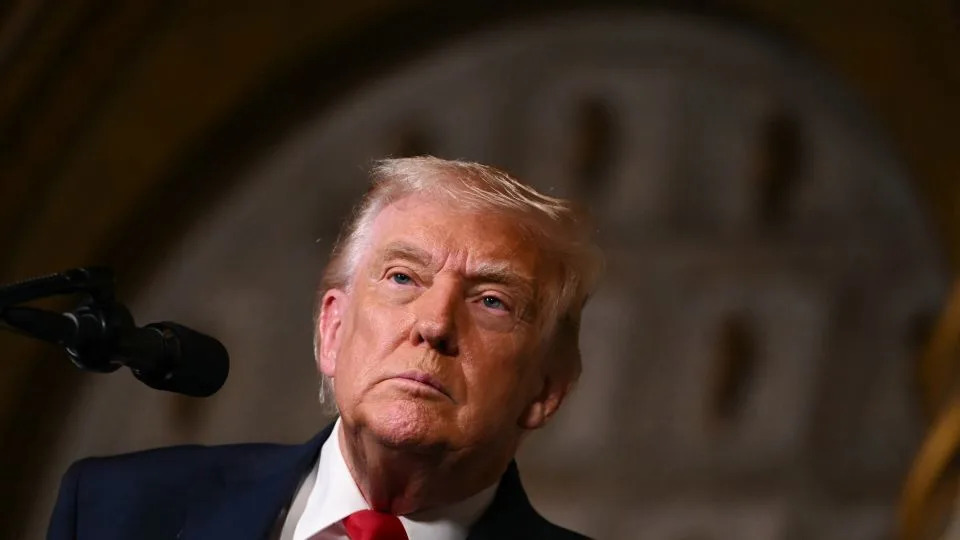
President Donald Trump at Mar-a-Lago in Palm Beach, Florida, on December 22. - Andrew Caballero-Reynolds/AFP/Getty Images
Administration officials and allies had explored using the Insurrection Act — a 19th-century statute that can authorize deployment of the regular military domestically and would largely circumvent the Posse Comitatus Act's restrictions on military involvement in civilian law enforcement. President Trump has publicly said he would consider invoking the Insurrection Act "if it's necessary."
“I’d do it if it’s necessary. So far it hasn’t been necessary,” the president told reporters in October. “But we have an Insurrection Act for a reason.”
Legal scholars warn that a shift from National Guard deployments to active-duty troops would be politically charged and visually stark. William Banks, a Syracuse University law professor, said the administration could risk creating "heavy martial images" by using units such as the 82nd Airborne rather than part-time Guard personnel with local ties and de‑escalation experience.
The administration had argued to the courts that the Guard was preferable in cities such as Chicago because Guard members are "civilians temporarily called up to serve with deep experience in deescalating domestic disturbances among their fellow citizens," whereas the standing Army is trained primarily to fight wars overseas.
Legal Experts and Unresolved Questions
Experts caution that invoking the Insurrection Act would present its own legal and political risks. Elizabeth Goitein of the Brennan Center said the Justice Department's reliance on section 12406(3) in its briefing could complicate any later attempt to justify action under the Insurrection Act, and that the administration "would likely run into similar trouble" invoking broader military authorities.
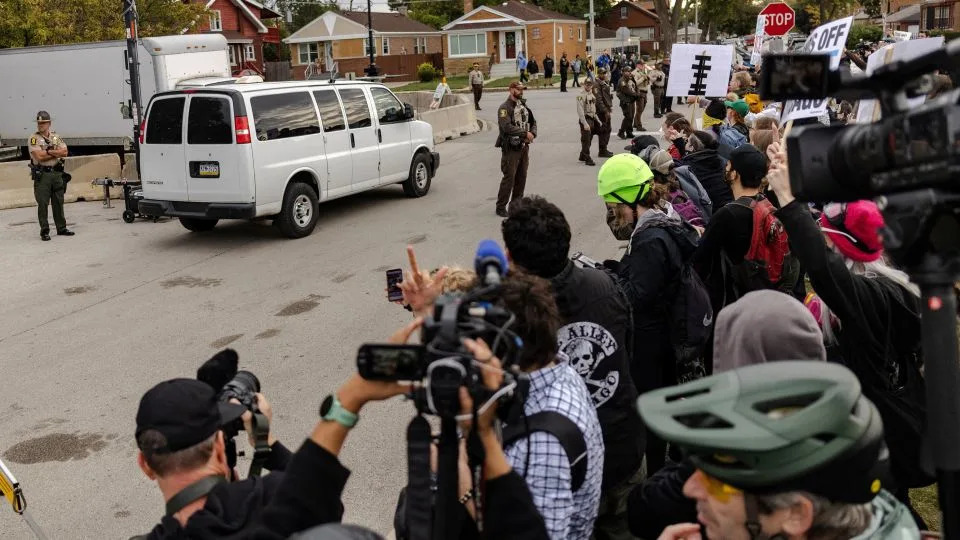
A transportation van leaves the Broadview ICE facility as protesters stand behind barricades in Broadview, Illinois, on October 10. - Jim Vondruska/Reuters
Justice Neil Gorsuch, dissenting, emphasized the complexity of the questions before the Court — including how section 12406(3) interacts with the Insurrection Act — and suggested such constitutional and statutory issues should be decided only in a case where they are fully briefed and argued.
Background And Current Status
The Insurrection Act's modern form was last used by President George H.W. Bush during unrest in Los Angeles in 1992. A prominent historical use came in 1957 when President Dwight Eisenhower federalized the Arkansas National Guard and sent active-duty troops to Little Rock to enforce school desegregation after Brown v. Board of Education.
In the present dispute, tensions near an Immigration and Customs Enforcement (ICE) facility outside Chicago had eased by the time the Court issued its order. Defense officials earlier said they were "rightsizing" planned deployments to Chicago, Los Angeles and Portland, and reported about 300 Illinois Guard personnel remained ready to deploy. Lower-court injunctions had limited the Guard's operations with the Department of Homeland Security.
For now, the Supreme Court's emergency ruling halts the administration's immediate plan to federalize the Illinois Guard. Whether officials will attempt to rely on the Insurrection Act or another authority remains an open, politically sensitive question that could trigger fresh litigation and constitutional debate.


