
Mia Tretta, a Brown University junior who was wounded in the 2019 Saugus High School shooting, received active-shooter alerts during finals when a gunman opened fire near Brown's campus in Providence. The attack left two people dead and nine injured. Tretta — now an advocate focused on curbing ghost guns — and other survivors describe renewed trauma and improvised safety measures. The incident highlights how a generation raised on lockdown drills continues to face campus gun violence.
Brown Student Who Survived 2019 Saugus Shooting Receives Active-Shooter Alerts During Finals

FILE - Survivor of gun violence Mia Tretta speaks while standing next to a wall with photographs of victims of gun violence during the Inaugural Gun Violence Survivors' Summit at ATF Headquarters in Washington, April 23, 2024. (AP Photo/Jose Luis Magana, File)(ASSOCIATED PRESS)
When Brown University junior Mia Tretta's phone began buzzing with emergency alerts during finals week, she hoped it wasn't happening again. In 2019, Tretta was shot in the abdomen during the mass shooting at Saugus High School in Santa Clarita, California; two students were killed and Tretta and two others were wounded. She was 15 at the time.
On Saturday, Tretta was studying in her dorm with a friend when the first alert reported an emergency at the university's engineering building. At first she clung to the hope that it wasn't a shooting. As additional messages urged people to lock down and stay away from windows, the language felt chillingly familiar and confirmed her worst fears.
By the end of the day, authorities said two people were dead and nine others injured in the Providence, Rhode Island, shooting that shattered the calm of the campus.
“No one should ever have to go through one shooting, let alone two,” Tretta said in a phone interview. “As someone who was shot at my high school when I was 15 years old, I never thought this was something I’d have to go through again.”
Tretta’s experience reflects a grim reality for many students now in college: a generation raised on lockdown drills and active-shooter rehearsals who are encountering the same violence again at institutions they hoped would be safe havens. Small but growing groups of students have endured multiple mass shootings at different stages of their education — survivors of the 2018 Parkland massacre later experienced a deadly attack near Florida State University, for example.
Another Brown student, Zoe Weissman, said on social media that she was in middle school next to Marjory Stoneman Douglas High School during the Parkland shooting; she recalled hearing shots, seeing first responders and later watching footage of the attack. Ben Greenberg, the 20-year-old son of Louisville Mayor Craig Greenberg, was pulled out of class in 2022 and told his father had survived an assassination attempt in his office. After that event, Greenberg said he was often on edge. When the Providence shooting occurred, he and his roommates feared the gunman might be nearby; they improvised a barricade in their house and spent the night on the phone with family.
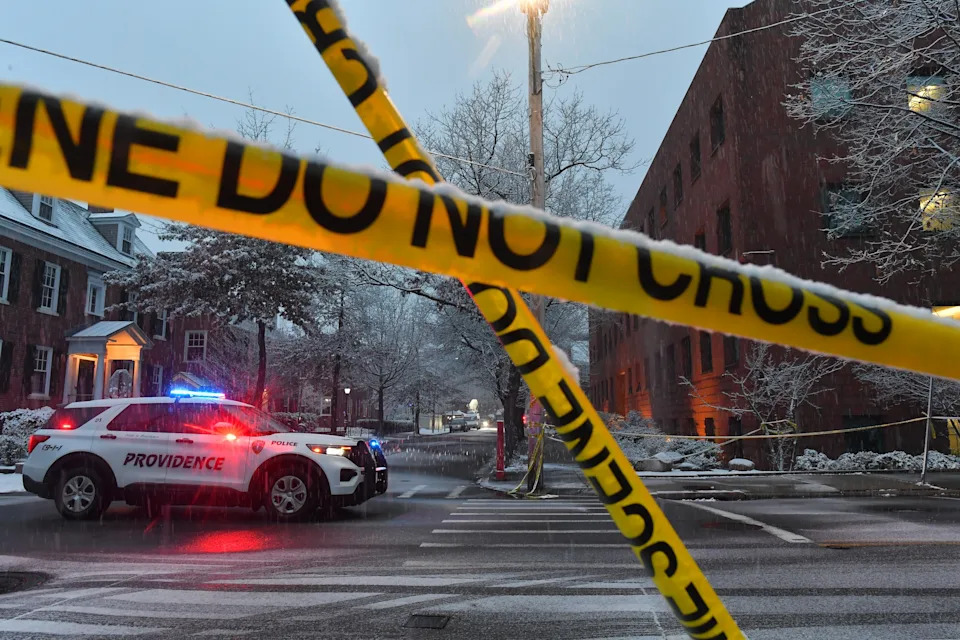
A police vehicle is parked at an intersection near crime scene tape at Brown University, Sunday, Dec. 14, 2025, in Providence, R.I., following a Saturday shooting at the university. (AP Photo/Steven Senne)(ASSOCIATED PRESS)
“The impact of gun violence goes far beyond the individuals who are wounded or killed,” Mayor Craig Greenberg said. “Those impacts are real — they’re not physical wounds, but they are traumatic wounds. My hope is that eventually our nation will come together to take meaningful action.”
After being wounded at Saugus High, Tretta became an advocate for stronger gun regulations and rose to a leadership role with Students Demand Action. Her activism has taken her to the White House and to meetings with senior officials. She has focused in particular on so-called ghost guns — unregistered, hard-to-trace firearms assembled from parts — the type used in the Saugus attack.
At Brown, Tretta had been researching a paper on the educational journeys of students who have lived through school shootings, a project shaped by her own experience and due in a few days. Saturday marked the first time she had received an active-shooter alert while at Brown.
“I chose Brown because it felt like a place where I could finally be safe and feel normal again,” she said. “And it’s happened again. It didn’t have to.”
Context: The Providence incident is one of several recent campus-related shootings that have reignited conversations about school safety, mental health supports, emergency notification systems, and regulation of firearms and gun parts. Survivors and families describe long-term psychological effects, sudden safety improvisations during crises, and renewed calls for policy action.
Associated Press reporter Claire Galofaro contributed from Louisville, Kentucky.


