
Tens of thousands of Brazilians rallied in Brasilia, Rio and other major cities to oppose a bill that would reduce former President Jair Bolsonaro’s more-than-27-year sentence for his role in the Jan. 8, 2023, attacks on government buildings. The lower house approved a measure that would make two of his convictions run concurrently and loosen parole rules, but the bill still needs Senate approval and presidential sanction — Lula has signaled he would likely veto an amnesty. Protesters and analysts say the demonstrations could reshape the legislation before final passage.
Mass Protests Across Brazil Reject Bill That Could Cut Bolsonaro’s Prison Time

Demonstrators protest a bill that looks to reduce former President Jair Bolsonaro's prison time, in Brasilia, Brazil, Sunday, Dec. 14, 2025. (AP Photo/Eraldo Peres)(ASSOCIATED PRESS)
RIO DE JANEIRO — Tens of thousands of Brazilians took to the streets on Sunday to oppose legislation passed by the lower house that would shorten the prison term of former President Jair Bolsonaro, who has been sentenced to more than 27 years for his role in attempting to overturn Brazil’s 2022 election.
Demonstrations were held in the capital, Brasilia, and in major cities including São Paulo, Florianópolis, Salvador and Recife. In Rio de Janeiro, crowds gathered along Copacabana’s promenade, where predominantly left-leaning protesters chanted “No amnesty” and “Out with Hugo Motta,” a reference to the speaker of the lower house who shepherded the measure through on Wednesday. The bill now moves to the Senate.

A demonstrator shouts "No amnesty" in Portuguese during a protest against a bill in that looks to reduce former President Jair Bolsonaro's prison time, in Brasilia, Brazil, Sunday, Dec. 14, 2025. (AP Photo/Eraldo Peres)(ASSOCIATED PRESS)
“It’s an attempt to protect those who tried to attempt a coup,” said Antonio Edson Lima de Oliveira, a 56-year-old geologist who joined the Rio demonstration. “Brazil has already had several dictatorships and they were awful for the country. We never want it to happen again.”
Famed musicians Caetano Veloso and Gilberto Gil performed in Rio, where the heat was intense and the mood mixed: festive at times, but angry and determined at others. Many protesters carried signs that read “Congress is the enemy of the people.”
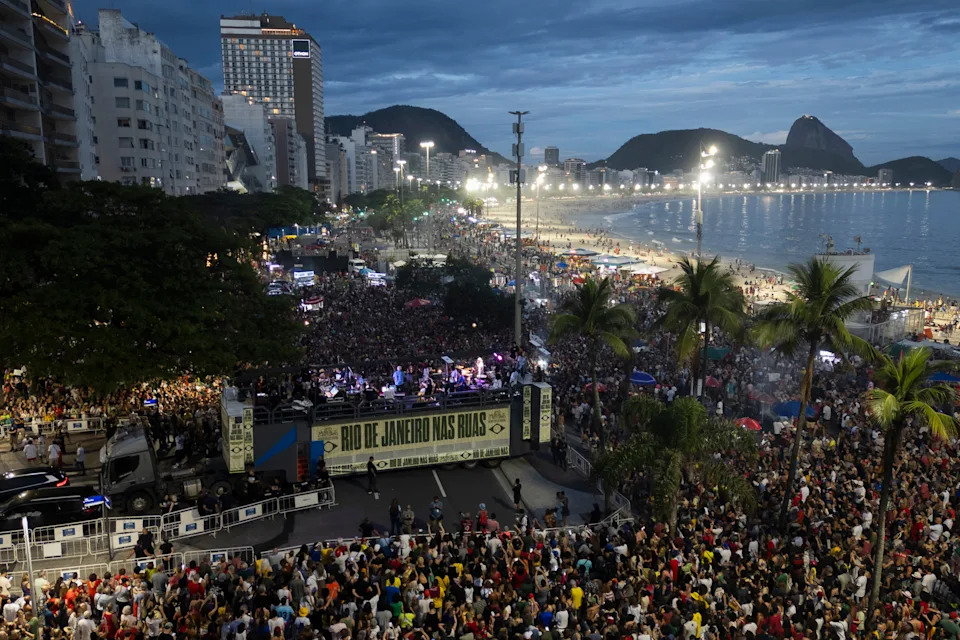
Demonstrators protest a bill that looks to reduce former President Jair Bolsonaro's prison time, in Rio de Janeiro, Sunday, Dec. 14, 2025. (AP Photo/Bruna Prado)(ASSOCIATED PRESS)
“It’s very important that they’re here, encouraging people to hit the streets. But I think we mustn’t come only to sing, we have to come to actually fight,” said Lavinia Scalia, an 18-year-old student movement organizer.
Jan. 8 Riot
The bill’s sponsor in the lower chamber, Paulinho da Força, has described the legislation as an act of reconciliation. He says that if enacted, it could cut Bolsonaro’s time behind bars to about two years and four months by ordering two of his convictions to run concurrently rather than consecutively. Those convictions relate to attempting a coup and violently seeking to overthrow the rule of law.
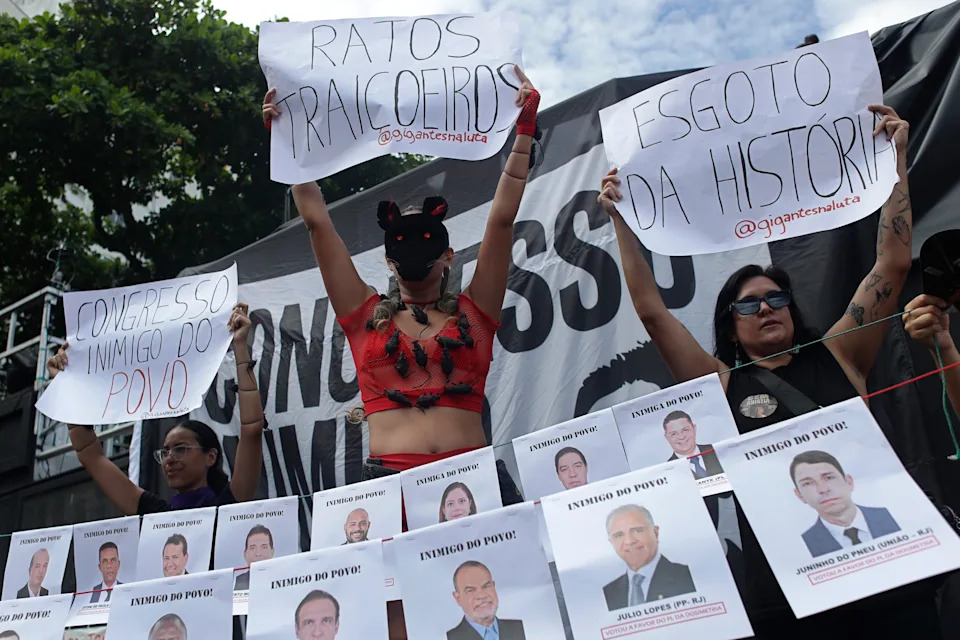
A demonstrator, center, holds up a sign with "Treacherous rats" written in Portuguese, referring to members of Congress, during a protest against a bill that looks to reduce former President Jair Bolsonaro's prison time, in Rio de Janeiro, Sunday, Dec. 14, 2025. (AP Photo/Bruna Prado)(ASSOCIATED PRESS)
The law would also relax parole rules, allowing prisoners to move from full confinement to day parole after serving one-sixth of a sentence instead of the current one-quarter requirement. The proposed changes would apply to all those convicted in connection with the Jan. 8, 2023, riot, when supporters of Bolsonaro stormed government buildings in Brasilia.
Brazilian justices concluded that the former president led a criminal organization behind the insurrection, which they said aimed to overturn the result of the October 2022 election and prevent Luiz Inácio Lula da Silva from taking office.
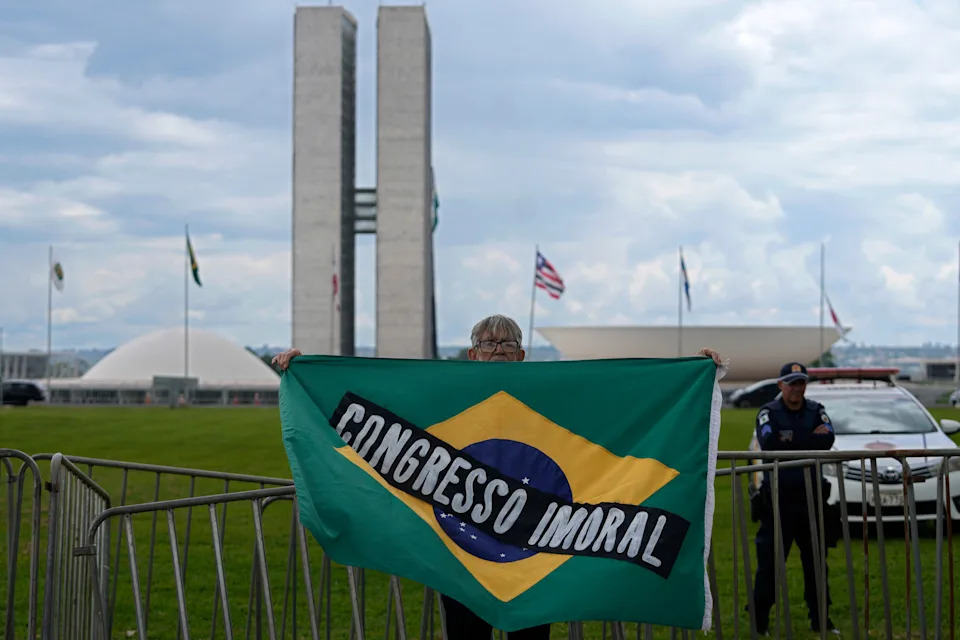
A demonstrator carries a Brazilian flag with the phrase, "Immoral Congress" in Portuguese in front of Congress during a protest against a bill that looks to reduce former President Jair Bolsonaro's prison time, in Brasilia, Brazil, Sunday, Dec. 14, 2025. (AP Photo/Eraldo Peres)(ASSOCIATED PRESS)
Next Steps And Political Context
Even if the lower house’s version remains intact, the measure still requires Senate approval and the president’s sanction. President Luiz Inácio Lula da Silva has previously indicated he would veto an amnesty for Bolsonaro and is expected to be reluctant to sign legislation seen as protecting those convicted in the Jan. 8 attack.
Analysts say the Senate — shaped differently from the lower house — and the widespread protests will likely lead to changes in the bill. “The composition of the Senate, the mobilizations and the fact that the vote in the lower house took place in the early hours of the morning mean the environment in favor of the bill is not as favorable as it was in the lower house,” said Luciana Santana, a politics professor at the Federal University of Alagoas.
International Fallout
International attention to Bolsonaro’s legal troubles intensified after U.S. President Donald Trump in July imposed steep tariffs on Brazilian goods, citing among other reasons Bolsonaro’s trial. That action strained U.S.-Brazil relations, though ties have since thawed: tariffs on many products, including coffee and beef, were later lifted, and U.S. authorities removed Brazilian Supreme Court Justice Alexandre de Moraes from a sanctions list after previously naming him in connection with the trial oversight.
Protests on Sunday underscored the polarizing nature of the debate over accountability, reconciliation and the rule of law in Brazil. Whether the demonstrations will influence the Senate’s deliberations remains to be seen, but organizers and observers say the popular backlash has already altered the political dynamics around the measure.


