
Researchers observed that buff-leaf hawkmoth larvae and pupae emit loud hisses and rapid defensive movements when touched, with most mature larvae and about half the pupae responding. Underwater trials showed the sounds result from air expelled through specific spiracles, producing bubbles — a forced-air mechanism never before demonstrated in pupae. Acoustic patterns resemble snake warning signals, suggesting possible acoustic mimicry to deter predators. The study, led by Shinji Sugiura (Kobe University) and published in the Journal of Experimental Biology, calls for further work to test predator responses and survey other species.
Hissing Hawkmoth Larvae Mimic Snakes: Air-Driven Hisses Ward Off Predators

Mature larvae of the buff-leaf hawkmoth react when touched.
A chunky, caterpillar-like insect perches on a stem until a pair of forceps approaches. The instant the tool touches the larva, the insect emits a loud hiss and snaps its body from side to side.
That irate creature is a mature larva of the buff-leaf hawkmoth (Phyllosphingia dissimilis). The forceps were used to simulate a predator, and the scene took place in a laboratory study probing how these larvae and their pupae produce surprisingly loud defensive sounds.
How The Hiss Is Made
Researchers led by Shinji Sugiura of Kobe University found that most mature larvae and roughly half of the pupae responded to simulated attacks with both a loud hiss and rapid body movements. By running some trials underwater, the team demonstrated the mechanism: the insects expel air through specific respiratory openings (spiracles), producing bubbles and audible hisses.
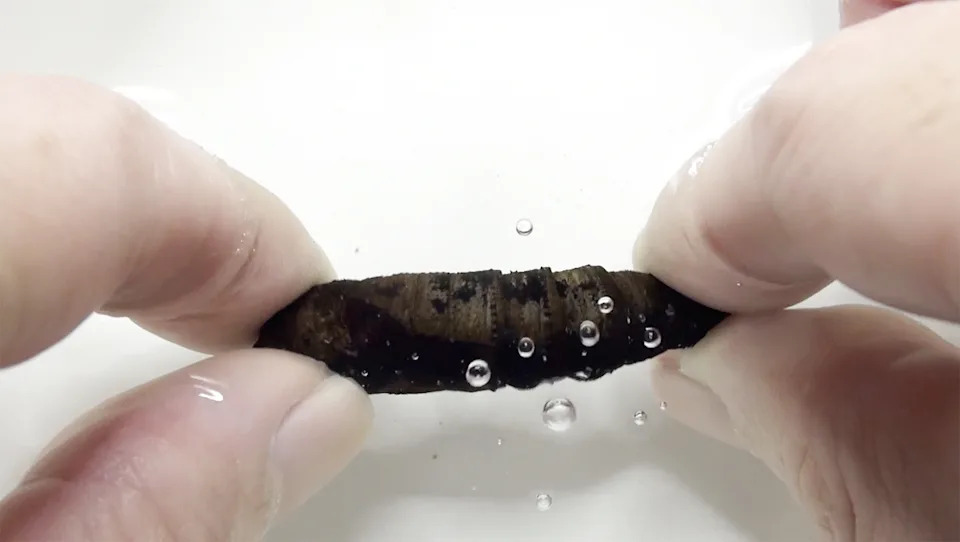
A pupa releases bubbles when bothered underwater.Image:Shinji Sugiura
"Until now, pupal sound production was thought to occur only through physical friction between body parts or against the substrate. This is the first evidence demonstrating a sound production mechanism in pupae that is driven by forced air," Sugiura said. Larvae and pupae of this species have one pair of spiracles on the thorax and eight pairs on the abdomen; in this species, specific spiracles act like a whistle when air is forced through them.
Why It May Work
Although the sounds are produced by air forced through spiracles, they do not resemble a simple whistle. Instead, acoustic analyses showed the hiss patterns are comparable to warning sounds made by snakes. The authors hypothesize that hawkmoth larvae and pupae may acoustically mimic snake warning signals to deter predators such as birds and small mammals—animals that would avoid potential encounters with snakes.
Implications And Next Steps
This study, published in the Journal of Experimental Biology, provides the first evidence of forced-air sound production in pupae. The finding expands our understanding of defensive signaling in immobile life stages and raises new questions: Do predators perceive these hisses as snake-like and avoid them? Do other insect species use similar spiracle-driven mechanisms? Follow-up experiments will need to test predator responses and survey other taxa for comparable adaptations.
Study Lead: Shinji Sugiura, Kobe University. Species: Buff-leaf hawkmoth (Phyllosphingia dissimilis). Publication: Journal of Experimental Biology.


