
The Stratolaunch Roc — a twin‑fuselage composite aircraft with a 385‑foot wingspan and six engines — was photographed and filmed taking off from Mojave Air and Space Port. Built as an airborne launch platform, Roc is designed to carry and release the autonomous Talon‑A2 vehicle, which can reach hypersonic speeds (around Mach 5) after release. The aircraft has reached roughly 35,000 feet during recent tests, and Stratolaunch reports completing multiple Roc and Talon‑A flights as it advances hypersonic flight services.
Massive Stratolaunch “Roc” — Wingspan Wider Than a Football Field — Spotted Over California

Creosote bushes spread far across the Mojave Desert in Johnson Valley, Calif. (Farley Elliott/SFGATE)
From a distance the aircraft looks like something from a Hayao Miyazaki film or a science‑fiction novel. Aviation spotters captured photos and video last week of the experimental Stratolaunch plane known as Roc taxiing and taking off from the Mojave Air and Space Port’s Rutan Field.
Stratolaunch markets Roc as the world’s largest flying aircraft: a composite twin-fuselage airplane powered by six engines with a 385‑foot wingspan — wider than a football field — and a maximum takeoff weight around 1.3 million pounds. In test flights completed last year the plane climbed to roughly 35,000 feet.
Designed as an airborne launch platform, Roc carries and releases Stratolaunch’s autonomous Talon‑A2 vehicle in flight. After release, the Talon‑A2 is intended to accelerate to hypersonic speeds — roughly Mach 5, or about five times the speed of sound — for high‑speed test missions.
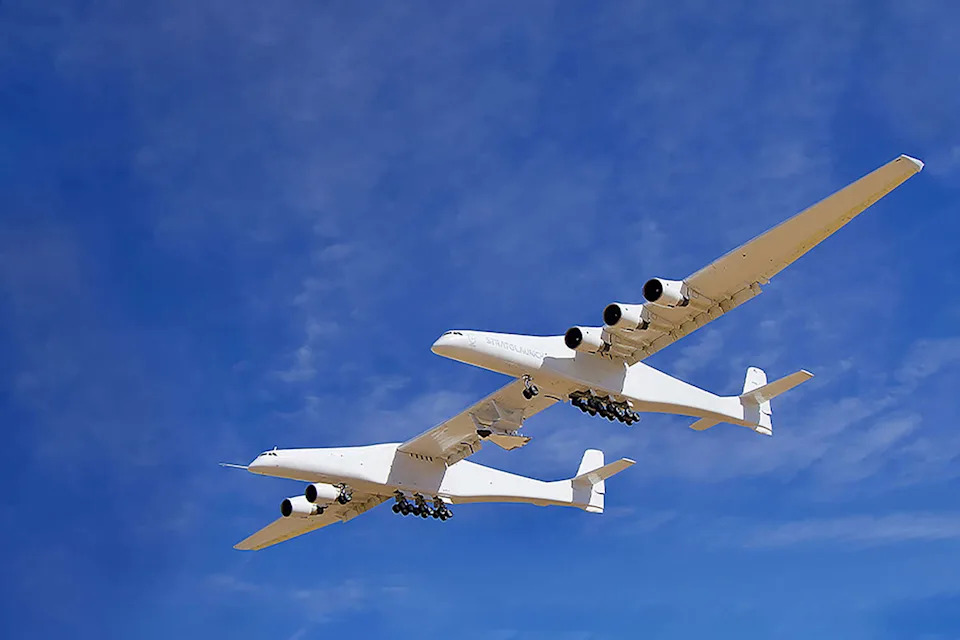
FILE: The Roc, a unique six-engine aircraft designed by Stratolaunch, takes flight. (Stratolaunch)
Photos and videos posted by hobbyist spotters show the enormous aircraft during ground operations and takeoff at Mojave Air and Space Port, an aerospace testing center in California’s high desert. Rutan Field began in 1935 as a small rural airport serving the local mining industry, became a World War II gunnery training site, and today hosts testing activities for more than 60 aerospace companies.
“I am in awe of what this team has achieved,” Stratolaunch CEO Zachary Krevor said in a recent news release. “We've executed four incredible Talon‑A flights, completed twenty‑four Roc flights to date, flew two new supersonic and hypersonic airplanes in a single year, and we are firmly on the path to making hypersonic flight test services a reality.”
Stratolaunch did not respond to additional requests for comment before publication. The plane’s nickname, Roc, references a legendary giant bird from Arabian folklore said to be big enough to carry elephants — a fitting image for an aircraft built to lift another vehicle into the upper atmosphere.
Why It Matters
Airborne launch systems like Roc can reduce the cost and complexity of high‑speed and high‑altitude tests by releasing payloads from high altitude rather than launching them from the ground. Continued Roc and Talon‑A test flights will be watched closely by aerospace companies and defense contractors interested in hypersonic research and rapid flight‑test capabilities.


