
Choi Sang-mok, who served as interim president during South Korea’s December 2024 martial law crisis, was indicted for dereliction of duty after leaving one of nine Constitutional Court seats vacant while the court weighed President Yoon’s removal. Choi also faces perjury charges. Another interim leader, Han Duck-soo, was indicted on similar charges, and several other officials — including Yoon’s justice minister — were charged as part of wider probes approved by President Lee Jae Myung.
Ex-Acting President Choi Sang-mok Indicted Over December 2024 Martial Law Vacancy

FILE - South Korea's acting President Choi Sang-mok speaks during the National Security Council at the government complex building in Seoul, South Korea, on Dec. 27, 2024. (Hong Hae-in/Yonhap via AP, File)(ASSOCIATED PRESS)
South Korea’s former acting president Choi Sang-mok was indicted on Thursday on charges of dereliction of duty for his role in the aftermath of the brief imposition of martial law in December 2024 by then-President Yoon Suk Yeol. The indictment, brought by an investigative team led by independent counsel Cho Eun-suk, marks the latest development in a sprawling legal and political crisis that has ensnared senior officials, military commanders and political allies.
Charges And Allegations
Prosecutors say Choi, who served as Yoon’s deputy prime minister and finance minister and acted as interim president during the emergency, failed to fill one of three vacancies on the nine-member Constitutional Court while it was weighing whether to remove Yoon from office. Choi appointed two justices but left a ninth seat vacant, citing a lack of bipartisan agreement when he assumed the interim presidency. Investigators argue that restoring the court to full strength could have affected the outcome because removing a president requires the support of at least six justices.
Choi also faces perjury charges related to testimony he gave at the trial of another former acting leader, Han Duck-soo.
Related Indictments And Broader Probe
Assistant special prosecutor Park Ji-young said Cho’s team also indicted Han on the same dereliction of duty charge. Han, who served as Yoon’s prime minister, had already been indicted in August on more serious charges accusing him of abetting Yoon’s bid to impose martial law — including attempts to route Yoon’s decree through a Cabinet Council meeting to give it procedural legitimacy. Han denies those allegations, saying he told Yoon he opposed the plan.
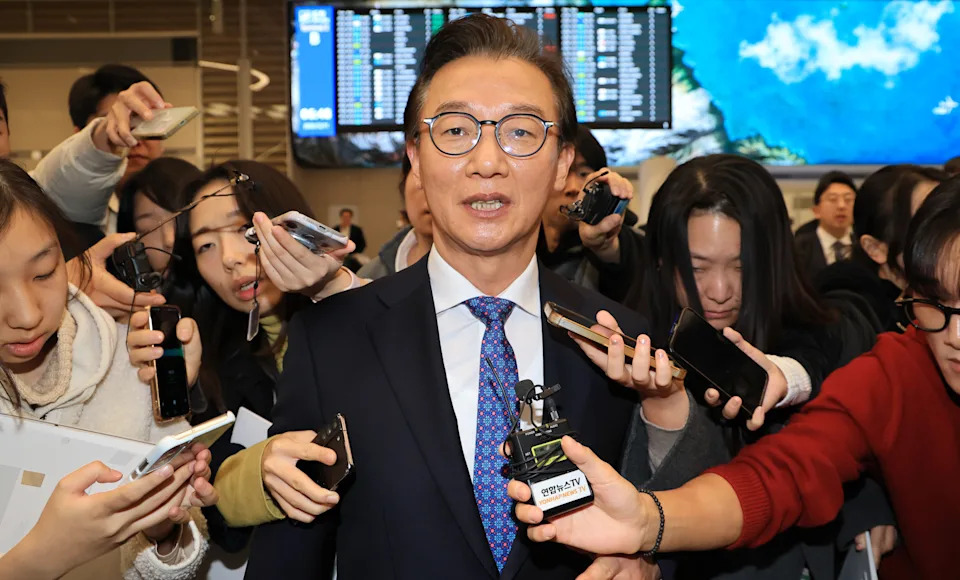
South Korean Oceans Minister Chun Jae-soo answers questions from reporters at the Incheon International Airport in Incheon, South Korea, Thursday, Dec. 11, 2025. (Kim Joo-hyoung/Yonhap via AP)(ASSOCIATED PRESS)
Park added that five other individuals, including Yoon’s justice minister, were indicted on Thursday on various charges connected to the martial law crisis.
Political Context
The charges connected to the December 2024 martial law declaration are part of three independent-counsel investigations approved by President Lee Jae Myung after he won an early election in June that followed Yoon’s removal. Yoon is currently jailed and awaiting trial on high-stakes rebellion charges.
Separately, Yoon’s wife, Kim Keon Hee, was arrested and indicted in August on allegations including violations of financial market rules, illegal political funding and accepting bribes. The leader of the Unification Church, Hak Ja Han, was later arrested and indicted on claims that she instructed church officials to bribe a senior lawmaker close to Yoon. Those developments have widened the scandal and prompted media reports that other prominent politicians may have received funds from the church.
Resignation And Ongoing Inquiries
On Thursday, Oceans Minister Chun Jae-soo denied any bribery allegations but offered to resign to avoid being a burden on the administration; President Lee accepted his resignation later the same day. Earlier this week, President Lee urged a thorough investigation of allegations involving politicians and a religious organization, without explicitly naming the Unification Church.
In April, the Constitutional Court — with eight sitting justices — issued a unanimous ruling to remove Yoon from office.
The new indictments underscore continuing political volatility in South Korea and the judicial scrutiny surrounding actions taken during the December 2024 crisis.


