
TIME commissioned two artists, Peter Crowther and Jason Seiler, to create the 2025 Person of the Year covers for the "Architects of AI." Crowther's chip-inspired illustration hides eight notable AI figures amid a construction scene, while Seiler's painting echoes a famous 1932 photograph of workers on a steel beam. TIME's creative director also experimented with OpenAI's GPT-5 and Google’s Gemini 3, concluding that AI can be a useful creative tool but that human judgment is essential in any collaboration with it.
Inside TIME’s 2025 Person of the Year Covers: The Architects of AI — Art, AI, and Human Judgment

Credit: Illustration by Peter Crowther for TIME; Painting by Jason Seiler for TIME; Background images courtesy of Peter Crowther and Jason Seiler.
To visualize TIME's selection of the "Architects of AI" as its 2025 Person of the Year, the magazine commissioned two distinct artists to interpret the technological upheaval reshaping our world. London-based illustrator and motion-graphics artist Peter Crowther and digital painter Jason Seiler each produced a cover that probes the tension and collaboration between humans and machines.
Two Covers, Two Visions
Peter Crowther drew inspiration from the circuitry and logic of computer chips. His detailed composition places an immense, chip-like AI structure above a bustling construction site, complete with recurring scaffolding and a sense that the work is constantly evolving. Crowther hid eight notable figures who helped shape the AI revolution among the workers, inviting readers to search the scene.
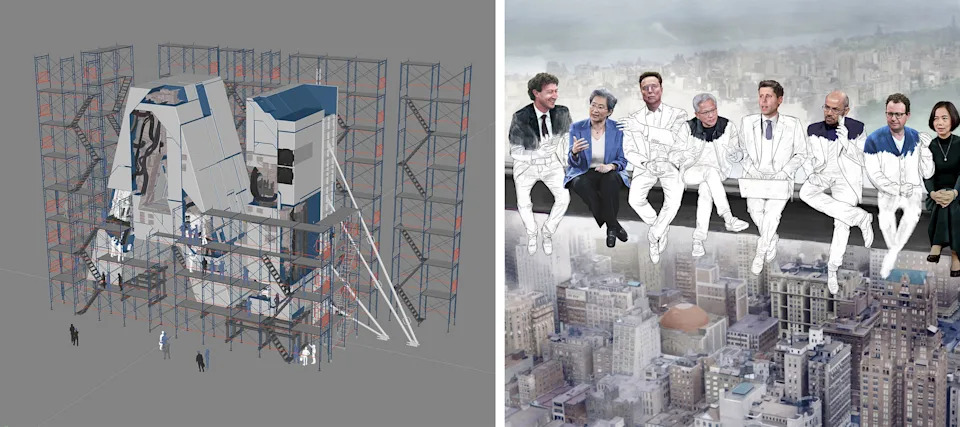
A work in progress view of the cover artCourtesy Peter Crowther and Jason Seiler
“I like to spend time thinking over the brief and begin once I have my design and technical approach sorted,” Crowther said. “I usually get a mental picture and see the whole process at once, often as a flash at an unexpected moment.”
Jason Seiler took a different route: a digital painting that echoes the iconic 1932 photograph of construction workers perched on a steel beam 800 feet above the RCA building in New York. In Seiler's cover, several of the people who have shaped AI appear prominently, posed in a composition that pays homage to that historic image. Seiler, a classically trained oil painter who studied at the American Academy of Art in Chicago, spent more than a week painting the scene on a 21-inch LCD display. He previously painted TIME Person of the Year covers for Pope Francis (2013) and Joe Biden and Kamala Harris (2020).
Experimenting With Generative Tools
As TIME's creative director, I wondered how AI might depict itself. Like millions of others, I experimented with powerful generative systems — OpenAI's GPT-5 and Google's Gemini 3 — asking prompts such as "What do you look like as a person?" or "Create an illustration using the letters AI." The issue includes a selection of the results from those experiments.
Using AI to produce images raises ethical and creative questions in visual journalism. Crowther warned that if a person simply prompts a machine and the prompt itself comes from an AI chatbot, the human may be too removed from the creative process to learn from it. "Ordering a meal does not make you a chef," he said.
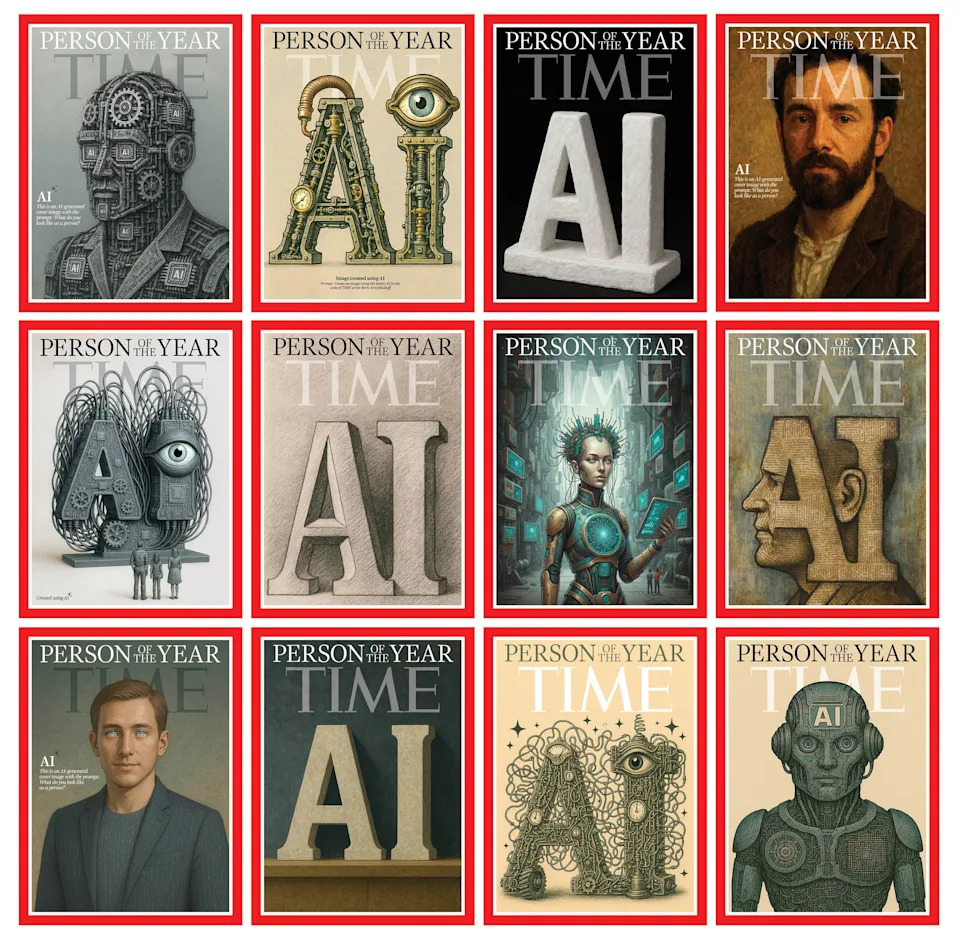
Images generated using AIA sampling of cover images created using ChatGPT and Gemini, from prompts such as “create an image of yourself” and “create an image using the letters AI.”
I approached the experiments cautiously at first. After generating hundreds of iterations, I learned how different models interpreted my instructions and which delivered the strongest starting points. The systems often produced wholly new images on each run, so I spent hours refining prompts and selecting outputs — an experience that felt like art directing more than passive receipt.
Human Judgment Remains Essential
TIME will continue to use its red-bordered cover to celebrate human creativity. This experiment reinforced that while AI can be a practical image-creation tool — analogous to a painter's brush or a photographer's lens — human choices, taste, and editorial judgment remain central to compelling visual storytelling. That balance is visible in the finished works by Crowther and Seiler.
Click here to buy your copy of this issue.
For reader correspondence: letters@time.com.


