
Researchers led by Michael Hill and Brian Wong presented electromechanical reshaping (EMR), a nonablative technique that uses a platinum mold and a small electrical potential to temporarily loosen corneal collagen by lowering local pH and allow the tissue to adopt a new curvature. In laboratory tests on 12 isolated rabbit eyes, 10 treated for myopia achieved the targeted focusing power in about a minute. These ex vivo results show promise, but they do not demonstrate safety, durability or improved vision in living animals or humans; no peer-reviewed paper was reported and further in vivo testing is needed.
Scalpel- and Laser-Free Vision Correction? Electrical ‘Mold’ Reshapes Cornea in Lab Tests

(Jacob Wackerhausen/iStock/Getty Images Plus)
Recognizing a friend across the street or reading a distant sign without squinting often depends on glasses, contact lenses or laser eye surgery. Researchers are exploring a different approach that could reshape the cornea without cutting or removing tissue.
What the team did: Chemist Michael Hill (Occidental College) and surgeon Brian Wong (University of California, Irvine) presented early laboratory results at the American Chemical Society’s fall meeting in August 2025 describing an electromechanical reshaping (EMR) technique. The method uses a platinum mold shaped like a contact lens that also functions as an electrode. Applying a small electrical potential locally lowers pH in the corneal tissue, temporarily loosening molecular interactions in the collagen matrix so the tissue becomes pliable and conforms to the mold.
Key findings from the lab tests: In ex vivo experiments using 12 isolated rabbit eyeballs placed in saline, the team reports that 10 eyes treated with a correction intended for myopia reached the targeted focusing power. The reshaping reportedly took roughly a minute in these tests. Images released by the American Chemical Society show a cross-sectional change in corneal curvature before and after EMR.
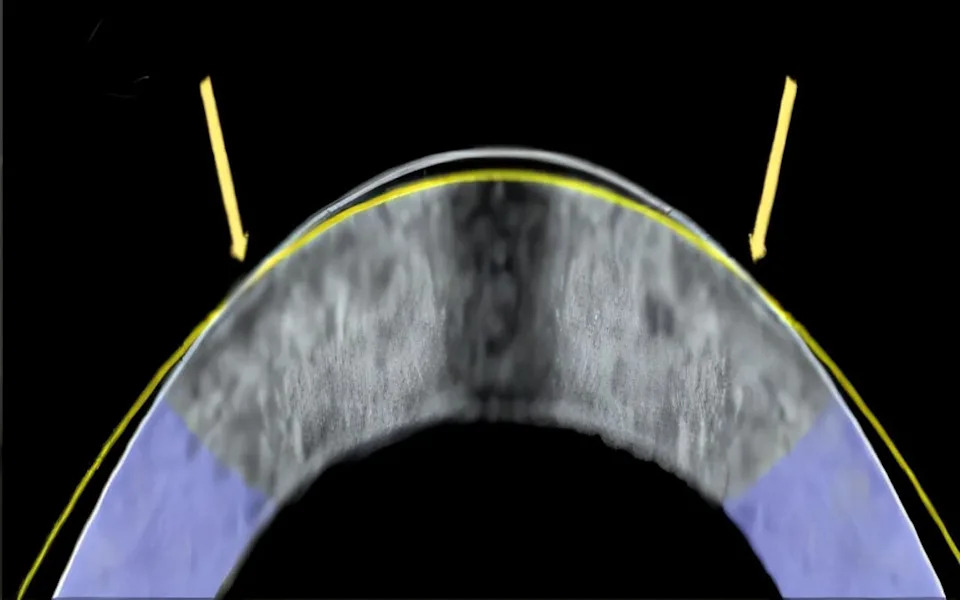
Cross section of a rabbit cornea reshaped using the experimental electromechanical technique. The white line marks its original shape; the yellow line shows the flatter profile after treatment. (Daniel Kim and Mimi Chen)
How it differs from LASIK: LASIK reshapes the cornea by ablating tissue with a laser. EMR aims to change corneal curvature by temporarily altering local chemistry (lowering pH) rather than removing tissue, with the goal that the cornea retains its new shape when pH and molecular interactions return to baseline.
Safety and limitations: The researchers reported cell survival in the ex vivo samples by carefully controlling the pH gradient, but these results do not establish long-term safety or effectiveness in living eyes. The experiments used eyes removed from animals, so they do not demonstrate improved vision in a living rabbit or human. Important questions remain: how long reshaping lasts in vivo, whether living eyes tolerate the treatment, what range of refractive errors can be corrected (myopia, hyperopia, astigmatism), and whether the effect is reversible. The announcement described a conference presentation and did not cite a peer-reviewed journal article.
Next steps and caveats: The team said they planned living-animal trials to assess durability and safety, but funding uncertainty has delayed progress. Hill and Wong previously tested EMR ideas in rabbit ears and pig skin, and the group also reported that the method may reverse some forms of chemically induced corneal cloudiness in laboratory settings. As the researchers note, there is a long road from promising ex vivo findings to a practical clinical alternative to LASIK.
Bottom line: EMR is an intriguing, nonablative concept that reshapes corneal curvature by temporarily changing tissue chemistry. Early ex vivo results are promising, but peer-reviewed studies and rigorous living-animal and human trials are required before its safety, durability and clinical value are known.
Help us improve.





















