Key Takeaway: The only authenticated lifetime portrait of Pocahontas—Simon van de Passe’s 1616 engraving—casts her in elite English dress and helped present her as proof that Indigenous peoples could be converted to English customs and Christianity. Earlier visual campaigns (notably John White’s watercolors and Harriot/de Bry’s engravings) prepared English audiences to view Native peoples as convertible and exploitable. The 1622 Powhatan uprising and the violent English reprisals that followed revealed the limits and dangers of those assumptions.
Beyond Disney: How a 1616 Portrait of Pocahontas Reveals English Visions of Colonization
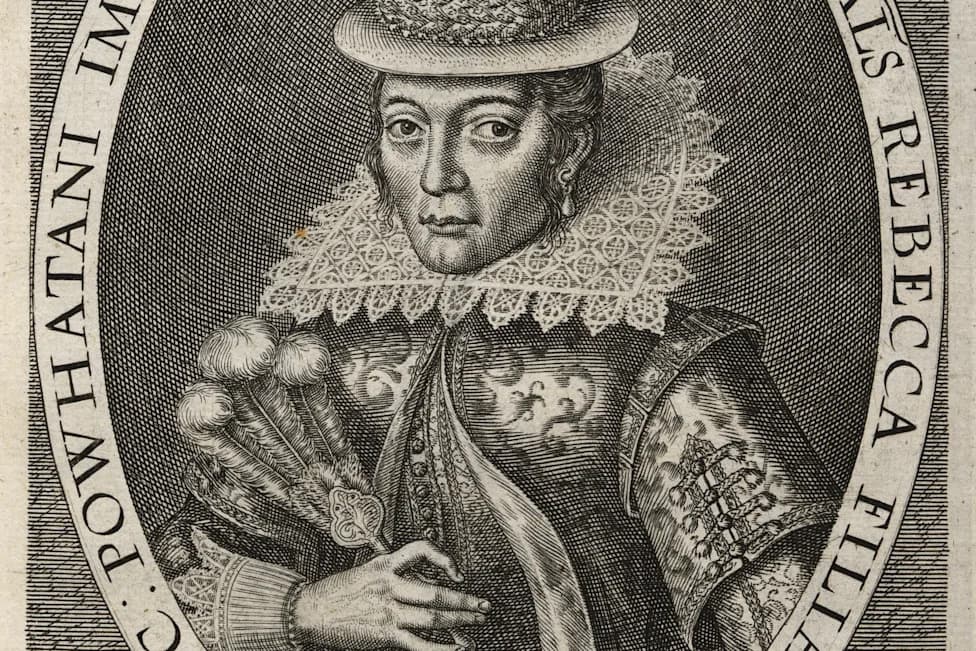
Simon van de Passe's 1616 engraving of Pocahontas is the only known portrait made during her lifetime.National Portrait Gallery/Wikimedia Commons
Pocahontas is often remembered through the prism of Disney’s 1995 film, which transformed her into a mythic figure who communes with nature and stars in a romanticized story. The single authenticated portrait of her made during her lifetime—a 1616 engraving by Simon van de Passe—offers a very different and historically revealing image. That engraving speaks to how English colonizers imagined cultural conversion, civilization, and the goals of settlement in early Virginia.
Who Was Pocahontas?
Pocahontas (also recorded as Matoaka and Amonute) was the daughter of Wahunsonacock, the paramount chief of the Powhatan confederacy, who governed many communities in the Chesapeake Bay region known to his people as Tsenacommacah. She was likely about 10 or 11 when she first encountered the English colonist John Smith in late 1607. Smith claimed that she saved his life from execution, a story scholars debate today and often interpret as part of a ritualized adoption rather than a literal reprieve.
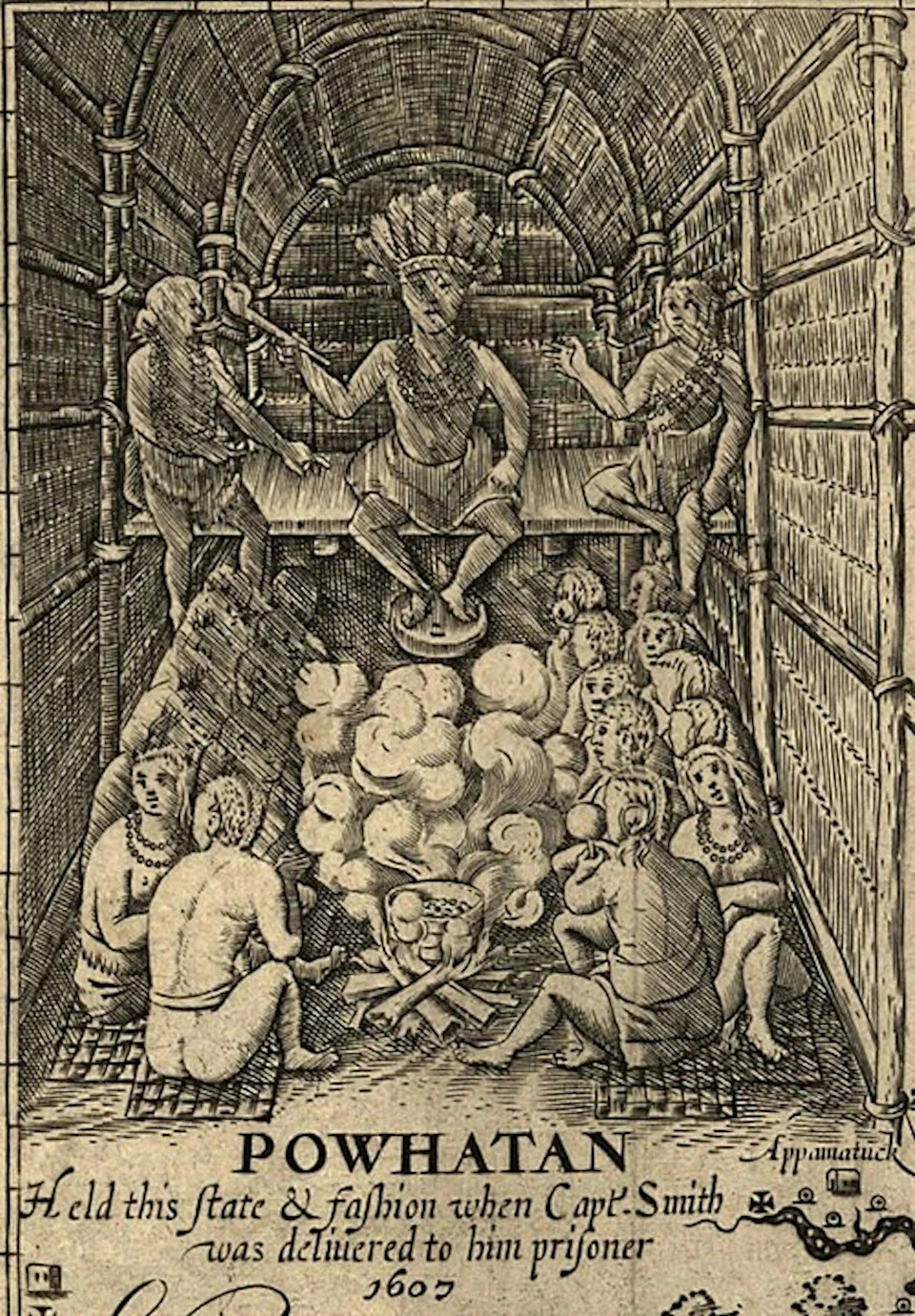
An engraving of Wahunsonacock by William Hole appeared on a map John Smith created of Virginia.Virtual Jamestown/Wikimedia Commons
Capture, Marriage, and a Trip to England
During the first Anglo-Powhatan War, English colonists seized Pocahontas in 1613. Her release in 1614 culminated in her marriage to tobacco planter John Rolfe, a union that helped stabilize relations for a time and that produced a son, Thomas, between about 1615 and 1617. The couple traveled to England in 1616 as part of a diplomatic and publicity mission; while in London she met King James I.
The 1616 Engraving and Its Message
Simon van de Passe’s engraving presents Pocahontas in the dress of an elite Englishwoman: a tall stovepipe hat, a wide lace collar, a richly embroidered gown, and a single pearl earring. In the image she holds an object variously described as a feather fan or a quill pen; either would have signaled literacy or genteel status to contemporary English viewers. The caption and the visual cues together framed her as Rebecca Rolfe, an example of successful conversion and Anglicization—powerful propaganda for English audiences and investors.
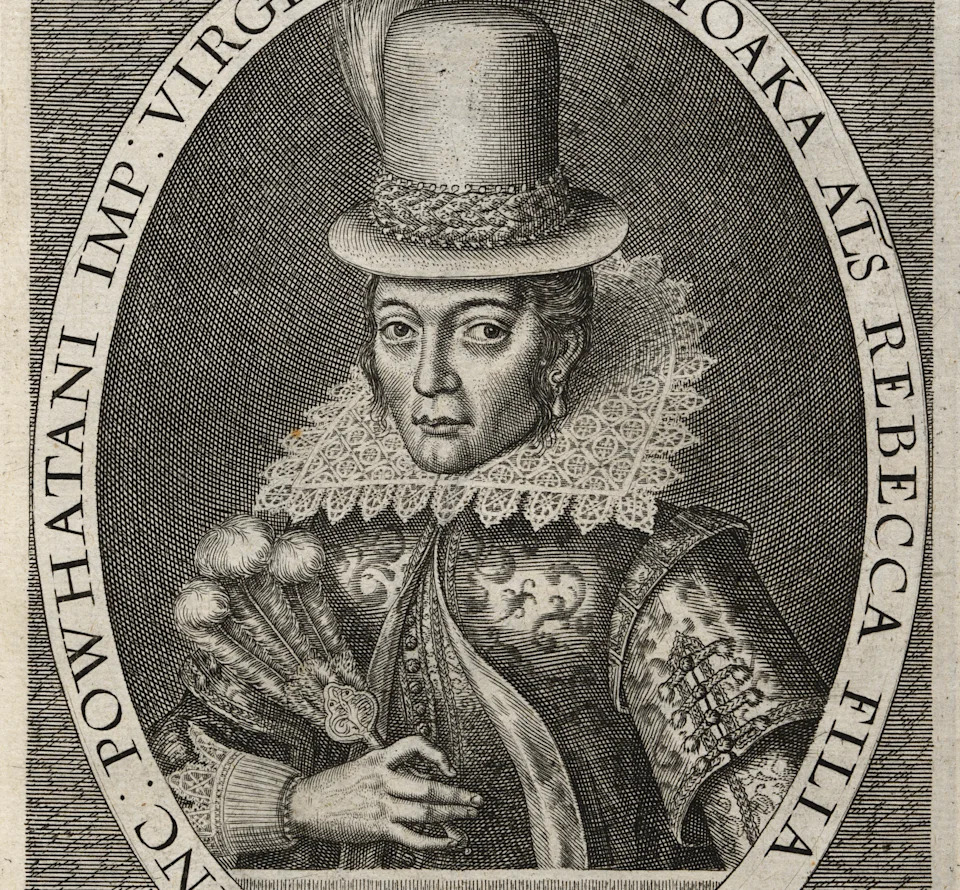
Simon van de Passe's 1616 engraving of Pocahontas is the only known portrait made during her lifetime.National Portrait Gallery/Wikimedia Commons
Visual Propaganda and Earlier Images
The van de Passe engraving did not appear in a vacuum. In the late 16th century, Europeans used vivid images to persuade prospective migrants and investors that North America offered profit and that Native peoples could be brought into English ways. John White’s 1585 watercolors of Algonquian peoples and Thomas Harriot’s written study were adapted by Theodor de Bry in 1590 into widely circulated engravings. Those images both exoticized and domesticated Native peoples—depicting some with little clothing to connote ‘‘primitivism,’’ while implying that, with proper instruction and conversion, they could become civilized in European terms.
From Symbol To Reality: Conflict and Consequence
Though the engraving suggested a smooth cultural transfer, the subsequent history exposed the limits of that assumption. Wahunsonacock died in 1618. In 1622, under the leadership of Opechancanough, the Powhatan launched a coordinated attack that killed about one-quarter of Virginia’s colonists on March 22. The English responded with brutal reprisals, including a mass poisoning in 1623—actions contemporaries acknowledged violated emerging norms of warfare. Those events made clear that assimilationist expectations were dangerously optimistic and frequently served to justify exploitation.
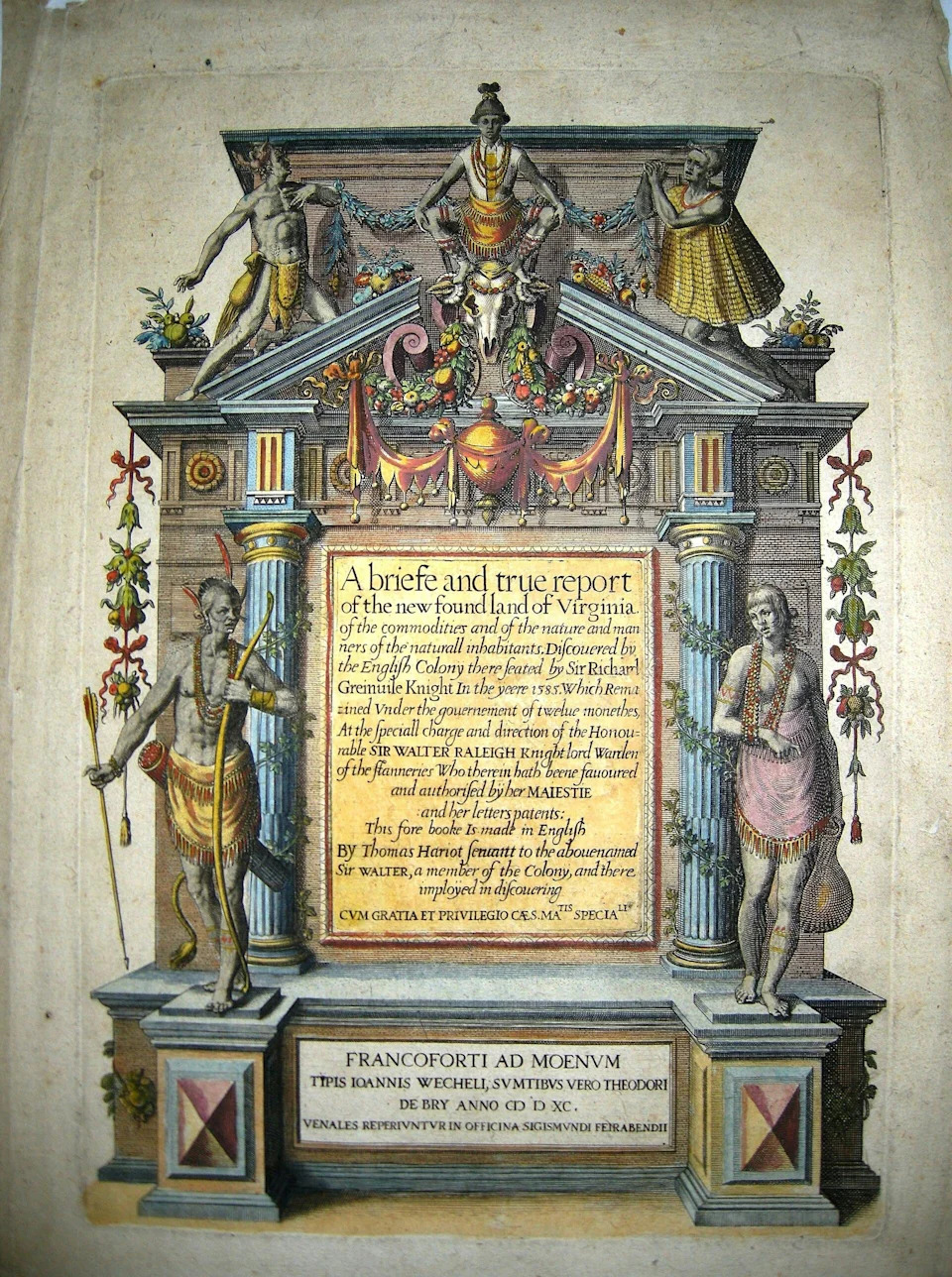
The title page of the 1590 edition of Theodor de Bry's 'A Briefe and True Report of the Newfound Land of Virginia.'Livinncary/Wikimedia Commons,CC BY-SA
Why the Portrait Matters
Van de Passe’s engraving is historically important because it shows how the English wanted to represent colonial success: through visible markers of English dress, religion, and literacy. It also highlights the use of personal imagery to legitimize broader political and economic ambitions. Pocahontas’s life—her capture, marriage, conversion, and premature death in 1617 after leaving England—became a narrative the English could deploy to suggest the desirability and achievability of cultural transformation in the colonies.
Note: The article has been updated to correct the identification of the object Pocahontas holds in van de Passe’s engraving; interpretations have varied between a feather fan and a quill pen.
Originally published in The Conversation on May 25, 2026. Written by Peter C. Mancall, USC Dornsife College of Letters, Arts and Sciences. Mancall has received funding from the Huntington Library, the National Endowment for the Humanities, and the Mellon Foundation.
Help us improve.