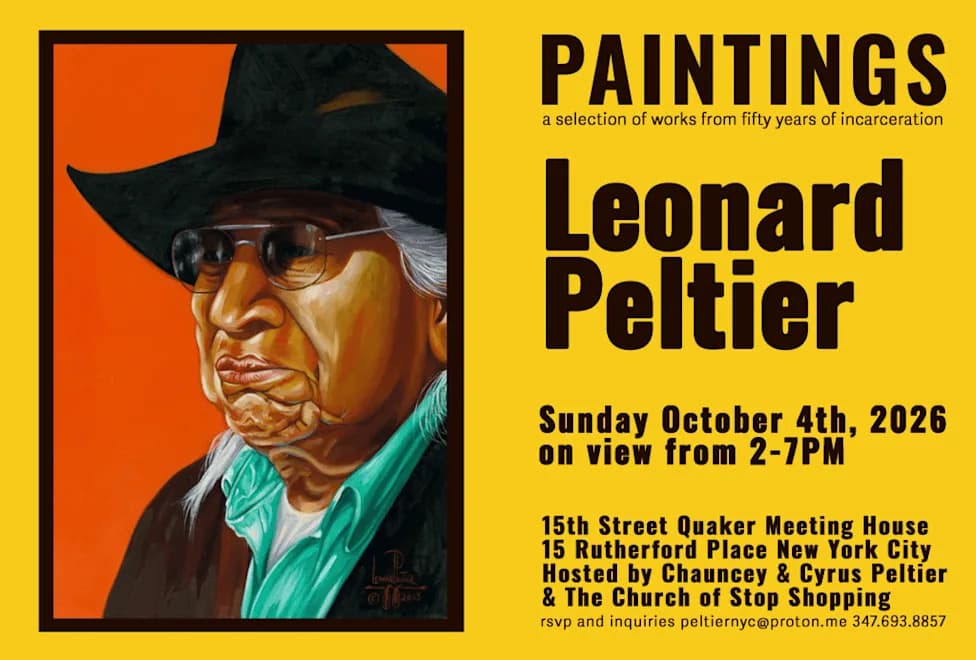
Leonard Peltier, released to home confinement in February 2025 after nearly five decades in prison, spoke with Native News Online about his health, artwork and ongoing work to correct the record. He produced more than 200 paintings while incarcerated; an exhibition opens in New York City on October 4. A documentary directed by David France will stream on Netflix on Indigenous Peoples’ Day, October 12, 2026, and Peltier plans to dictate an authorized biography because of significant vision loss. He urged Native youth to defend land, treaty rights and cultural education.
Leonard Peltier Reflects on Life After Prison: Art, Health, a Netflix Documentary and a Call to Native Youth
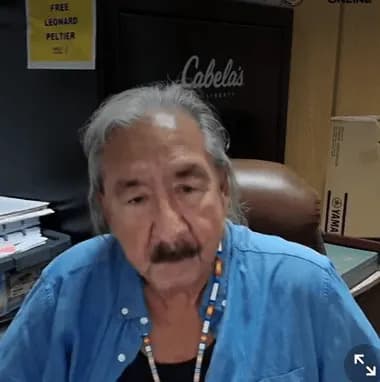
Leonard Pelter was interviewed on Sept. 14, 2026 by Levi Rickert.
Editor's note: Levi Rickert, founder and publisher of Native News Online, interviewed Leonard Peltier on Monday, September 14, 2026. This Q&A has been edited for clarity and length.
Leonard Peltier, who turned 82 on September 12, discussed adjusting to life outside prison, his health and eyesight, the artwork he produced while incarcerated, an upcoming New York exhibition, a Netflix documentary about his case, plans for an authorized biography, and his view on progress and ongoing challenges in Indian Country. Peltier was released to home confinement on Feb. 18, 2025, after President Joe Biden commuted his sentence; he had served nearly five decades following his 1975 conviction in the deaths of two FBI agents on the Pine Ridge Indian Reservation.
Q&A Highlights
Levi Rickert: Leonard, happy birthday. How did you mark it?
Leonard Peltier: A few family members came, brought a couple of cakes, sang “Happy Birthday” and gave gifts. It was different from any birthday I’ve had before, so that was nice.
Rickert: How is your health? People worry about your eyesight and overall condition.
Peltier: I’ve lost about 82 percent of my vision, though some sight is returning. People around the world are helping me pursue treatments to try to restore more eyesight.
Rickert: You’ve been out of Coleman for about a year and a half. Are you settling into life outside prison?
Peltier: I’m doing pretty well. Freedom is incomparable. It’s a million times better than being confined to a prison cell.
Art Made Behind Bars
Rickert: There’s an exhibition of your prison paintings opening in New York City on October 4. Tell us about creating art while incarcerated.
Peltier: I’ve been involved in art since childhood. Growing up, we made our own toys and drew in the dirt because we couldn’t afford supplies. Art is deeply rooted in our people’s history—cave drawings, artifacts and traditional crafts show that legacy. I painted murals during my activism in Seattle and at AIM offices, and I returned to painting seriously during my time in prison.
Contrary to some assumptions, supplies were not freely handed out. We had to buy materials, orders could take months to arrive, and we were not allowed to work in our cells. We used designated hobby or craft spaces in the institutions where I was held.
Rickert: How many works did you produce in custody?
Peltier: We began inventorying after about 200 pieces because people said they might become valuable. The tally exceeded 200 paintings—and likely more.
Documentary, Book and Record Revisions
Rickert: The documentary Free Leonard Peltier, directed by David France, is set to stream on Netflix on Indigenous Peoples’ Day, October 12, 2026. What role did you play?
Peltier: David France approached me before my release. I agreed to the film only if it presented key facts I believe have been omitted in past accounts. For example, the Myrtle Poor Bear matter was mishandled: the prosecutor later acknowledged that her affidavits lacked credibility, and there is evidence he was involved in helping craft her statement. David agreed to address such issues, and the finished documentary aims to present that fuller context.
Rickert: Will you write your own book?
Peltier: I’ve received offers for a biography. Because of limited vision, I will dictate the story and work with a writer whose style I trust to shape it into an authorized biography.
Views on Indian Country and a Message to Youth
Rickert: Despite revenue from gaming and federal funds, many Native communities still face disparities. What should tribes prioritize?
Peltier: Communities like Turtle Mountain have invested in re-educating students, teaching culture and providing constructive programs, and they are buying back land even as prices rise. Their success has prompted political pushback; recently the state tried to pass a law aimed at restricting tribes from reacquiring their own land.
Rickert: What message do you have for Native youth?
Peltier: We need you. The next generation must step up to protect land, restore treaty rights and carry on the work of defending our people. I won’t be here forever; young leaders must be ready to say no to further dispossession and to demand the return of land and rights taken illegally.
Closing
Peltier expressed gratitude for ongoing support and said he hopes the exhibition, documentary and forthcoming biography help clarify the record, honor Indigenous culture and inspire younger generations to defend their rights.
Watch the complete interview on Native News Online.
Help us improve.