Researchers report the first direct biochemical evidence that folded four-stranded G-quadruplex (G4) structures exist in nucleic acids captured from human blood plasma. Using a gentle capture method and two independent detectors — an anti-G4 antibody and a fluorescent probe — they found signals consistent with pre-existing folded G4s and used controls to rule out several artefacts. The assays cannot yet distinguish DNA-derived from RNA-derived G4s, so further enzymatic tests and sequencing are planned. While G4s are linked to gene-regulatory regions and some tumors, additional work is needed before any diagnostic application.
Scientists Find Four-Stranded 'G-Quadruplex' Structures Floating in Human Blood Plasma
(Jonathan Knowles/Stone/Getty Images)
If you picture DNA as the classic double helix, recent research suggests there may be another form hiding in our bloodstream.
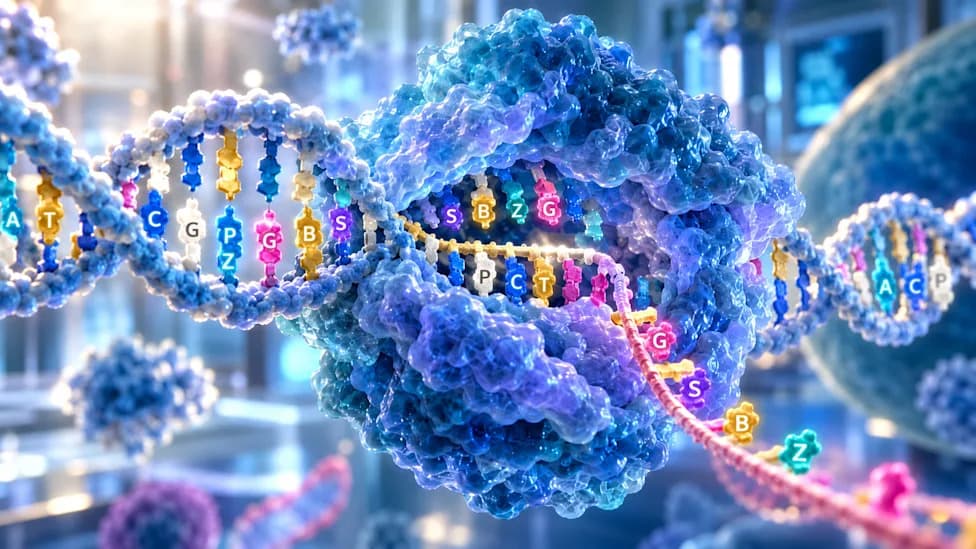
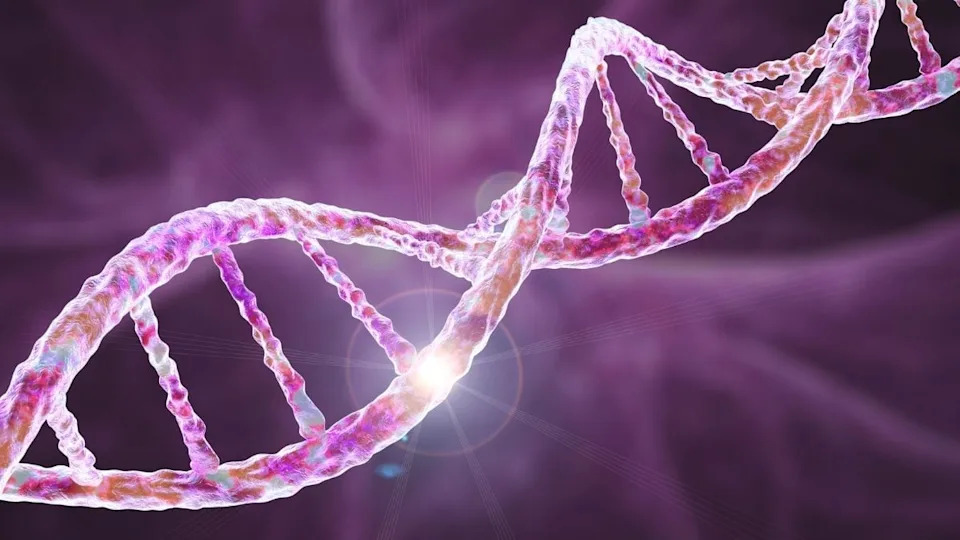
While the double helix is the image most people associate with genetic material, DNA and RNA can sometimes fold into compact, four-stranded configurations called G-quadruplexes (G4s). These atypical shapes have been observed inside cells; a new preprint reports the first direct biochemical evidence that folded G4 structures exist in nucleic acids captured from human blood plasma.
(Kateryna Kon/Science Photo Library/Getty Images)
How The Team Detected G4s
The researchers began by focusing on ultrashort cell-free fragments — single-stranded nucleic acids roughly 50 nucleotides long — that can escape standard capture methods. Some of these fragments contained enough guanine (G) to form G4s, and computational analyses suggested they might fold into those structures.
To avoid creating artefacts during extraction, the team used a gentle capture method that did not involve heating or harsh chemical steps. They then applied two independent detection probes: an anti-G4 antibody engineered to bind folded G4s and a small fluorescent molecule that lights up when it binds the same fold. Both probes produced signals consistent with pre-existing folded G4s in plasma.
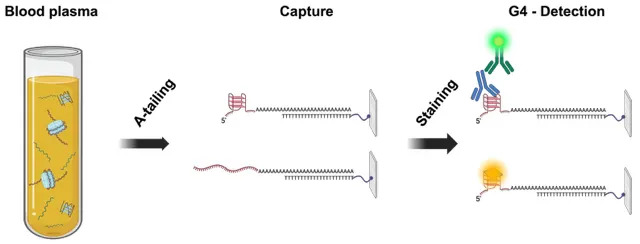
The researchers captured nucleic acids directly from human blood plasma before using two independent detection methods to identify folded G-quadruplex structures. (BioRender/University of Cologne)
"Our study provides, to our knowledge, the first direct biochemical evidence that folded G-quadruplex structures are present in nucleic acids captured directly from human plasma," said Robert Hänsel-Hertsch, a molecular biologist at the University of Cologne.
Controls strengthened the finding: a matching sequence engineered so it could not form a G4 produced no signal, and competition assays showed the two detectors interfered with each other’s binding, consistent with both recognizing the same folded structures rather than binding nonspecifically.
Limitations And Next Steps
A key limitation is that the detection methods recognize the folded shape itself and cannot distinguish whether the structures derive from DNA or RNA — both molecules can form identical G4 folds. The authors describe this ambiguity as "a real limitation." Planned follow-ups include treating captured samples with enzymes that selectively degrade DNA or RNA, followed by sequencing of the remaining folded molecules to identify their molecular type and genomic origin.

Subscribe to ScienceAlert's free fact-checked newsletter
Researchers also do not yet know which tissues release these structures, or whether they fold inside cells and are released already folded, or instead fold after release into the bloodstream.
Why This Could Matter
G4s are often found in genomic regions involved in gene regulation, and elevated G4 levels have been reported in several tumor types. That raises the possibility that circulating G4s might one day provide biomarker information that complements sequence-based assays. However, the present study was designed only to demonstrate presence of folded G4s in plasma, not to evaluate their diagnostic value in disease cohorts.
Before any clinical application, researchers must identify the molecules, map their genomic origins, measure their abundance across well-characterized patient and control groups, and test whether disease alters their number, source, or pattern in a reproducible way.
For now, the central takeaway is conceptual: the fragments of genetic material in our blood may carry structural information as well as sequence information. In other words, how the nucleic acid is folded could itself be biologically meaningful — and scientists are only beginning to learn how to read that layer of information.
Source: The preprint reporting these findings is available on bioRxiv.
Help us improve.