German Foreign Minister Johann Wadephul visited Budapest seeking a reset in relations after Péter Magyar defeated Viktor Orbán. He praised the new government's swift reforms and the restoration of rule-of-law standards. Wadephul highlighted Hungary's expulsion of 10 Russian diplomats and its solidarity after the Leipzig/Halle drone attempt as signals to Moscow; Russia denies involvement.
Germany Seeks Fresh Start With Hungary After Orbán's Ouster — FM Wadephul Visits Budapest
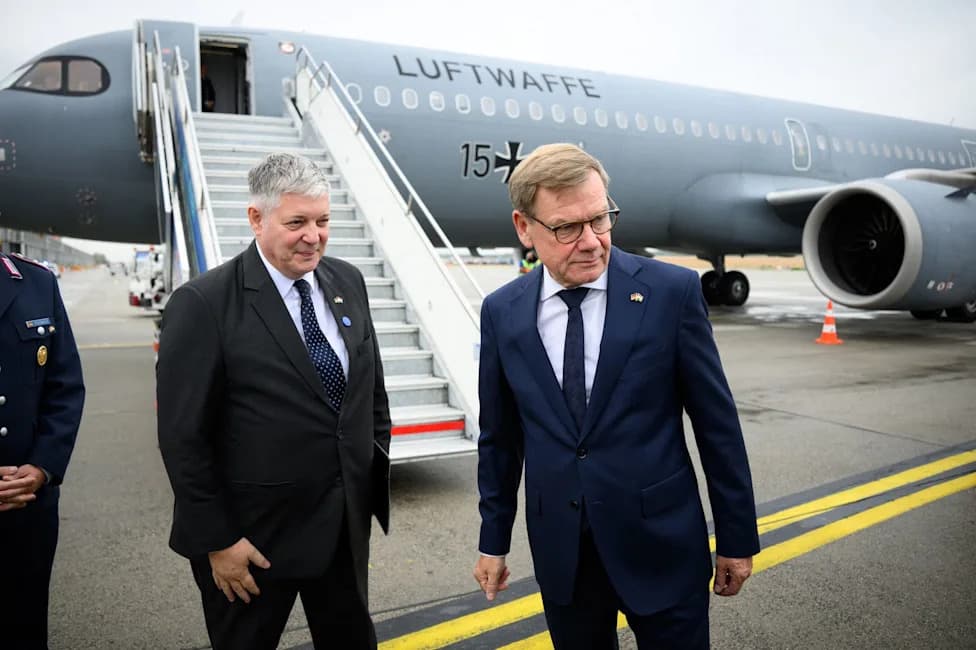
German Foreign Minister Johann Wadephul arrives at Ferenc Liszt Airport in Budapest, where he is greeted by Alexander Schoenfelder, German ambassador to Hungary. (is associated with: «Germany eyes fresh start with Hungary as top diplomat visits Budapest») Bernd von Jutrczenka/dpa
German Foreign Minister Johann Wadephul arrived in Budapest on Monday for an official visit, signaling Berlin's desire to reset ties after a change of government in Hungary earlier this year.
Conservative leader Péter Magyar toppled right-wing populist Viktor Orbán in April, ending Orbán's 16-year tenure. The previous administration had been seen as relatively sympathetic to Moscow, resisted some EU sanctions and frequently criticised Ukraine.
Wadephul welcomed the new government's early reform steps and said the return to respect for the rule of law and compliance with European standards were encouraging developments for Hungary and the wider EU.
"We hope Hungary rediscovers its great European heart," Wadephul said, framing the visit as an opportunity to strengthen cooperation between Berlin and Budapest.
During his stay, Wadephul is scheduled to meet President András Baka, Foreign Minister Anita Orbán and Economy Minister István Kapitány. He is the first German foreign minister to visit Hungary in almost seven years and is accompanied by a business delegation aimed at deepening economic ties.
Wadephul pointed to Hungary's recent expulsion of 10 Russian diplomats as a clear signal to Moscow. He also highlighted Budapest's expression of solidarity after an attempted explosive-drone attack on Leipzig/Halle airport in early August — an incident that Berlin has attributed to Russia, though Moscow denies involvement.
"Together with EU sanctions that Hungary has approved, these steps show we are defending the peace order in Europe against Russia's aggression," Wadephul said, underscoring the diplomatic importance of Hungary's policy shift.
Russia has denied any role in the Leipzig incident. The visit is likely to test how quickly and fully Budapest will align with EU foreign-policy positions after the political transition.
Help us improve.