EU Economy Commissioner Valdis Dombrovskis told Euronews the bloc must first determine the exact size of Ukraine's financing shortfall before deciding how to plug it. Kyiv has requested about $27bn (€23bn) — including €6bn in advance payments for 2027 deliveries — and the IMF is carrying out technical checks. Options include frontloading a €90bn support loan or tapping €210bn of immobilised Russian central bank assets, but Brussels insists on full accounting, monitoring and anti-corruption guarantees.
EU Says It Must 'Pin Down' Ukraine's Exact Financing Gap Before Deciding How To Fill It, Dombrovskis Says
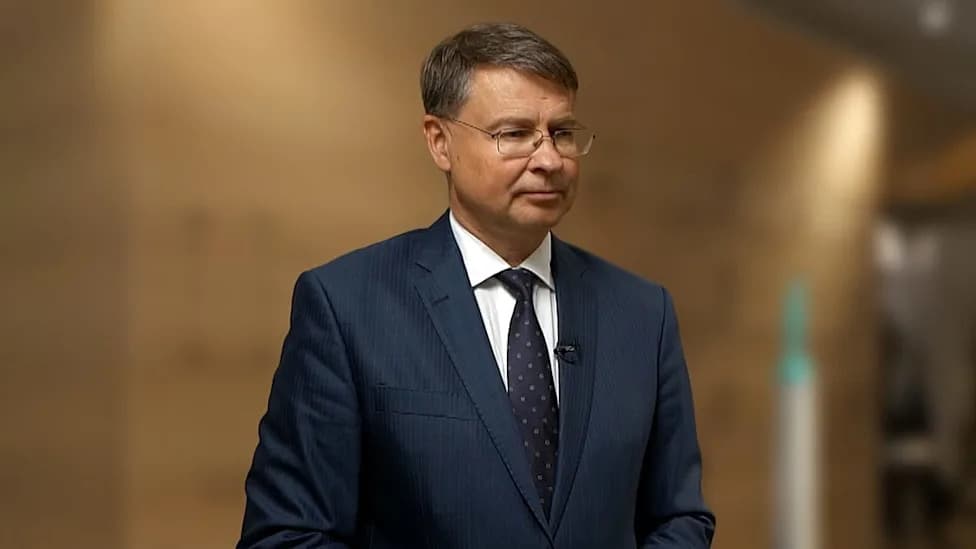
EU needs to 'pin down' Ukraine's exact budget needs, Dombrovskis tells Euronews
The European Union must first establish the precise scale of Ukraine's rising budget shortfall before deciding how to cover it, EU Economy Commissioner Valdis Dombrovskis — who coordinates EU support to Kyiv — told Euronews in an interview recorded in Riga, Latvia.
"We obviously need to do a proper, detailed assessment, but we understand that the war continues to rage at high intensity. If anything, Russia is intensifying its attacks,"
Dombrovskis said the intensity of the fighting has worsened Ukraine's economic situation and may push up its financing needs. "Correspondingly, the economic situation in Ukraine is also very difficult. So we can understand that this may lead to higher financing needs for Ukraine," he added, while stressing that "there are still open questions."
Last month, Ukrainian President Volodymyr Zelenskyy surprised some allies by requesting roughly $27 billion (€23 billion) to plug a shortfall in the Ministry of Defence. Kyiv says the gap stems from bringing forward funds originally earmarked for the second half of the year to cover costs incurred in the first six months.
The €23 billion request is intended to cover personnel, social support and weapons purchases, including about €6 billion in advance payments for deliveries scheduled for early 2027. Brussels has asked for a detailed breakdown to understand the size of the gap, what is driving it and how it could be financed. The International Monetary Fund is involved in technical checks of the figures.
One option Kyiv has proposed is to accelerate disbursements under the EU's existing €90 billion support loan. That instrument was originally arranged in two equal tranches of €45 billion for 2026 and €45 billion for 2027. Frontloading those payments could deplete planned assistance and risk leaving a funding shortfall next year.
Dombrovskis said the Commission has not received a formal written request from Kyiv to speed up the loan. "First of all, we need to find out exactly what these additional financing needs are and then discuss with the Ukrainian authorities how we are financing them," he said, noting that the €90 billion framework does allow for "some adjustments."
The sudden shortfall has renewed concerns about accountability and transparency — issues that have shadowed Ukraine since the start of Russia's full-scale invasion. Kyiv has faced multiple corruption scandals and reports of waste or misspending. As a condition of the EU loan, Ukraine granted Brussels monitoring rights over its state account, and the Commission examines defence contracts.
"We attach very strong attention to questions of good governance, good financial management and anti-corruption in all those programmes, and those are also part of the conditionality of our macro-financial assistance programme,"Dombrovskis said.
So far, under the €45 billion tranche earmarked for 2026, the EU has disbursed €3.2 billion in budgetary aid and €8.35 billion in military assistance.
As an alternative to frontloading the loan, Ukraine has urged EU governments to revisit the idea of using immobilised assets of the Russian central bank. The EU currently holds about €210 billion of those assets, most of them at Euroclear in Belgium. A group led by Sweden, the Netherlands, Spain and Poland — backed by the Baltic states — is pushing to revive the plan, which collapsed last year amid fraught negotiations. Belgium has warned that its objections have not "magically disappeared."
The Commission said it can support member states that want to pursue this route but has not committed to tabling a new legal proposal. Dombrovskis recalled that Brussels presented a legislative text last year that failed mainly because of resistance from Belgium. "But we certainly are ready to re-engage in those discussions, seek those additional reassurances which may be needed and help find a way forward," he said.
Ukraine has also proposed moving the Russian assets held at Euroclear to an EU-owned custodian; a cross-party group of 122 Members of the European Parliament has backed the transfer. Meanwhile, Brussels is pressing Western partners to cover about one-third of Kyiv's needs. US President Donald Trump said last week he would ask Europeans to reimburse American aid provided under the previous US administration — a prospect Dombrovskis downplayed.
"The European Union and its member states are by far the largest supporter and financial contributor to Ukraine," he said, while adding that it is important other jurisdictions, including the US, "are also playing their part."
Help us improve.