
GJ 523b is an unusually massive, rocky exoplanet confirmed through TESS, WIYN and JWST observations. The young planet (≈170 million years) has a radius of ~2.5 Earths, a mass of ≈23 Earth masses and an exceptionally high density (~7.8 g/cm³), yet orbits its star every 17.75 days. Its existence contradicts standard models that predict a gas giant should form above ~20 Earth masses; researchers suggest either intense atmospheric stripping or a giant collision as possible explanations.
GJ 523b: Newly Confirmed 'Mega‑Earth' That Defies Planet‑Formation Models
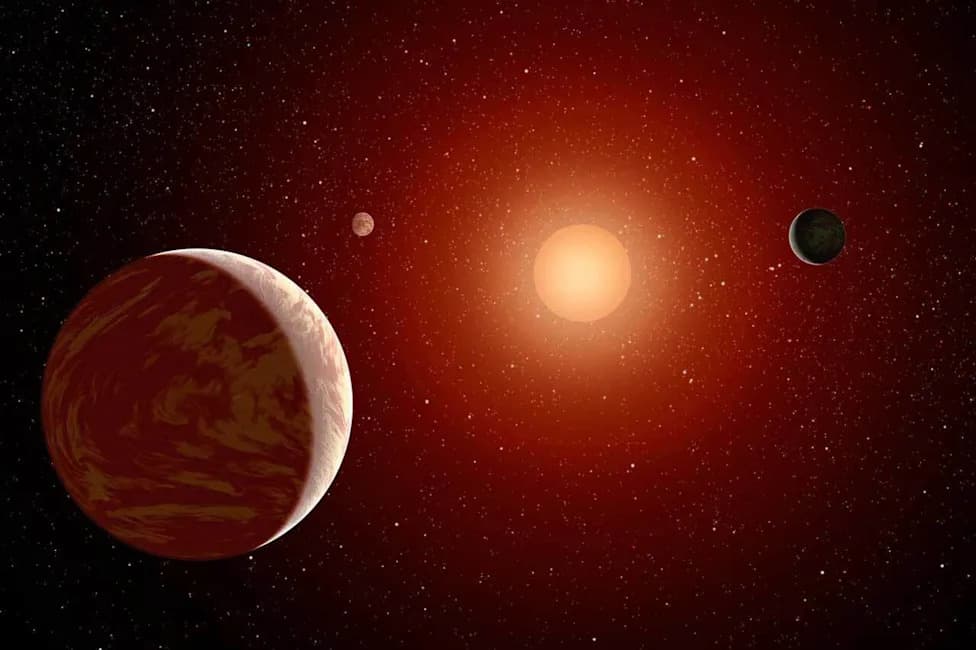
Astronomers using NASA’s TESS and the James Webb Space Telescope have confirmed a giant, predominantly rocky world that defied expectations by avoiding becoming a gas giant. ©Image Credit: NASA
Astronomers have confirmed a startling new exoplanet, GJ 523b: an exceptionally massive, predominantly rocky world that challenges current ideas about how planets form and evolve.
The planet was first flagged when NASA's Transiting Exoplanet Survey Satellite (TESS) recorded a small dip in its host star's light as the object transited. Follow‑up observations from the WIYN 3.5‑meter Telescope at Kitt Peak National Observatory and the James Webb Space Telescope (JWST) helped verify the signal and measure the planet's properties.
A team led by graduate student Max Kroft, working with Assistant Professor Thomas Beatty at the University of Wisconsin–Madison's Wisconsin Center for Origins Research (WiCOR), reported the planet's remarkable characteristics:
- Age: ≈170 million years — very young on astronomical timescales.
- Radius: ≈2.5 Earth radii (about 60% of Neptune's radius).
- Mass: ≈23 Earth masses concentrated in a very heavy core.
- Density: ≈126.82 grams per cubic inch (≈7.8 g/cm³), indicating a predominantly rocky composition.
- Orbital Period: 17.75 days — the planet orbits close to its star.
"This isn't what we expected at all," Kroft said. "Dense planets like this aren't uncommon, but they're usually small rocky planets similar to Earth or Mercury."
Why GJ 523b Is Puzzling
Standard planet‑formation models predict that when a protoplanetary core grows beyond roughly 20 Earth masses, its gravity should efficiently capture large amounts of hydrogen and helium from the protoplanetary disk and become a gas giant. GJ 523b exceeds that threshold yet appears overwhelmingly rocky and retains only a thin atmosphere — a combination that current models struggle to explain.
Leading Explanations
Researchers have proposed two main scenarios that could produce such an extreme mega‑Earth:
- Atmospheric Stripping: GJ 523b might originally have accreted a thick gaseous envelope that was subsequently stripped away by intense stellar radiation and heat because the planet orbits relatively close to its star.
- Giant Impact: Two large, rocky protoplanets could have collided, merging dense cores while blasting away lighter gaseous layers, leaving a single ultra‑dense rocky remnant.
Both explanations are plausible and carry different implications for how quickly and violently young planetary systems evolve.
What Comes Next
GJ 523b offers one of the clearest empirical examples of a true "mega‑Earth," and its existence will prompt refinements to formation and evolution models. Continued observations — especially spectroscopy of any remaining atmosphere and detailed studies of the host star — will help discriminate between the atmospheric loss and collision scenarios and shed light on how such extraordinary worlds form.
Sources: University of Wisconsin–Madison, Space.com, Detroit Free Press.
Help us improve.





















