A new study finds that a single large asteroid impact likely formed Deimos' 10-kilometer south-pole basin and spread a global layer of regolith that smoothed the moon's surface. Researchers ran about 100 Bern SPH simulations and identified a best-fit scenario: a ~320-meter object striking at 45 degrees, redistributing up to ~200 meters of material without destroying the moon. The model matches Hera flyby images and makes clear, testable predictions for JAXA's MMX mission, due to arrive in 2027.
One Violent Impact Likely Sculpted Mars' Potato-Shaped Moon Deimos
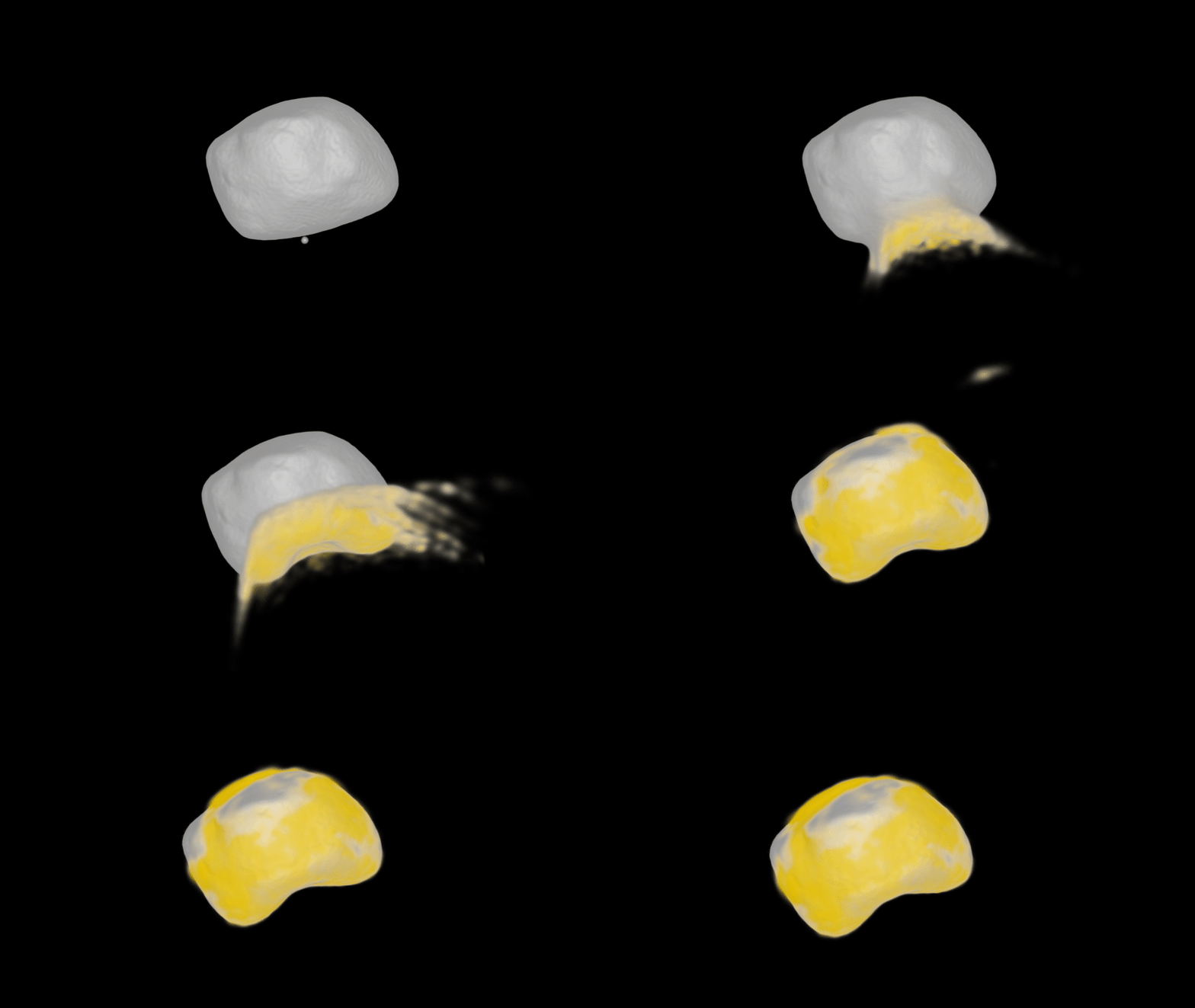
Animation shows how an asteroid strike may have reshaped Deimos and cloaked it in dusty material. - S. D. Raducan/ESA
Mars has two tiny moons, Phobos and Deimos, whose origins remain debated. New research combining high-resolution imagery from the European Space Agency's Hera flyby with detailed impact simulations suggests that a single large asteroid collision may explain Deimos' dramatic south-pole basin and its global blanket of fine dust and rubble.
New Model Links Crater and Global Dust Layer
Deimos is a lumpy, potato-shaped body roughly 7.5 miles (12 kilometers) across that orbits about 14,913 miles (24,000 kilometers) above Mars. Hera's March 2025 flyby provided sharp images that show a 6.2-mile-wide (10-kilometer-wide) impact basin at the moon's south pole and a surprisingly smooth surface covered by a thick layer of regolith. By matching those images to impact simulations, researchers argue that one violent strike can account for both features.
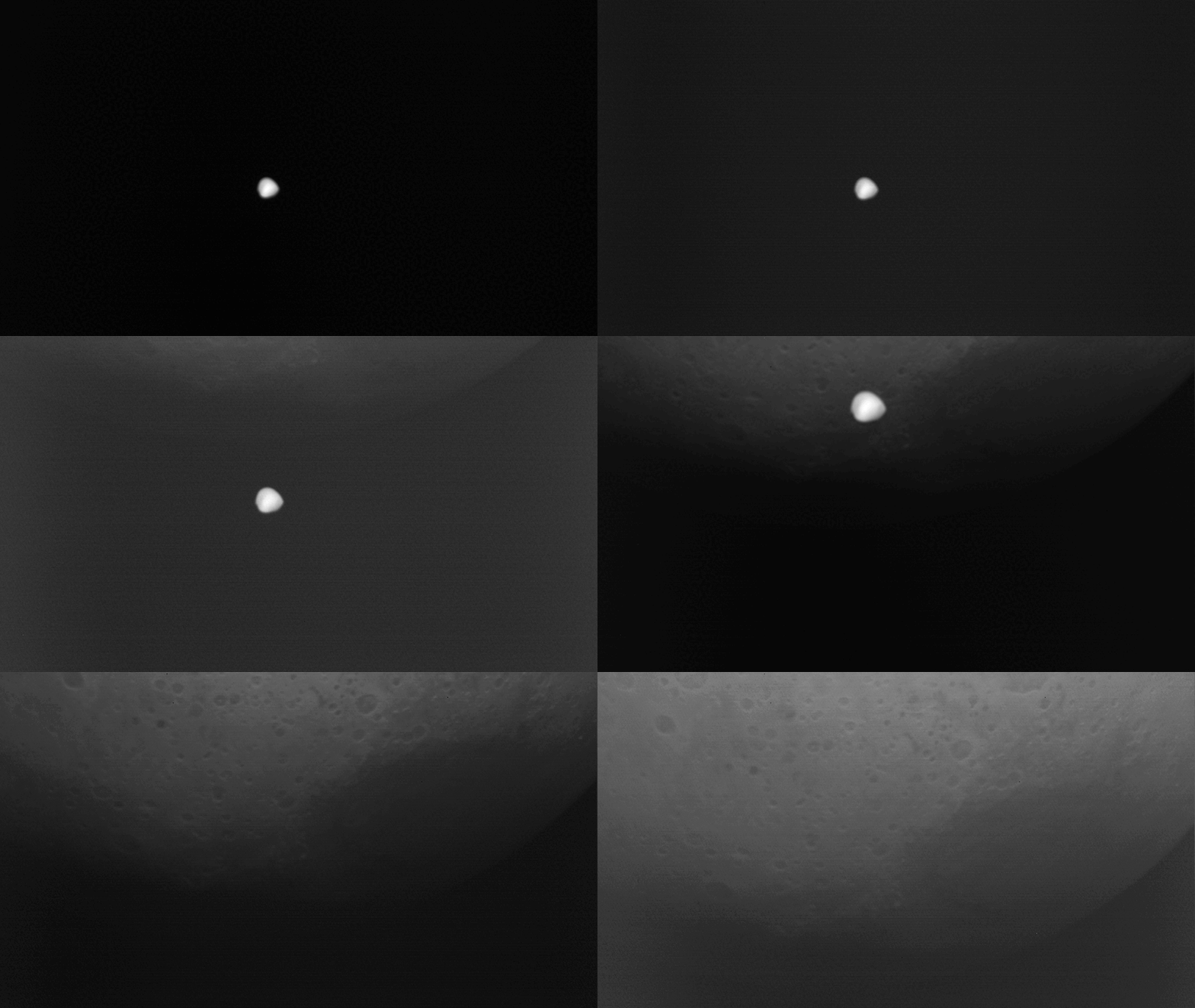
Deimos crosses Mars in a series of images that the Hera mission captured in March 2025. - ESA
What the Simulations Show
The team used the Bern Smoothed Particle Hydrodynamics (SPH) code to run about 100 simulations, each taking roughly a week to compute. They varied impactor size, speed and angle, along with different internal structures for Deimos. Their best-fit scenario involves an asteroid about 1,050 feet (320 meters) across striking Deimos at a 45-degree angle.
That collision would have excavated the south-pole basin and lofted large volumes of debris that later settled back across the moon, burying older features beneath as much as about 656 feet (200 meters) of material. The impact was energetic enough to redistribute material globally yet not so powerful as to shatter the moon.
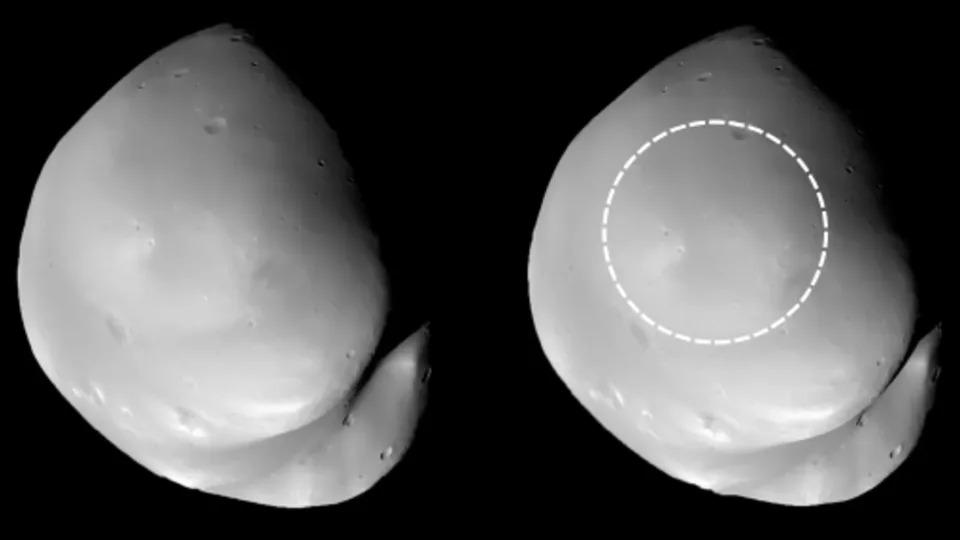
An ancient impact can be seen under the surface dust layer on Deimos. - S. D. Raducan/B. May/London Stereoscopic Company
'Our simulation thus shows that a single impact was sufficient to decisively shape the current landscape of Deimos,' said coauthor Dr. Martin Jutzi of the University of Bern.
Why Deimos Survived
Hera imagery still hints at faint outlines of buried, older craters beneath the dust layer. The simulations suggest that Deimos' interior is highly porous and fractured, more like a rubble-pile asteroid than a solid rock. This porosity would have damped seismic shocks from the impact, preserving sub-surface structures instead of allowing shock waves to erase them.
Predictions and Next Tests
The authors provide concrete, testable predictions for Japan's Martian Moons eXploration (MMX) mission, which is expected to arrive at the moons in 2027. MMX will map both satellites in detail, select a sampling site on Phobos, and return samples to Earth by 2031. Those observations and returned material should help confirm whether Deimos is a captured rubble-pile asteroid or formed from debris ejected from Mars.
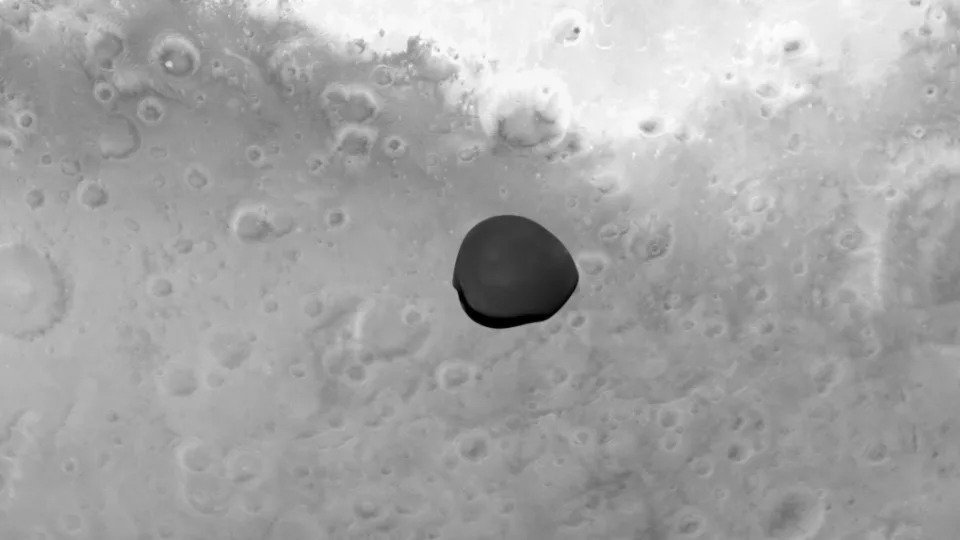
Deimos appears dark when framed by bright Mars from Hera's perspective. - ESA
Broader Implications
This work links observational imagery and physics-based modeling to offer a plausible origin for Deimos' unusual shape and surface. If validated by MMX, the result will not only clarify the moon's history but also shed light on early solar-system dynamics when impacts and captures were more common.
Study: Published in Nature Astronomy. Lead author: Dr. Sabina Raducan. Simulation tool: Bern SPH.
Help us improve.