The Sziget Festival returned to Budapest’s Danube island under a markedly different political climate after Peter Magyar’s election ended Viktor Orbán’s 16-year rule. Organisers said they no longer faced the bureaucratic “headwinds” of past years and reported greater cooperation from ministers on logistics. Attendance dipped to about 350,000 amid a regional heatwave, while EU court action lifted restrictions tied to a 2021 anti-LGBTQ law. Past clashes over artistic freedom—most notably the barring of Irish group Kneecap—remain part of the festival’s recent history.
Sziget Festival Embraces New Freedoms After Political Shift in Hungary
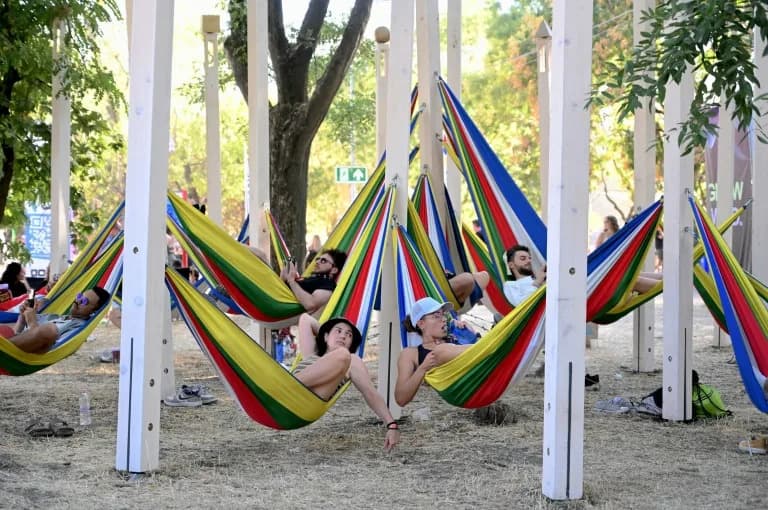
The Sziget festival, known for its open and inclusive vibe, sometimes found itself at odds with the previous government's "illiberal" vision (Attila KISBENEDEK)
Festivalgoers drifted between concert stages, lounged on hammocks and celebrated on Budapest's Danube island as one of Europe’s largest outdoor music events returned with a brighter political atmosphere for organisers and attendees alike.
The Sziget Festival, long known as the “Island of Freedom,” has built a reputation for openness, diversity and self-expression—values that sometimes clashed with the policies of Hungary’s previous government.
This year's edition followed a decisive April election victory by pro-EU conservative Peter Magyar, whose win ended Viktor Orbán’s 16-year rule. Organisers said the change in government translated into fewer bureaucratic obstacles and more constructive engagement from ministers on practical issues such as transport, healthcare and site visits during the festival.
Organisers Say The 'Headwinds' Have Eased
“We were able to do our job without headwinds blowing against us. That is a huge thing in itself,” said Tamas Kadar, head of the organisation that runs Sziget. Staff and volunteers also reported more openness from officials and an atmosphere of relief among many artists and advocacy groups.
“It feels like everything that's happened in the past six months comes to a head here,” said Greta Racz, a 27-year-old student who volunteered at a pro-democracy NGO tent. “Foreign visitors told us they were proud and asked how we experienced the change.”
Attendance, Line-Up and Programming
Founded in 1993, Sziget has recently drawn about 400,000 visitors; this year attendance fell to roughly 350,000, which organisers attributed in part to an intense heatwave. The week-long line-up featured Twenty One Pilots, Florence + The Machine, Lewis Capaldi and Sombr, alongside a wide range of cultural and advocacy spaces.
Advocacy, Legal Changes And Past Conflicts
As in previous years, the festival hosted venues promoting LGBTQ rights and other advocacy programs—elements organisers describe as part of “Sziget’s DNA.” Under the prior administration, those values brought scrutiny: a 2021 law restricting the "promotion of homosexuality" to minors forced ID checks at the long-running Magic Mirror venue to limit some events to adults.
The obligation to gate certain events was lifted after the European Union’s top court found the law incompatible with EU rules. Kadar also recalled a 2023 incident when the outgoing government barred Irish rap group Kneecap from performing and imposed a three-year entry ban on the band amid allegations of antisemitic hate speech—an episode organisers said underscored tensions over artistic freedom.
Organisers lamented that Sziget, one of Hungary’s largest tourism draws, received no state support over the past decade even after missing two editions because of the Covid-19 pandemic.
Atmosphere At The Festival
Attendees largely praised the festival’s atmosphere. “Sziget has always been a political bubble where everyone is friendly and liberal,” said 25-year-old finance worker Marton Szabo. Others said a change in government had made them feel less politically engaged for the moment: “Now that the government has changed, I'm much less interested. It's summer,” said 24-year-old Niki Liptak.
What Remains Clear: Sziget continues to blend music, culture and civic-minded programming—now with a reported easing of the political pressures that shaped previous editions.
Help us improve.