The ACLU has asked the U.S. Supreme Court to block a Texas law that requires the Ten Commandments (King James text) to be posted in every public-school classroom, arguing the mandate violates the Establishment Clause. Decisive precedent includes Stone v. Graham (1980), which struck down a similar posting law, and Mahmoud v. Taylor (2025), which protected parents' rights to religious upbringing. Some justices, notably Justice Clarence Thomas, favor a narrower reading of the Establishment Clause that would limit its reach against states. If the Court takes the case, the ruling could be a major separation-of-church-and-state decision.
ACLU Asks Supreme Court To Block Texas Rule Requiring Ten Commandments In Every Classroom
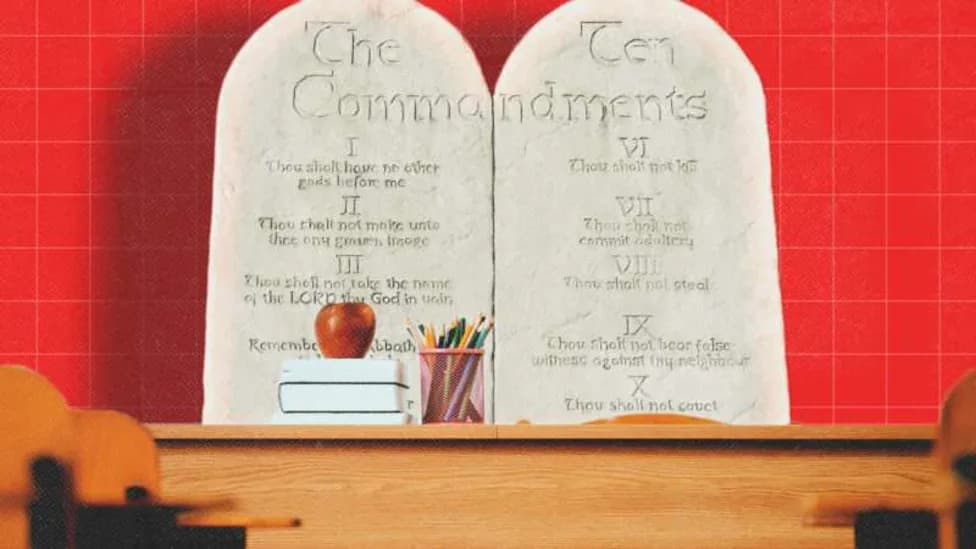
Illustration: ESBBasics/Envato/erika8213/Envato
The First Amendment prohibits government action "respecting the establishment of religion," yet Texas recently enacted a law requiring the text of the Ten Commandments (King James Version) to be posted in every public-school classroom. The central legal question is whether that mandate violates the Establishment Clause of the U.S. Constitution.
Earlier this week the American Civil Liberties Union (ACLU), representing several Texas families "of diverse faiths and beliefs — including Baha'ism, Christianity, Hinduism, Judaism, Unitarian Universalism, and nonreligious traditions — whose children attend Texas public schools," asked the U.S. Supreme Court to intervene and declare the law unconstitutional.
Legal Background
The challengers rely on established Supreme Court precedent. In Stone v. Graham (1980), the Court struck down a nearly identical Kentucky law requiring Ten Commandments postings in public school classrooms. The Court warned that such displays were not part of curricular instruction and risked encouraging students to "read, meditate upon, perhaps to venerate and obey, the Commandments," which is not a permissible state objective under the Establishment Clause.
"This is not a case in which the Ten Commandments are integrated into the school curriculum, where the Bible may constitutionally be used in an appropriate study of history, civilization, ethics, comparative religion, or the like. . . . If the posted copies of the Ten Commandments are to have any effect at all, it will be to induce the schoolchildren to read, meditate upon, perhaps to venerate and obey, the Commandments. . . . it is not a permissible state objective under the Establishment Clause."
More recently, in Mahmoud v. Taylor (2025), the Court emphasized that the Free Exercise and related protections can be violated when a school's actions "substantially interfere[] with the religious development" of a family's child or pose "a very real threat of undermining" parental efforts to impart religious beliefs and practices. The ACLU argues that a permanent, unavoidable display of biblical scripture in public classrooms plausibly creates that kind of interference.
How The Current Court Might Rule
Not all current justices accept the prevailing Establishment Clause framework. Justice Clarence Thomas has argued that the Establishment Clause should be read as a federalism provision that "resists incorporation," meaning it limits only federal power and not state governments under the Fourteenth Amendment. If the Court adopted that view fully, many state-level restrictions on government-sponsored religion could be weakened.
Other conservative justices have also criticized modern Establishment Clause doctrine as too hostile to religious expression by public officials, including teachers and coaches. Those perspectives could make the Court more receptive to upholding the Texas requirement in whole or in part.
Why This Case Matters
If the Supreme Court agrees to hear this challenge, it would mark one of the most consequential church-and-state disputes in years. The decision could reaffirm longstanding limits on government endorsement of religion, narrow those limits, or reshape how the Establishment Clause is applied to state and local governments.
Note: The ACLU filed the petition on behalf of families across a range of faiths and nonreligious traditions; the dispute centers on whether a statewide mandate to display religious text in classrooms crosses the constitutional line separating church and state.
Help us improve.