
The James Webb Space Telescope may have found a candidate "black hole star," MoM-BH*-1: a red, starlike source whose light appears powered by a central black hole rather than nuclear fusion. The object has an estimated mass of about 100,000 suns and may have formed within ~700 million years after the Big Bang. A dense hydrogen envelope could hide X-ray emission and reproduce the observed spectral features; if confirmed, similar red sources could explain the rapid early growth of supermassive black holes.
James Webb Finds Candidate 'Black Hole Star' — MoM-BH*-1 Could Rewrite Early-Universe Physics
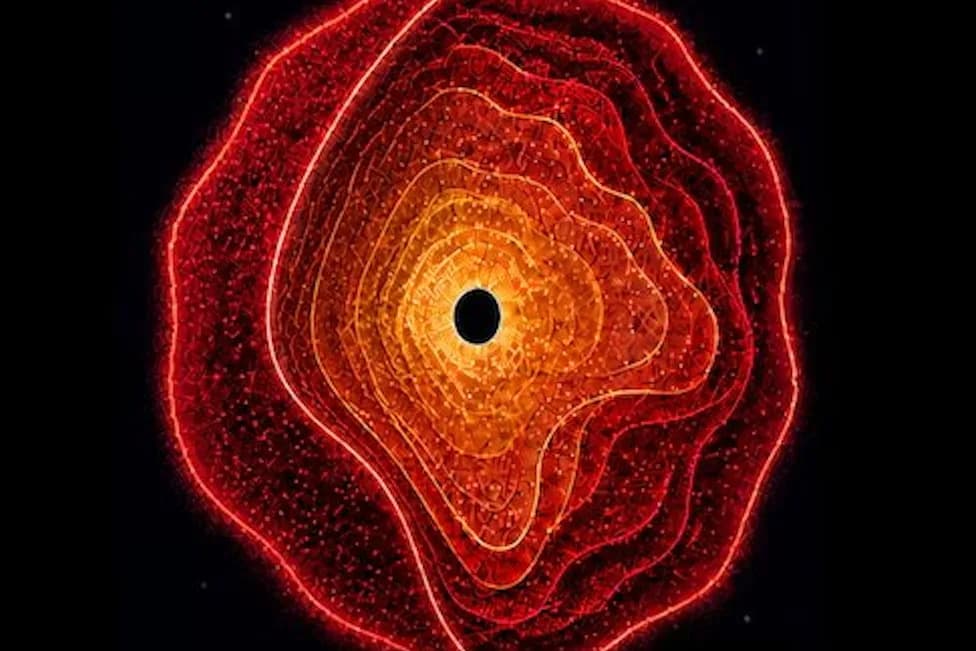
Photo Credit: X
The James Webb Space Telescope may have revealed a candidate for a rare and exotic object: a "black hole star" — a bright, starlike source whose emission appears to be powered not by nuclear fusion but by a black hole accreting material at its center.
What Astronomers Found
Researchers have designated the source MoM-BH*-1. Described in a paper published in Nature, the object appears red and carries an estimated mass equivalent to roughly 100,000 suns. It is surrounded by a very thick envelope of gas that, on a solar-system scale, can resemble the photosphere of a star.
How It Produces Light
Unlike ordinary stars, whose light comes from nuclear fusion, MoM-BH*-1's luminosity is thought to arise from a central black hole pulling in matter and releasing enormous energy. The study authors report that the central source could produce energy output on the order of 100 billion times that of a typical star, making the object extraordinarily luminous for its age and size.
"It is a very special thing to find an object with no comparison given the vast stores of data on billions of stars, galaxies, and black holes that we have in our archival databases." — Rohan Naidu, University of Hawai'i
Why It Looks So Red
Webb's observations showed an unusual dip in brightness at particular wavelengths — a feature often associated with dust absorption in young stellar sources. However, the team found no clear dust signatures. Their simulations indicate that a dense, hydrogen-rich shell enveloping an accreting black hole can reproduce the observed spectral features while suppressing the expected X-ray signatures.
Context And Implications
The idea of black hole–powered objects, sometimes called quasi-stars, dates back nearly two decades. Webb's deep infrared imaging recently uncovered numerous small red sources in the early universe that appeared too compact to be galaxies yet too bright to be ordinary stars. If many of those red dots are similar to MoM-BH*-1, this population could help explain how supermassive black holes grew so large within a few hundred million years after the Big Bang.
The object is believed to have formed within about 700 million years after the Big Bang. Follow-up observations, especially in X-rays and at higher spectral resolution, will be crucial to test the black hole-star interpretation and to distinguish it from alternative scenarios.
The Role Of Webb And Next Steps
This discovery highlights how next-generation observatories like JWST can reveal phenomena that older instruments missed. As astronomers continue mining Webb's archive and obtain targeted follow-up data, more such unusual objects may be identified — potentially reshaping our picture of the universe's first luminous sources.
Help us improve.





















