
LandSpace achieved a major milestone on Aug. 18, 2026, when the Zhuque-3 first stage landed upright on land using deployable legs, marking the first land recovery by a private Chinese orbital launcher. Launched from the Dongfeng Commercial Space Innovation Pilot Zone, the mission’s upper stage delivered the Honghu 03 satellite to its intended orbit. Zhuque-3 uses a LOX/liquid-methane (methalox) propulsion system and resembles SpaceX’s Falcon 9 in design and capability. The success highlights China’s growing push toward reusable rocket technology across state and private programs.
Touchdown: LandSpace's Zhuque-3 Lands Upright — First Land Recovery by a Private Chinese Orbital Rocket
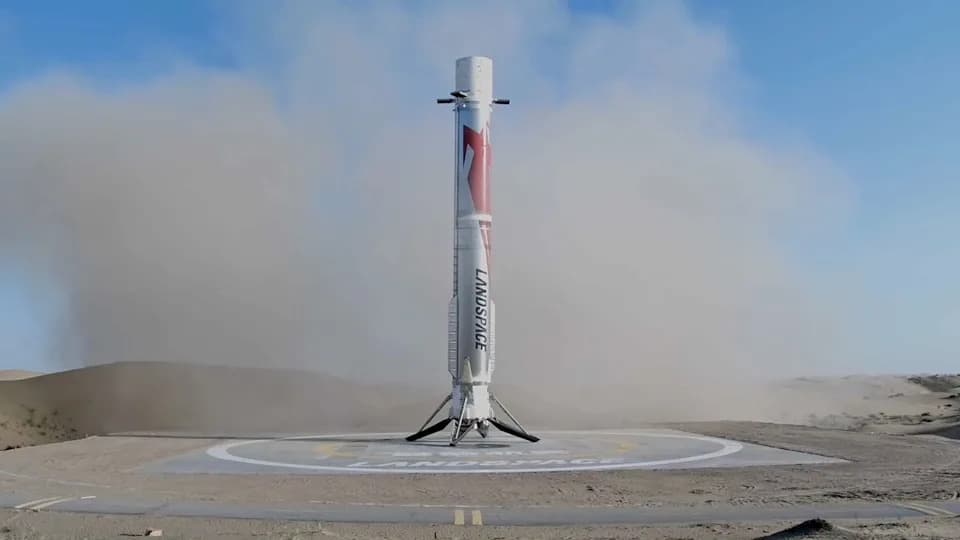
The first stage of LandSpace's Zhuque-3 rocket rests on its landing pad shortly after its historic touchdown on Aug. 18, 2026. | Credit: LandSpace
China marked a notable milestone in commercial spaceflight on Aug. 18, 2026, when Beijing startup LandSpace successfully landed the first stage of its Zhuque-3 rocket upright on land. The reusable booster returned to a designated pad using deployable landing legs, a method familiar from SpaceX’s Falcon 9 operations.
Launch and Landing Details
Zhuque-3 lifted off from the Dongfeng Commercial Space Innovation Pilot Zone in northwest China at 7:35 p.m. EDT (2335 GMT; 7:35 a.m. on Aug. 19 Beijing time). This was the vehicle’s second flight: its maiden launch on Dec. 2, 2025, saw the upper stage reach orbit but ended in a failed booster recovery when the stage experienced what state media described as an "abnormal combustion" and exploded near the landing pad.
On Aug. 18, the mission was an unambiguous success. The first stage touched down upright on solid ground and remained stable, while the expendable upper stage delivered the Honghu 03 satellite, built by Hongqing Technology, to its intended orbit.
Why This Matters
LandSpace says this flight "marks China's first-ever successful recovery attempt of the first stage of an orbital-class launch vehicle using landing legs, and China's first successful booster recovery on land." The company characterized the test as a transition from technology demonstration to an engineering application phase for reusability, validating the design and operational maturity of the Zhuque-3 reusable systems.
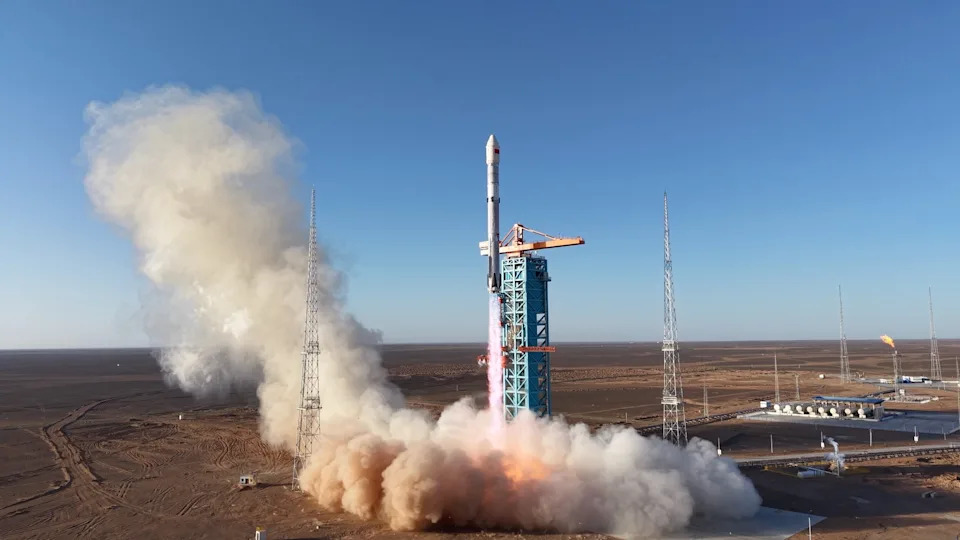
LandSpace's Zhuque-3 rocket launches on its second-ever mission on Aug. 18, 2026. The flight was a success, and Zhuque-3's first stage returned to Earth for a landing — the first ever for a private Chinese orbital rocket. | Credit: LandSpace
How Zhuque-3 Compares
Visually and conceptually, Zhuque-3 resembles SpaceX's Falcon 9: both use a reusable first stage with an expendable upper stage and are similar in height — roughly 216 feet (66 m) for Zhuque-3 versus about 230 feet (70 m) for Falcon 9. Payload capacity is comparable: Zhuque-3 can lift about 40,350 pounds (18,300 kg) to low Earth orbit, while Falcon 9's LEO capacity is roughly 50,265 pounds (22,800 kg). However, the two rockets use different propellants: Falcon 9 runs on liquid oxygen and RP-1 (rocket-grade kerosene), whereas Zhuque-3 uses a liquid-oxygen/liquid-methane (methalox) combination — the same propellant family that SpaceX’s Starship also employs.
Context: China’s Push Toward Reusability
This success comes amid a broader push across China’s state and private sectors to develop reusable launchers. The state-owned China Aerospace Science and Technology Corporation (CASC) achieved an earlier orbital-class booster recovery on July 10 with a Long March 10B, which was retrieved via a net-like device on a ship. CASC is also developing reusable-capable Long March 12A and 12B boosters; the Long March 12A’s December 2025 debut delivered its second stage to orbit but did not achieve a successful booster landing.
Private firms including CAS Space, Deep Blue Aerospace, Galactic Energy, iSpace, Orienspace and Space Pioneer are likewise developing recoverable first stages. With multiple teams testing landings, successful Chinese booster recoveries could become routine within a short time.
LandSpace Comment: "This mission further verified the design correctness and reliability of the Zhuque-3 reusable launch vehicle system, validated its first-stage recovery capability and engineering maturity," the company wrote on X.
What’s Next
LandSpace will likely continue flight tests to refine turnaround operations, reuse procedures and reliability before moving to frequent operational missions. As more Chinese providers validate reusable hardware, launch costs and cadence in the region may shift — mirroring the global impact reusable boosters have had since Falcon 9 began regular landings in 2015.
Help us improve.





















