
JWST's NIRSpec has identified MoM‑BH*-1, a compact object 13.1 billion light-years away whose spectrum mimics a star while concealing a supermassive black hole of roughly 100,000 solar masses. The source radiates an estimated 100 billion times more energy than stellar fusion can produce, shows one of the largest hydrogen Balmer breaks on record, and contains almost no heavy elements. While the Nature paper presents a strong quasi-star interpretation, alternatives (compact galaxies or unusual AGN) remain plausible and follow-up X-ray and radio observations are required.
JWST Detects First 'Black Hole Star' — A Supermassive Black Hole Masquerading as a Star 13.1 Billion Light-Years Away
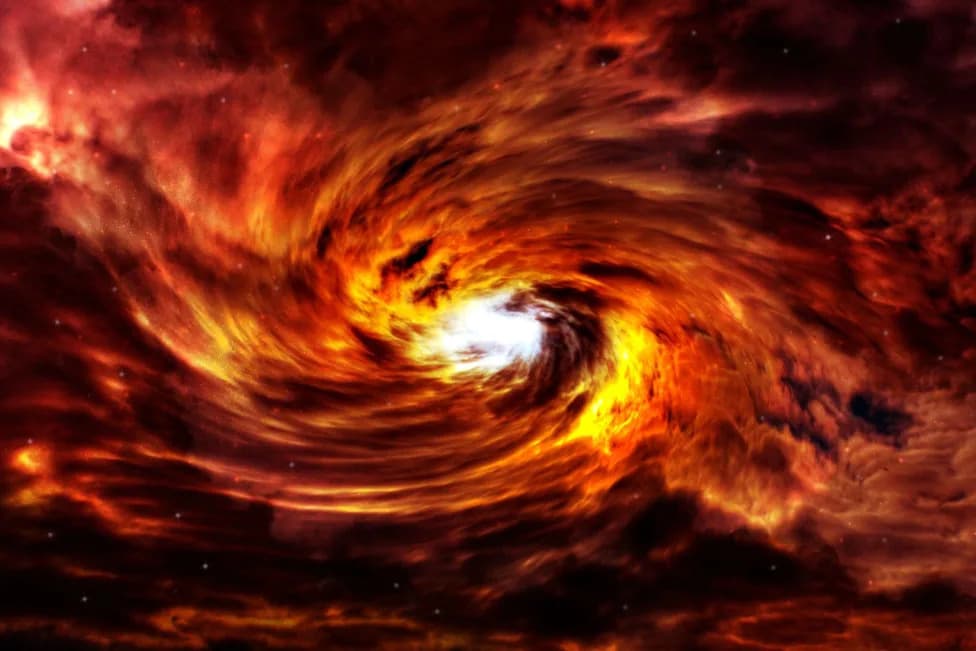
Image: Deposit Photos
In a paper published in Nature on August 12, 2026, astronomers report the discovery of MoM‑BH*-1: a compact, star-like object whose spectrum hides a far stranger engine — a supermassive black hole cloaked in an ultra-dense hydrogen envelope. The finding comes from the James Webb Space Telescope's NIRSpec instrument as part of the "Mirage or Miracle" survey.
What the Team Found
MoM‑BH*-1 appears roughly the size of our solar system but radiates an estimated 100 billion times more energy than stellar nuclear fusion can produce. The authors interpret the data as a nested structure: a ~100,000-solar-mass black hole at the core, surrounded by an optically thick hydrogen shroud that absorbs the black hole's output and reradiates it with a star-like spectral signature — a theorized object often called a "quasi-star." The light detected by JWST left the source about 660 million years after the Big Bang, placing the object roughly 13.1 billion light-years away in the constellation Cetus.
Key Evidence
- Enormous Energy Output: The object's luminosity is modelled to be ~100 billion times greater than what fusion alone can account for.
- Pronounced Hydrogen Balmer Break: The spectrum shows one of the largest Balmer breaks ever recorded, a sharp drop in brightness that ordinary stellar populations cannot reproduce.
- Pristine Composition: The spectrum contains virtually no heavy elements, consistent with primordial hydrogen gas in the early universe.
- Host Galaxy Suppressed: The source outshines its host galaxy so completely that the galaxy's signature is almost erased from the data.
'The black hole star is essentially completely outshining its surrounding host galaxy, such that we're seeing pure black hole star light.' — Rohan Naidu, University of Hawaiʻi Institute for Astronomy
Why This Matters
If MoM‑BH*-1 really is a quasi-star, it provides a natural pathway for rapid early growth of supermassive black holes, helping explain how billion-solar-mass black holes appeared so soon after cosmic dawn. Quasi-stars would act as efficient, obscured growth engines that standard star-formation or slow accretion models struggle to produce quickly enough.
Uncertainties and Next Steps
The Nature paper makes a compelling case but stops short of a definitive detection of accretion. The authors and independent researchers note that alternative explanations — extremely compact, unusual star-forming galaxies or atypical active galactic nuclei (AGN) — have not been fully ruled out. Conclusive confirmation requires follow-up in other bands: sensitive X-ray and deep radio observations to detect accretion signatures, and continued JWST spectroscopy to refine the envelope and black hole parameters.
Bottom Line
MoM‑BH*-1 is the most convincing candidate to date for a "black hole star" or quasi-star: a supermassive black hole hidden beneath a dense hydrogen cloak that mimics a stellar spectrum. The discovery opens a new observational window on the first billion years of cosmic history and, if such objects are common, could force revisions to models of early black hole formation and growth.
Published: Nature, 12 August 2026. Instrument: JWST NIRSpec. Survey: "Mirage or Miracle." Lead author: Rohan Naidu (University of Hawaiʻi Institute for Astronomy).
Help us improve.





















