
Researchers simulated a 1‑megaton standoff nuclear detonation against a 160‑metre, Bennu‑like asteroid and found X‑rays — which can carry 70–80% of a nuclear blast’s energy — can vaporize surface material and drive internal shock waves, causing widespread damage and potential fragmentation. In one scenario 98.2% of the modeled material was damaged and ~97% exceeded escape velocity within 145 ms. Simulations covered only milliseconds and were computationally costly, so the long‑term fate of fragments remains uncertain.
Could a Nuke Stop a 'City‑Killer' Asteroid? New Simulations Suggest It Might
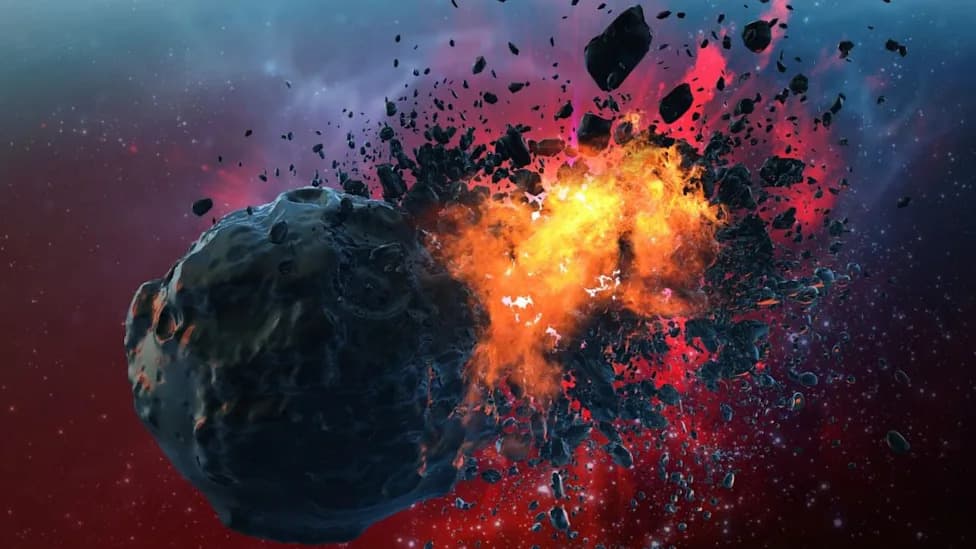
(Victor Habbick Visions/Science Photo Library/Getty Images)
If an asteroid roughly the size of a football field were to strike Earth, it could obliterate a city. Detecting some of these dark, low‑reflectivity objects is challenging, and conventional mitigation — gentle nudges or a planetary shield — isn't always possible. That has led researchers to investigate more extreme last‑resort options.
A team led by astrophysicist Isaiah Santistevan at Lawrence Livermore National Laboratory ran high‑fidelity three‑dimensional simulations to test whether a standoff nuclear detonation could disrupt a 160‑metre (525‑ft) “city‑killer” asteroid modeled on the rubble‑pile structure of Bennu. The device simulated was a 1‑megaton explosion placed a short distance from the rock rather than on its surface.

YouTube Thumbnail
How a Nuclear Standoff Could Work
Contrary to popular imagination, the effect is not primarily a gas‑carried shockwave — space is a vacuum and cannot transmit blast waves like an atmosphere can. Instead, the simulations show that ionizing radiation, especially X‑rays, is the dominant coupling mechanism. About 70–80% of a nuclear detonation’s energy can be emitted as X‑rays; those X‑rays deposit energy in a thin surface layer, rapidly heating, vaporizing and ablating material.
As the surface material vaporizes it expands violently. If the vaporized mass can overcome the asteroid’s local gravity it will be ejected, imparting a reactive impulse that changes the asteroid’s momentum. At the same time, the intense, short‑duration radiative pulse drives stress waves into the interior that can crack and fragment the body from within.
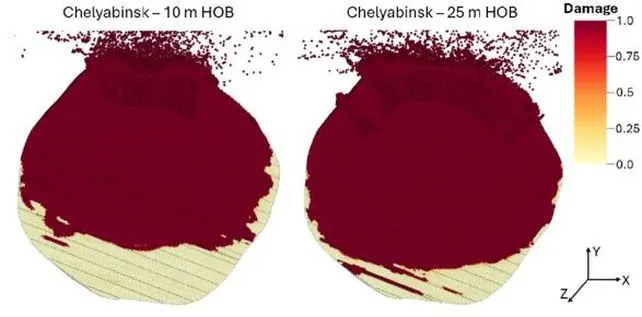
Simulated asteroid damage 68 milliseconds after a nuclear detonation 10 meters (left) and 25 meters (right) above the surface. Surprisingly, the more distant explosion produced more widespread damage in a model of the Chelyabinsk meteorite. (Santistevan et al.,Planet. Sci. J., 2026)
"These X‑rays deposit energy in a thin surface layer of the asteroid, driving vaporization and ablation," the authors write. "The vaporized material expands, and if it can overcome the local gravitational field, it is ejected, which imparts a change in momentum that alters the asteroid’s velocity."
Key Simulation Results
The researchers ran three scenarios that varied the standoff distance and the asteroid’s fracture properties (parameters informed by Chelyabinsk and Aba Panu meteorites). Highlights include:
- With the 1‑megaton device 10 metres above the surface, 98.2% of the asteroid material in the model became fully damaged, and roughly 97% of the mass was accelerated above escape velocity within the 145‑millisecond simulated window.
- A detonation 25 metres away illuminated a broader surface area and — somewhat counterintuitively — produced more widespread damage at an early snapshot (92.6% damaged at 68 ms versus 78.1% for the 10‑m case at the same time), suggesting that closer is not always better.
- The radiative pulse also drove internal stress waves that fractured the simulated rubble‑pile structure, enabling the rock to pull apart in opposing directions in some runs.
Caveats and Next Steps
These simulations were computationally intensive: the longest run simulated only 145 milliseconds of physical time but required 59 days on 1,680 processors. Because of that limitation, the team could not follow the long‑term fate of fragments. After the initial disruption, pieces might disperse harmlessly, reaccumulate under gravity, or fragment into smaller but still hazardous projectiles.

Subscribe to ScienceAlert's free fact-checked newsletter
The authors stress that their work is an important step toward realistic nuclear mitigation modeling for planetary defense — but not a final answer. Longer‑duration simulations, additional fracture models, and international policy and operational planning would all be required before such an option could be considered in practice.
The study was published in The Planetary Science Journal and represents a significant advance in understanding how radiative coupling and interior fracturing influence the effectiveness of standoff nuclear detonations against rubble‑pile asteroids.
Help us improve.





















