
Using JWST’s MIRI and NIRCam, astronomers obtained the first continuous mid-infrared spectrum of the AGB star IRS 3 and its dusty envelope, detecting silicate dust, oxygen-bearing molecules and water. IRS 3 lies only ~0.55 light-years from Sagittarius A* and launches winds of ~15 km/s that have created a dusty shell reaching ~10,000 AU. Modeling suggests the star began with ~6 solar masses and is ~72 million years old, demonstrating that stellar enrichment can persist close to a supermassive black hole.
JWST Detects Water and Dust Surviving Surprisingly Close to the Milky Way’s Black Hole
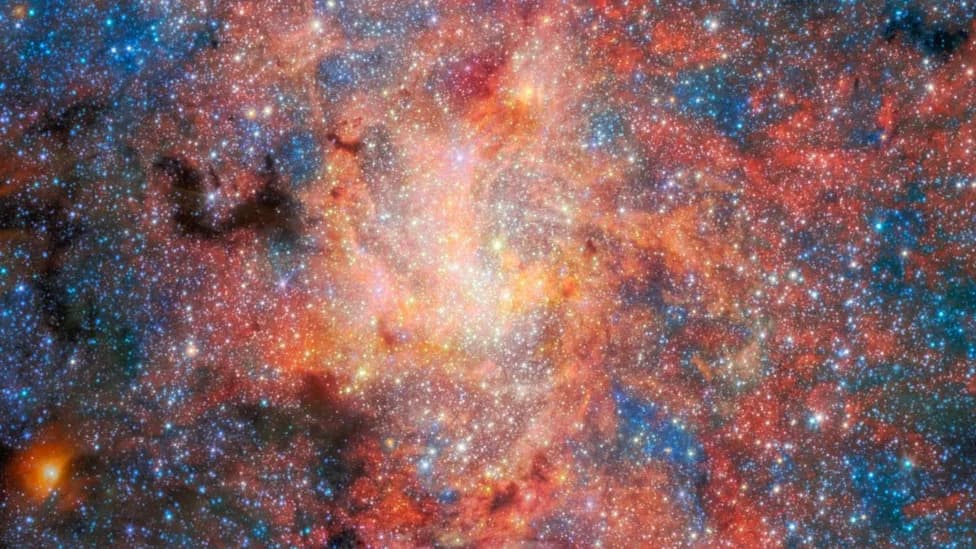
The field that holds the evolved, dying star IRS 3. (ESA/Webb/NASA/CSA/F. Peißker/J. Lu/F. Yusef-Zadeh/N. B. Sabha/C. Chan)
At the center of the Milky Way, a supermassive black hole dominates its surroundings — yet new observations from the James Webb Space Telescope show that even in this extreme environment a dying star is still returning chemically rich material to its neighborhood.
The target, IRS 3, is an asymptotic giant branch (AGB) star in the late stages of stellar evolution. Using Webb’s Mid-Infrared Instrument (MIRI) and Near-Infrared Camera (NIRCam), astronomers obtained the first continuous mid-infrared spectrum of the star and its dusty envelope, revealing clear signatures of silicate dust, oxygen-bearing molecules and — notably — water in the ejecta.
What the Observations Show
IRS 3 drives powerful stellar winds that push its outer layers into space at roughly 15 km/s. Those winds have produced an enormous dusty envelope extending to about 10,000 astronomical units (AU). Remarkably, IRS 3 lies only ~0.55 light-years from Sagittarius A*, the ~4-million-solar-mass black hole at our galaxy’s center.
Because galactic centers are bathed in intense radiation and dynamical forces, it was unclear whether fragile molecules and dust could survive there. The Webb spectra, combined with modeling and evidence for a bow shock where the star’s envelope collides with surrounding gas, show that dust production and molecular survival are possible even under these harsh conditions.
Inferred Properties and Implications
From spectral fits and hydrodynamic modeling, the team estimates IRS 3’s initial mass at roughly 6 solar masses and an age on the order of 72 million years. The star’s effective temperature is about 2,800 K (≈2,530 °C / ≈4,580 °F), yet it may shine with a luminosity on the order of 60,000 times that of the Sun. The star appears to have produced multiple concentric shells of ejecta spaced by hundreds of years, possibly tracing mass loss over the past ~5,000 years.
“The detection of water is especially exciting because it shows that molecular material can survive in an environment dominated by intense radiation,” says Macarena Garcia Marin (ESA, MIRI team), co-author of the study.
The results indicate that AGB stars can continue to enrich the central regions of galaxies with dust and molecules — including water — even within a few light-years of supermassive black holes. Those star-borne ingredients mixed with energetic radiation and shocks may drive complex chemistry and the formation of novel molecules or grains in galactic nuclei.
The study detailing these findings was published in Astronomy & Astrophysics.
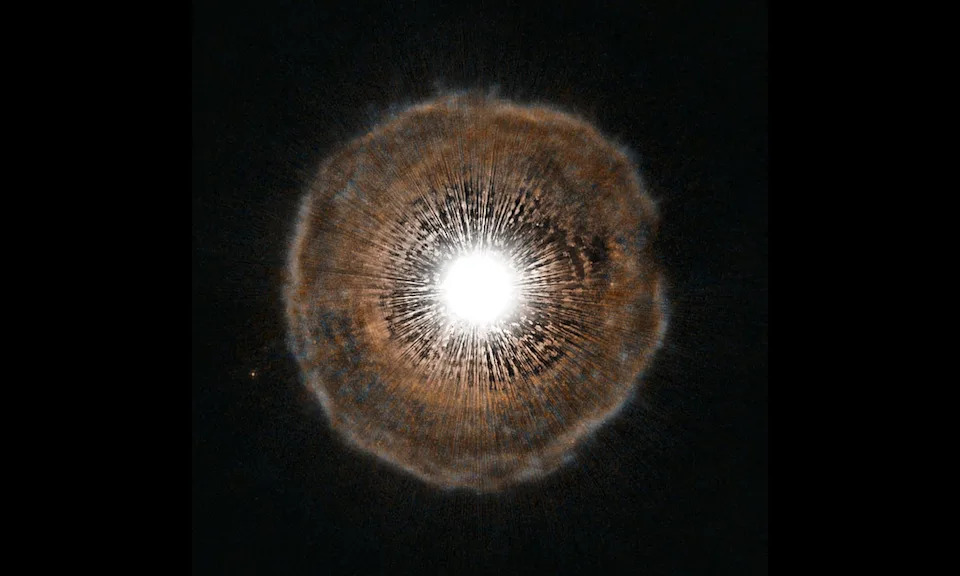
The dying star U Camelopardalis losing its outer layers, as imaged by the Hubble Space Telescope.(ESA/Hubble/NASA/H. Olofsson (Onsala Space Observatory))
YouTube Thumbnail
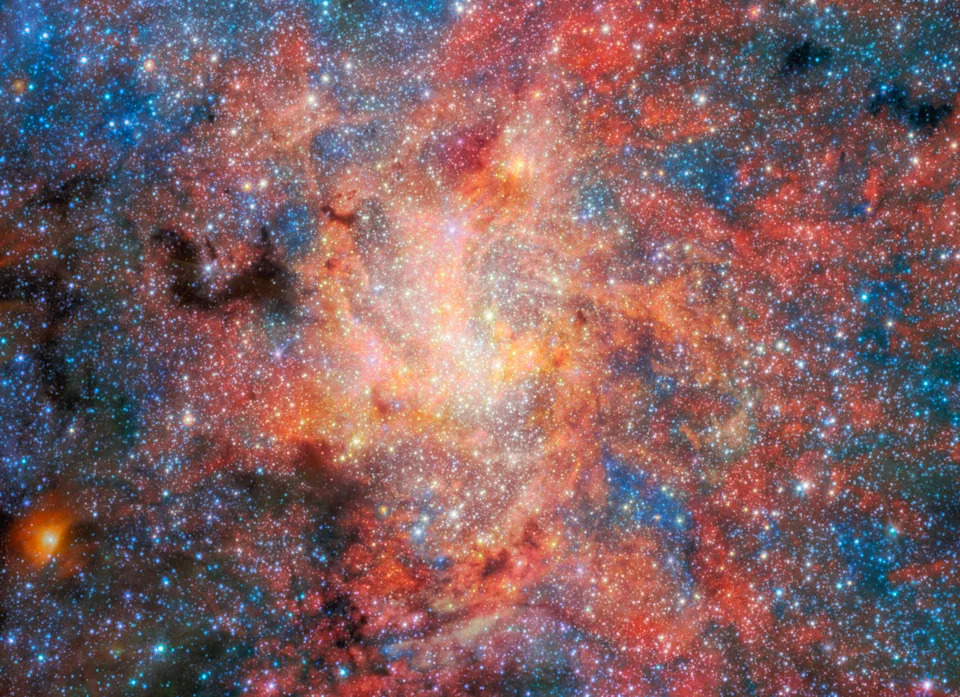
The cosmic region containing IRS 3, captured with JWST's NIRCam (Near Infrared Camera) and MIRI.(ESA/Webb/NASA/CSA/F. Peißker/J. Lu/F. Yusef-Zadeh/N. B. Sabha/C. Chan)
The central region of our Milky Way, part of the most detailed view of our galactic center ever observed, courtesy of the Euclid space telescope.(ESA/Euclid/Euclid Consortium/NASA, CFHT, image processing by J.-C. Cuillandre and E. Bertin (CEA Paris-Saclay))
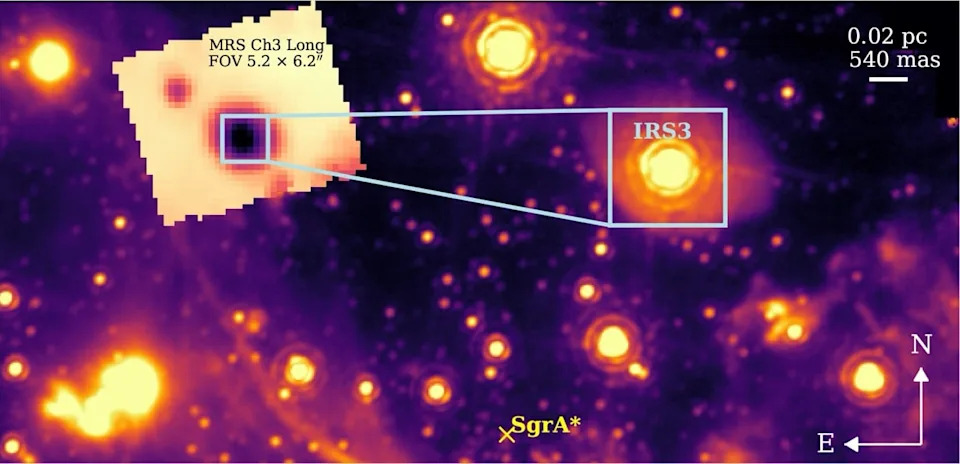
An image in mid-infrared wavelengths showing IRS 3 among the jumble of our galactic center.(Peißker et al.,A&A, 2026)

Subscribe to ScienceAlert's free fact-checked newsletter
YouTube Thumbnail
Help us improve.





















