President Xi Jinping led a ceremony at the Great Hall of the People to mark the 100th anniversary of Jiang Zemin's birth, highlighting Jiang's role in China’s market reforms and global opening. Xi used a 40-minute address to urge the Communist Party to carry forward Jiang's legacy while warning of mounting risks ahead. State media aired a 12-part documentary and the central bank plans commemorative coins, underscoring official efforts to recast Jiang's reform-era legitimacy amid a shift toward state-led policy.
Xi Leads Centenary Tribute to Jiang Zemin, Framing Legacy Amid Shift Toward State-Led Policy
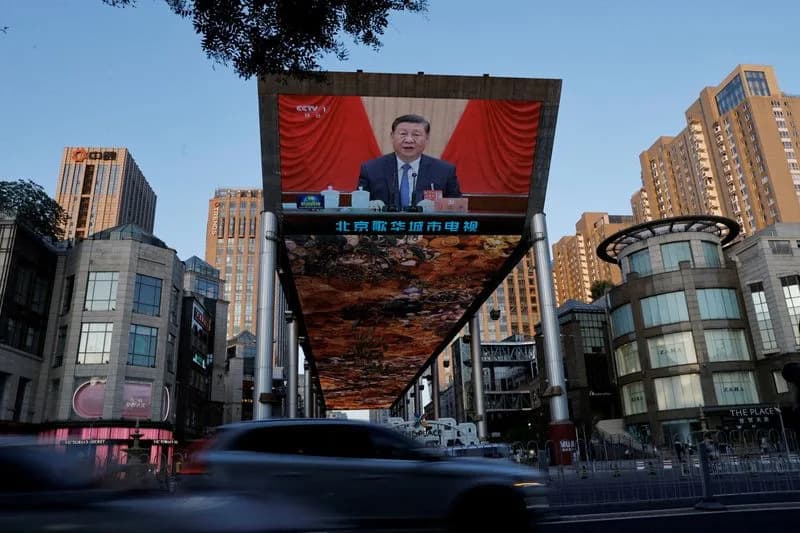
FILE PHOTO: A giant screen shows news footage of Chinese President Xi Jinping attending the third plenary session of the 20th Central Committee of the Communist Party of China (CPC), in Beijing, China July 18, 2024. REUTERS/Tingshu Wang/File Photo
BEIJING — President Xi Jinping and senior Chinese officials gathered on Monday in the Great Hall of the People to mark the 100th anniversary of the birth of former leader Jiang Zemin, who presided over a pivotal era as China transformed from a peripheral economy into a global growth engine.
Jiang, who died in 2022 at age 96, is credited with steering China through a decade of rapid expansion after the 1989 Tiananmen crackdown. His longtime governing partner, the pragmatic former premier Zhu Rongji, died last week; Zhu's funeral was scheduled for Tuesday.
Legacy of Market Reform
The commemorations underscored Jiang's role in a period of fast-paced market reforms in the 1990s and early 2000s that emphasized private entrepreneurship and wealth creation. Under Jiang and Zhu, Beijing implemented difficult but consequential measures: closing chronically loss-making state firms, replacing the old welfare housing system with a commercial property market, weathering the Asian financial crisis of the late 1990s, and securing China's accession to the World Trade Organization in 2001.
Xi's Message and Political Significance
In a roughly 40-minute address, Xi urged the Communist Party to carry Jiang's legacy forward and framed the current leadership as inheriting aspects of Jiang's political and ideological project. State media amplified that theme in coverage ahead of the event, signaling an official effort to link past reform-era legitimacy with today's leadership.
“On the new journey ahead, we must heighten our sense of vigilance against potential dangers,” Xi said. “With an indomitable fighting spirit and superb skill in struggle, we must proactively meet the major tests posed by high winds and rushing waters, or even by raging storms.”
Analysts note a clear contrast between Jiang's market-oriented reforms and Xi's approach, which emphasizes stronger central control and a state-led economic strategy focused on technological self-reliance and strategic industries.
Who Attended—and Who Was Missing
Events featuring Xi are closely watched for clues about elite politics and the health of retired leaders. Former president Hu Jintao, Jiang's immediate successor and now 83, did not immediately appear in state footage of the ceremony. Visible attendees included Hu's former premier Wen Jiabao and ex-vice president Wang Qishan, once Xi's anti-corruption czar — a sign they remain within the leadership's circle despite recent probes involving some associates.
Cultural Echoes and Public Reaction
State broadcaster CCTV aired a 12-part prime-time documentary series on Jiang's life ahead of the anniversary. The programme recalled both Jiang's early days as a student protester and his decision in 1989 to order the closure of a reformist Shanghai newspaper after it expressed support for the pro-democracy demonstrations. The account also notes that the internet arrived in China under Jiang in the mid-1990s, followed within years by the construction of the so-called Great Firewall to limit access to content deemed destabilizing.
Despite his role in suppressing dissent, Jiang has retained a measure of popular affection among some Chinese netizens as a symbol of an era when rapid growth produced tangible everyday improvements. Online, he is often nicknamed “the Elder,” and younger admirers have embraced his more personable traits: a Soviet-trained ex-automobile factory manager who enjoyed singing and once recited the Gettysburg Address from memory in English.
Last week the People's Bank of China announced plans to issue commemorative coins bearing Jiang's likeness later this month to mark the centenary — a move that excited his online fan base and generated jokes about how hard the coins will be to obtain.
(Reporting by Beijing Newsroom; Editing by Philip McClellan and Stephen Coates)
Help us improve.