
The Helix Nebula reveals how material shed by a dying star is stripped, fragmented and mixed into interstellar gas. New Hα images show at least 22 bow-shaped shocks whose size and clarity decline with distance, implying coherent fragment-and-bow structures last on the order of 10,000 years (e-folding ≈ 7,000 years). Shock and ejecta speeds are estimated at 80–90 km/s and 35–45 km/s, respectively, placing some clumps at ages of ~20,000–30,000 years. The observations—made with the partly completed MOTHRA array—offer a direct benchmark for how stellar ejecta return to the galaxy.
Helix Nebula Shows How Dying-Star Debris Is Torn Apart and Recycled Into Interstellar Gas
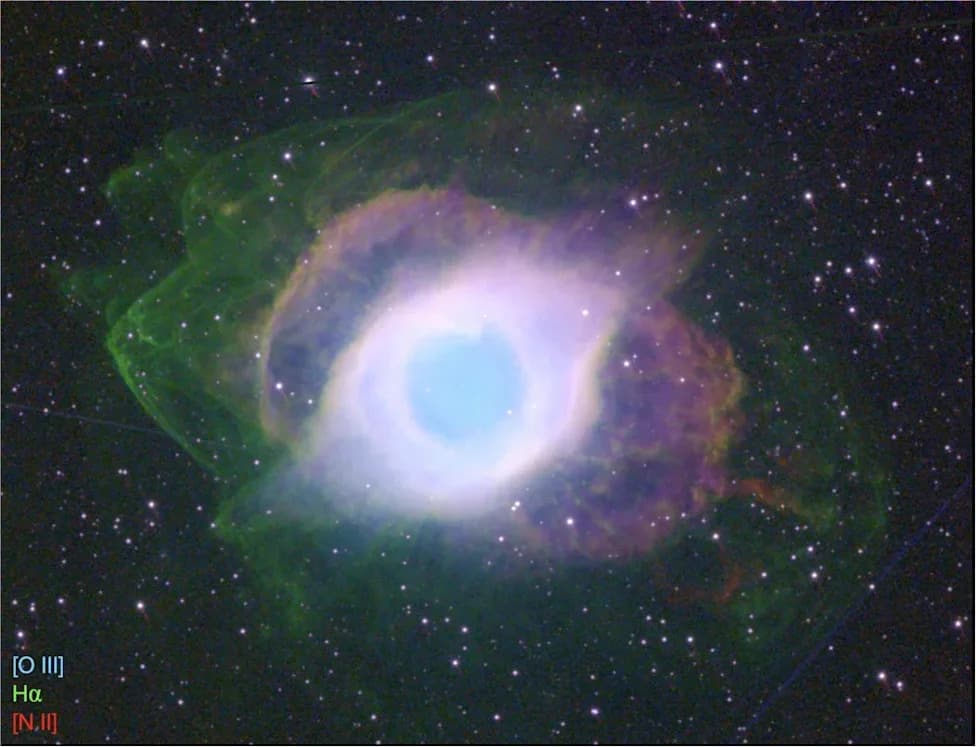
Color representation of the Helix Nebula. (CREDIT: Pieter van Dokkum et al, Nature)
The Helix Nebula is providing a rare, direct view of how material cast off by a dying star is shredded and mixed into the gas between stars. New hydrogen-alpha (Hα) imaging reveals an extensive network of bow-shaped shocks and fragments on the nebula's eastern flank that become progressively smaller, fuzzier and more fragmented with distance from the central white dwarf.
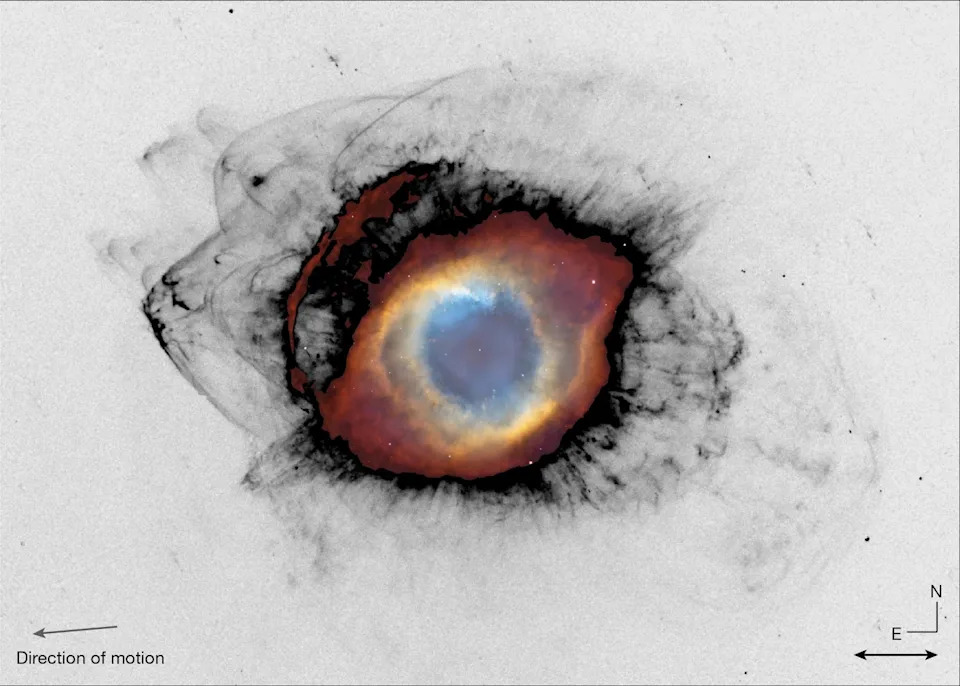
MOTHRA Hα imaging of the Helix Nebula. (CREDIT: Pieter van Dokkum et al, Nature)
Key Findings
An international team led by Pieter van Dokkum (with collaborators including researchers affiliated with Northwestern University) identified at least 22 complete or partial bow-shaped arcs visible in Hα. These arcs trace mostly invisible, dense clumps of stellar ejecta as they plow through thin interstellar gas. The arcs act like boat wakes, lighting up the surrounding gas even when the clumps themselves are too faint to see directly in the observed emission lines.
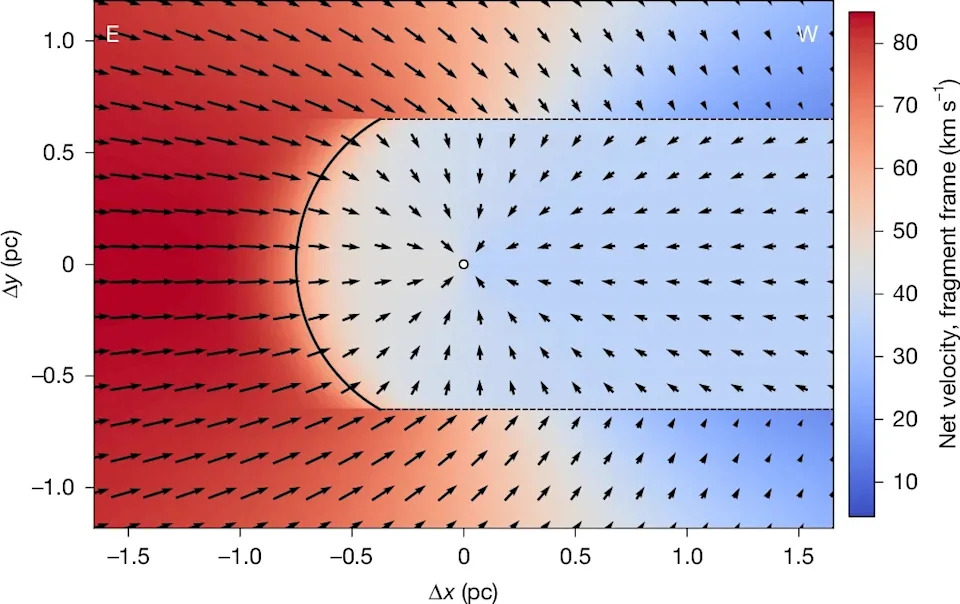
Schematic velocity field around the Helix, for a bulk velocity with respect to the ISM of vISM = 45 km s−1 eastward, a postshock flow velocity of vwake = 5 km s−1 and a radial expansion velocity of the ejecta of vexp = 40 km s−1. (CREDIT: Pieter van Dokkum et al, Nature)
Shock-model fits indicate shock speeds of roughly 80–90 km/s on the eastern side. After correcting for the nebula's motion through the interstellar medium, the team estimates the ejecta are expanding at about 35–45 km/s. At distances near one parsec these speeds imply clump ages of roughly 20,000–30,000 years, older than the planetary nebula itself (≈12,000 years). The material therefore most likely derives from an earlier envelope lost during the star's asymptotic giant branch (AGB) phase.
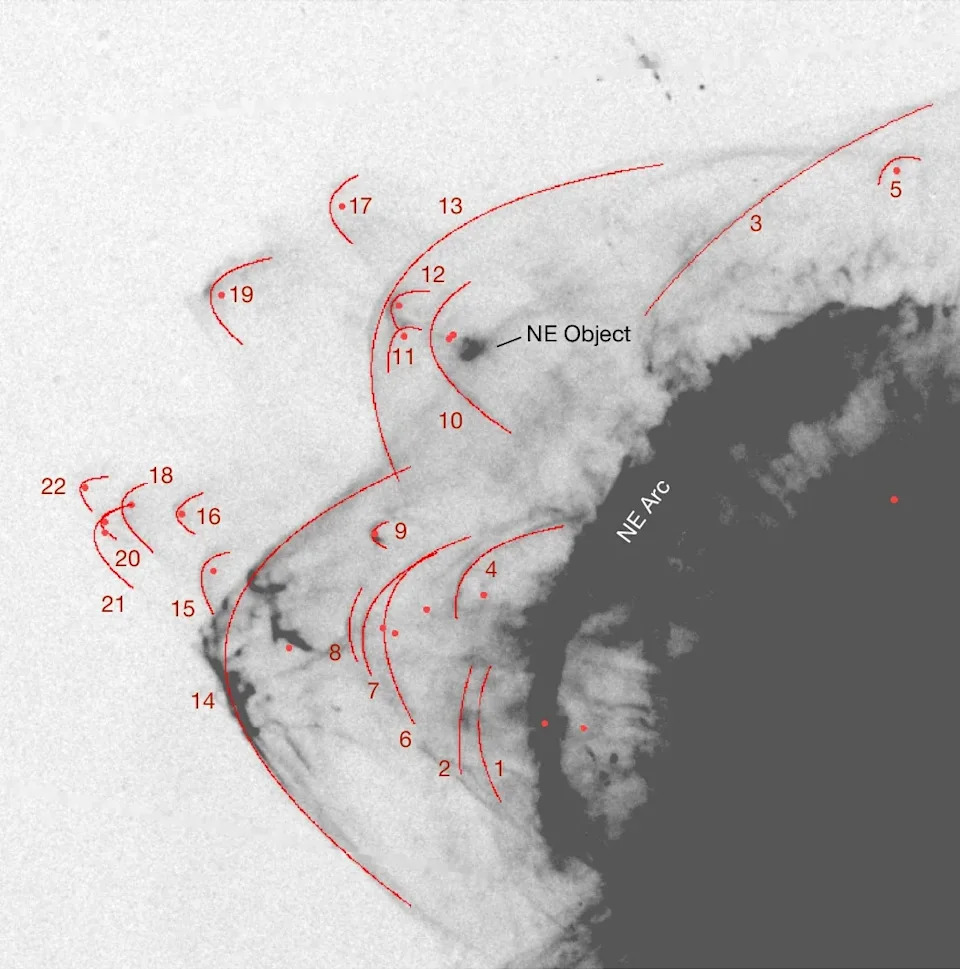
Twenty-two complete and partial bow shocks are identified in the Hα image. They are fitted with parabolas, indicated with the red lines. (CREDIT: Pieter van Dokkum et al, Nature)
The bow-shock characteristic scale declines by about two orders of magnitude between roughly 0.4 and 1.4 parsecs from the white dwarf, a progression the authors interpret as steady stripping and fragmentation of dense clumps. From this change the researchers estimate that the visible, coherent fragment-and-bow structures survive on the order of 10,000 years, with an e-folding time for the decline in bow-curvature scale near 7,000 years. The authors emphasize this timescale refers to how long dense fragments and their visible bows remain coherent once exposed to the diffuse medium—not a direct mass-loss rate measurement.
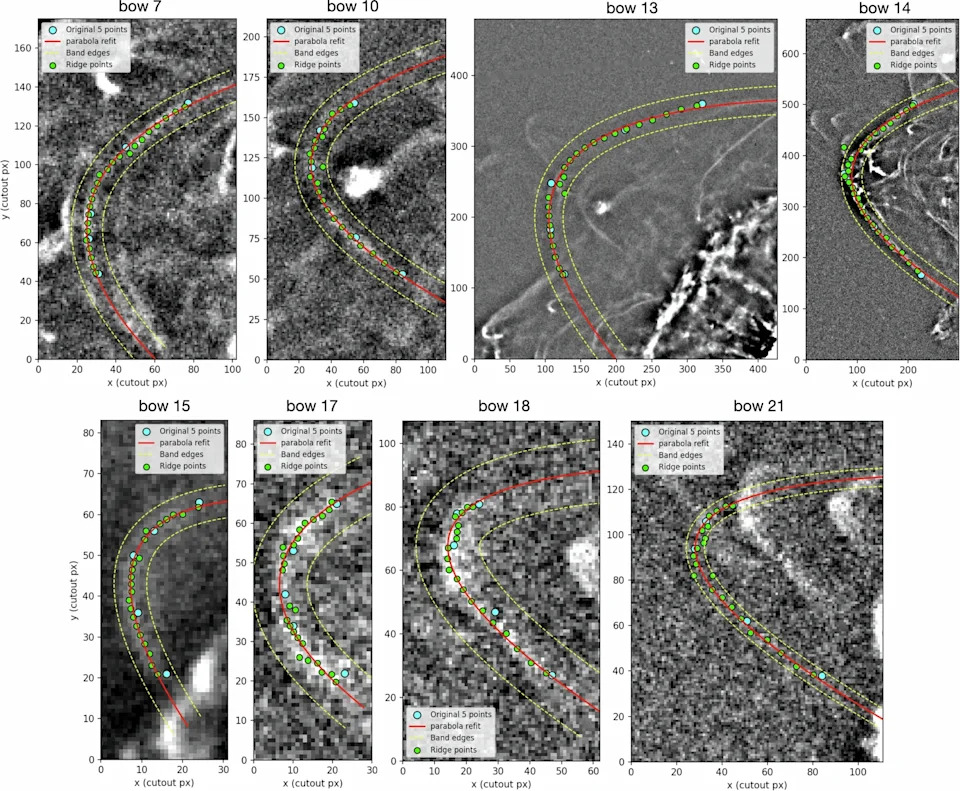
Eight bows covering a range of distances from the white dwarf are shown, in unsharp masked Hα images. For each bow, blue points show the initial manual definition of the structure. (CREDIT: Pieter van Dokkum et al, Nature)
“The shocks change dramatically with the distance from the central star,” said co-author Imad Pasha. “Those nearer the center are large, thin and sharply defined. Farther out, they become smaller, fuzzier and increasingly fragmented.”
“We thought we were taking a calibration image of one of the best-known nebulae in the sky,” said co-author Roberto Abraham. “Instead, we found this extraordinary network of bow-shaped structures.”
How the Structures Were Detected
The discovery arose while testing MOTHRA (Modular Optical Telephoto Hyperspectral Robotic Array) at El Sauce Observatory in Chile. Although the array was only partly assembled for these observations, it revealed faint ionized-gas structures not previously seen. When complete, MOTHRA will comprise 1,140 high-end telephoto lenses with specialized filters—optically equivalent to a 4.8-meter f/0.08 refractor and optimized to detect extremely faint emission across large sky areas. The Helix result corresponds to roughly 20 minutes of on-source exposure with the completed array, suggesting similar features could be discovered around other planetary nebulae with modest observing time.
Broader Significance
These observations fill a missing step in how galaxies recycle gas, dust and newly made elements: they catch dense stellar ejecta in the act of being dismantled and mixed into the interstellar medium. The result provides an empirical timescale for a previously elusive stage of stellar recycling, and a useful benchmark for galaxy-formation and chemical-evolution models that must treat unresolved mixing. The largely invisible clumps might also be detectable via molecular tracers—such as CO rotational lines or the H2 2.12 μm line—which would help test how fragment survival depends on shock velocity and environment.
Publication: The full study is available in Nature. Related work includes James Webb Space Telescope imaging of the Helix, ultraviolet studies of wind–ISM interactions around AGB stars, and far-infrared surveys of bow shocks and detached shells around evolved stars.
Help us improve.





















