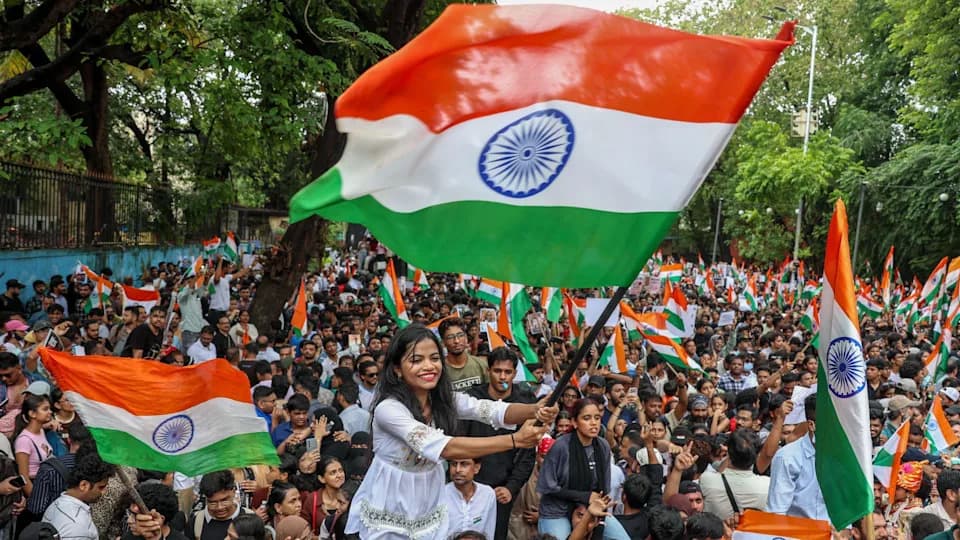
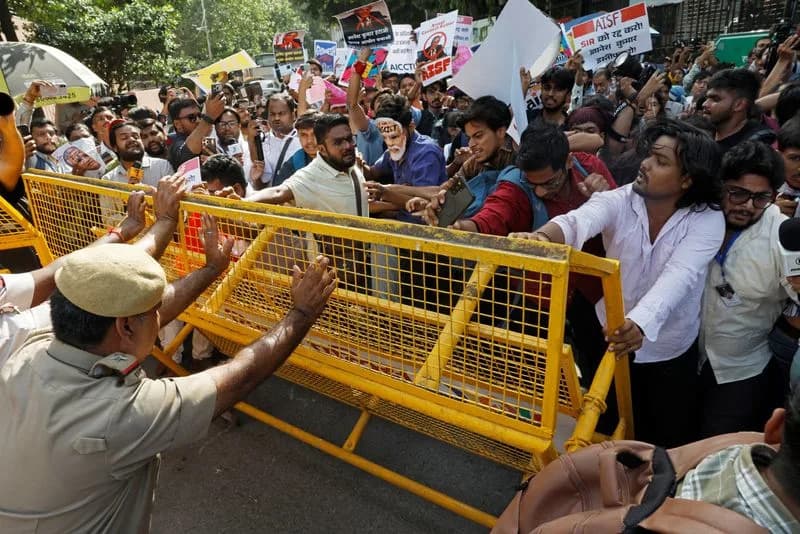
Summary: Student protests at Jantar Mantar in July 2026 — driven by viral online mobilisation and long-standing student unions — forced Education Minister Dharmendra Pradhan to resign amid alleged exam leaks. Central to the demonstrations was the chant "Azadi" (freedom), a slogan with roots in South Asian feminist and Kashmiri movements that has been repurposed by India's youth. Digitally astute Gen Z organisers, backed by seasoned campus groups, sustained a decentralized movement that resisted attempts to label dissent "antinational."
From Chant to Anthem: How 'Azadi' Became the Voice of India's Student Protests
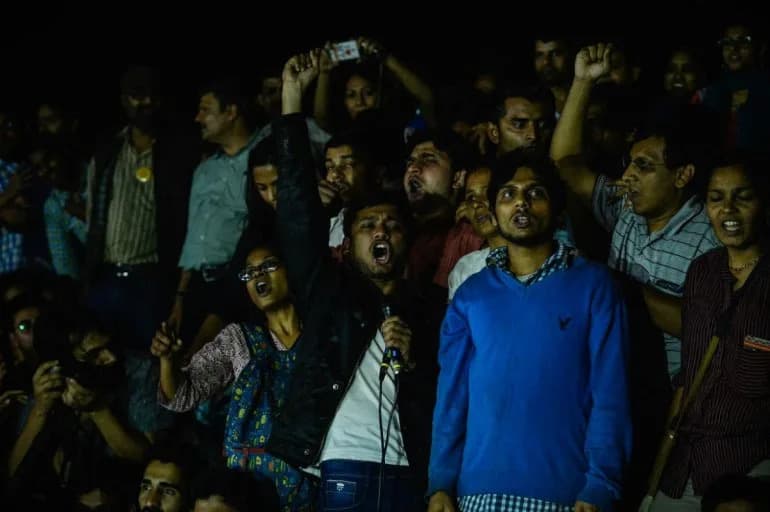
Indian student union leader Kanhaiya Kumar, centre, shouts slogans as he addresses students and activists at Jawaharlal Nehru University (JNU) in New Delhi on March 3, 2016 [Chandan Khanna/AFP]
New Delhi — Early on July 26, municipal workers painted over graffiti at Jantar Mantar after a week of sustained student protests that culminated in the resignation of Education Minister Dharmendra Pradhan. What began as outrage over alleged exam leaks grew into a broader youth-led movement — and the chant "Azadi" (freedom) became its unmistakable anthem.
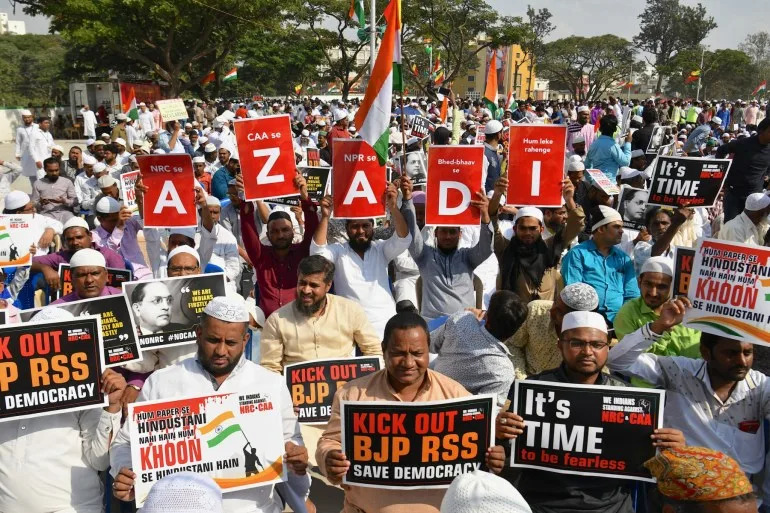
Muslim protesters hold placards and wave Indian flags during a rally against India's new citizenship law in Bangalore on January 3, 2020 [Manjunath Kiran/AFP]
How a Slogan Took Center Stage
A man climbed a tree with a loudspeaker, playing a chant-turned-song that rippled through the crowd: "Azadi, give me freedom!" Video of police beating students on Parliament Street amplified the refrain, propelling it beyond Delhi to Jaipur, Lucknow, Mumbai and other cities. The chant's resonance linked contemporary demands for education reform to longer struggles for social and political rights.
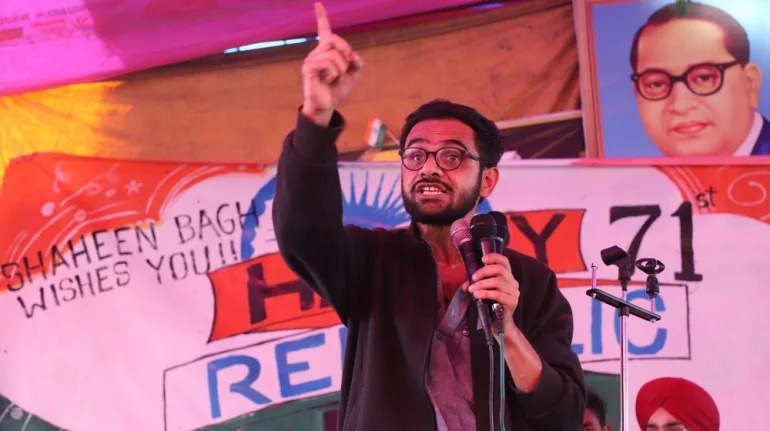
JNU former student and social activist Umar Khalid speaks at Shaheen Bagh during a protest against the Citizenship Amendment Act and NRC in New Delhi, India on January 26, 2020 [Nasir Kachroo/NurPhoto via Getty Images]
Roots and Reinvention
The political life of the word "Azadi" travels across decades and borders. It figured in Pakistan's 1980s feminist resistance to General Zia-ul-Haq and in Kashmiri movements of the late 1980s. Indian activists — including late feminist Kamla Bhasin — adapted it for local struggles. On December 9, 2016, footage of Jawaharlal Nehru University (JNU) students chanting "Azadi" turned into a national controversy, triggering sedition charges and a sustained campaign to brand dissenting students "antinational."
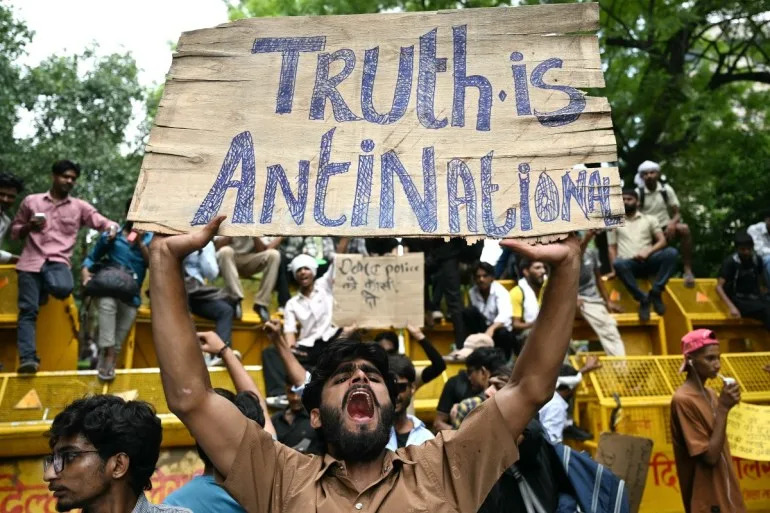
A Cockroach Janta Party (CJP) supporter shouts slogans at Jantar Mantar in New Delhi on July 23, 2026 [Sajjad Hussain/AFP]
From Street Chants to Pop Culture
Producer Dub Sharma layered the JNU crowd's chant with electronic beats, and a reworked version featuring rapper Divine later appeared in Zoya Akhtar's 2019 film Gully Boy. Critics argued the film's version diluted the chant's original social-justice calls, but the adapted track helped embed "Azadi" in youth culture and protest music — a texture that Gen Z protesters revived this summer.
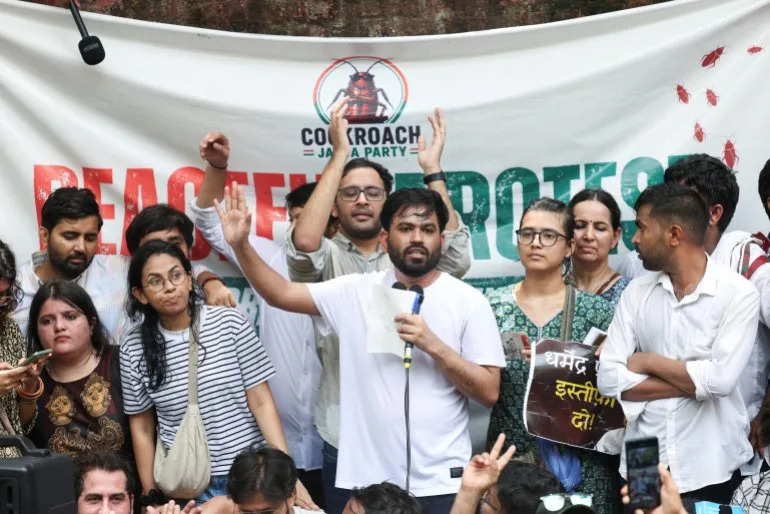
Abhijeet Dipke, head of the Cockroach Janta Party (CJP), stands beside All India Students' Association national president Neha Bora, right, during a sit-in protest demanding the resignation of Indian Education Minister Dharmendra Pradhan, in New Delhi, India, on June 6, 2026 [Adnan Abidi/Reuters]
Organization, Digital Savvy and a New Generation
The protests were partly organised by the online-born Cockroach Janta Party (CJP), whose founder Abhijeet Dipke harnessed viral social media momentum to mobilize students. Established student bodies — notably the All India Students' Association (AISA) and the Student Federation of India (SFI) — provided logistical experience and continuity at the Jantar Mantar sit-in. Activists such as AISA president Neha Bora and volunteers including Mohammad Junaid played visible roles in sustaining the camp, coordinating shifts, and drawing in lawyers, academics and farmers to broaden support.
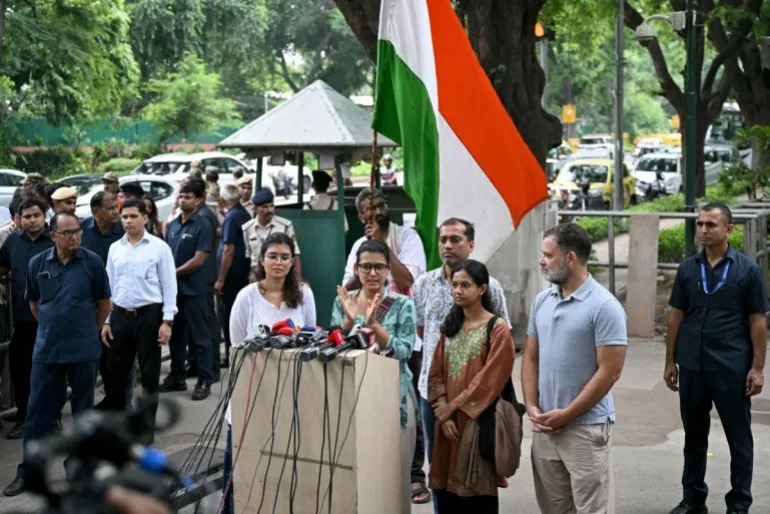
All India Students' Association (AISA) President Neha Bora, centre, addresses a news conference alongside opposition leader Rahul Gandhi (second from right) in solidarity with the Cockroach Janta Party (CJP) in New Delhi on July 25, 2026, amid the ongoing protest demanding Education Minister Dharmendra Pradhan's resignation over alleged NEET exam irregularities [Arun Sankar/AFP]
"It requires a lot of courage to be a student activist or leader in India," said Delhi University professor Apoorvanand, noting an intensified crackdown on campus dissent in recent years.
Why This Wave Felt Different
Analysts and veteran organisers point to several shifts that made this movement harder to marginalize: the broad appeal of education-related grievances, a digitally fluent generation that "became the media themselves," and a more diverse leadership profile that complicated earlier tactics of delegitimisation. Videos, memes and social-media storytelling helped humanize protesters and erode the potency of labels like "antinational."
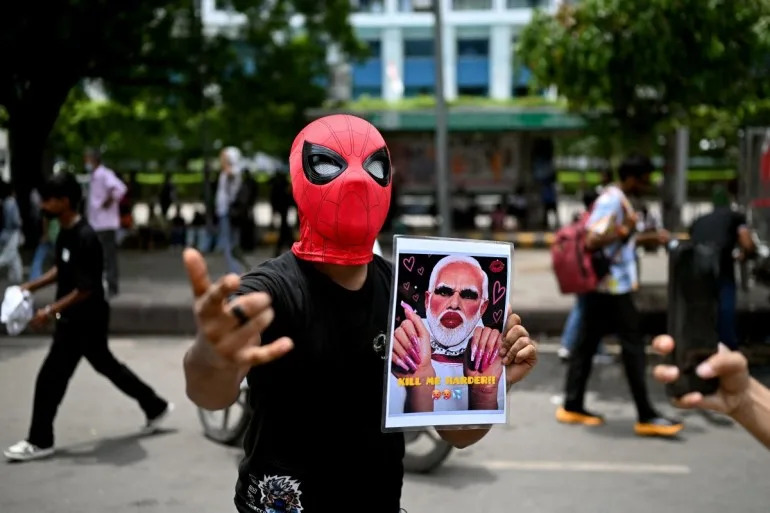
A Cockroach Janta Party (CJP) supporter holds a placard of India's Prime Minister Narendra Modi at Jantar Mantar in New Delhi on July 25, 2026, during the ongoing protest to demand the resignation of India's Education Minister Dharmendra Pradhan over alleged NEET exam irregularities [Sajjad Hussain/AFP]
Continuities: Arrests, Violence and Political Contestation
The protests remain anchored to a longer trajectory of campus clashes and legal action. Several activists arrested in prior crackdowns — including Umar Khalid and Sharjeel Imam — remain entangled in legal cases. Organisers say universities have seen political appointments, funding cuts and constraints on events that have narrowed campus dissent. Police harassment of some participants continued during and after the Jantar Mantar occupation.
What "Azadi" Means Today
For many young protesters, "Azadi" has become both a cultural refrain and a political demand: a flexible slogan that links struggles against caste hierarchies, economic inequality, and state overreach. As veteran organisers mentored younger activists, the chant evolved from a once-criminalised cry into a mainstream symbol of youth resistance under Prime Minister Narendra Modi's decade in power.
Key figures mentioned: Dharmendra Pradhan; Abhijeet Dipke (Cockroach Janta Party); Neha Bora (AISA); Sonam Wangchuk; Dub Sharma; Divine; Umar Khalid; Sharjeel Imam; Kamla Bhasin; Kanhaiya Kumar.
Help us improve.