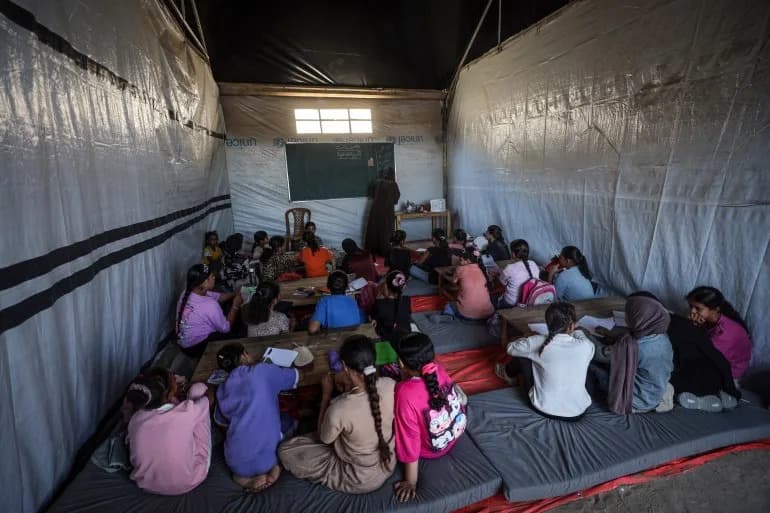
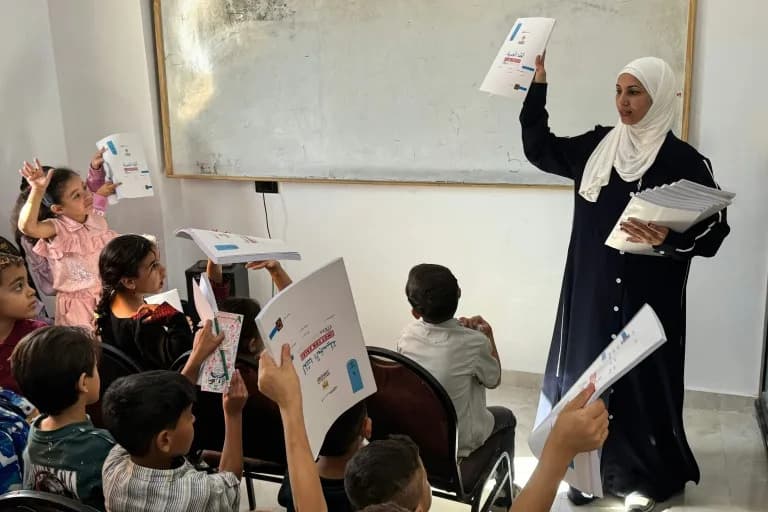
Art and music initiatives across Gaza — from a beach café in Deir el-Balah to displaced classrooms in Nuseirat — are offering children important emotional outlets amid the ongoing war. Sixteen-year-old Maryam, who lost her home in January 2024, says drawing has helped her cope and regain hope. Organizers and psychologists stress that while creative activities are not a cure-all, they provide stabilizing routines and nonverbal ways to process trauma when sustained and supervised.
Brushstrokes of Hope: How Art and Music Help Gaza’s Children Cope With War
[Eman Abu Zayed/Al Jazeera]
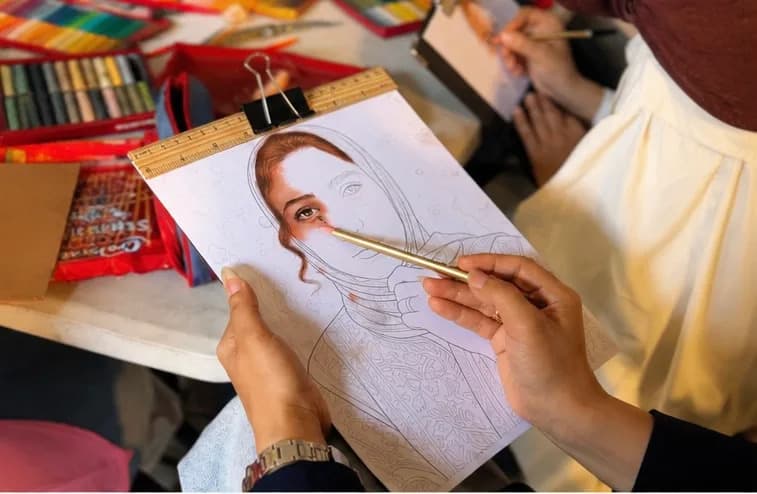
Deir el-Balah, Gaza Strip — Sixteen-year-old Maryam sits before a blank sheet of paper, pencil poised, and begins with the first few steady lines. As she focuses on details, the noise of the surrounding destruction recedes and, for a few hours, she returns to something familiar and sustaining.
Maryam’s family home was destroyed in January 2024, and she now lives with her grandmother in Deir el-Balah. She has lost friends and relatives, including an uncle, in recent strikes. More than 73,000 Palestinians have been killed since October 2023, according to local health authorities — a toll that amplifies the emotional toll on children across the Gaza Strip.
The small art space where Maryam draws, set up in a café on the beach, has become a refuge.
'The space helped me return to myself and rediscover my passion for drawing,' Maryam says.
For Maryam, drawing is more than a pastime: it is a way of putting feelings onto paper when words fail. 'I feel a great sense of psychological relief, as if I can put my feelings on the paper instead of keeping them trapped inside me,' she explains. Completing each piece gives her a sense of achievement and a small spark of hope amid heavy days.
Creating Safe Spaces Amid Displacement
The art space was established in April by 35-year-old Abdullah al-Ghafri. With many cultural and educational centres in Gaza damaged or destroyed, al-Ghafri says local initiatives are essential to give young people a place to express themselves.
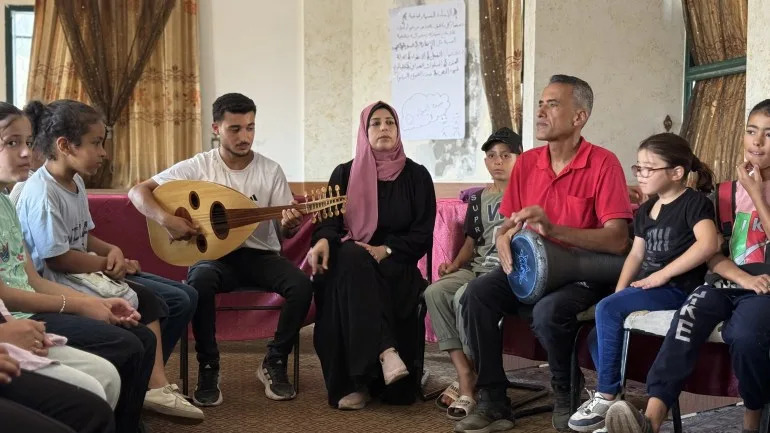
A music performance at the Edward Said National Conservatory of Music in Nuseirat camp [Eman Abu Zayed/Al Jazeera]
'The idea was born out of necessity and the difficult reality,' al-Ghafri says. 'The main goal is to lift the participants out of the atmosphere of war and destruction and provide a place where they can release negative energy and replace it with positive energy and hope.'
Al-Ghafri struggles to cover rental costs and is continually seeking donors to keep the space open. Despite financial challenges, volunteers and teachers are determined to maintain regular activities so children can establish a stable routine.
Art and Music as Emotional Outlets
Psychologist Asil Abu Shawish emphasizes that creative activities give children a nonverbal way to release pressure and process trauma. 'When a child draws, sings or plays an instrument, they are, in a way, releasing some of the pressure and emotions that have built up inside them,' she says.
Abu Shawish notes that a dependable, safe environment for art or music provides a sense of control and stability amid constant upheaval: 'That feeling is very important psychologically.' She cautions that art is not a cure-all but can be an important means of emotional release and coping when activities are age-appropriate and supervised by trained staff.
'Sometimes a child who is quiet or withdrawn begins to interact with the group through drawing or music. The activity can become the starting point for a relationship, a conversation or a sense of safety,' Abu Shawish says.
Taking Music to Displaced Children
In Nuseirat, the Palestinian Student Care Association partners with the Edward Said National Conservatory of Music to bring instruments and singing to children in displacement sites. Jabr Thabet, projects and venue coordinator at the Conservatory's Gaza branch, says teachers continue lessons wherever families are located.
'We are trying to bring music to children wherever they are, even if the place changes and the centres are damaged,' Thabet says. 'We are not just teaching music. We are giving children a moment of normality — a chance to feel joy and meet peers.'
Thabet watches children's enthusiasm from arrival to the final note: many come in hesitant and leave eager to return. For him and other educators, art and music are forms of resilience. 'When a child can sing, play and create something beautiful amid all this destruction, they preserve a part of themselves and their life,' he says.
What This Means Going Forward
Organizers, psychologists and teachers say sustained access to creative activities is most effective when it becomes part of a child's routine. While artistic programs cannot resolve all the psychological harms of war, they offer vital tools to help young people process grief, reduce anxiety and reclaim small pockets of normalcy and hope.
Help us improve.