New X-ray polarimetry of magnetar 1E 1547-5408 by NASA's IXPE, combined with ISS X-ray data and radio observations, reveals X-ray polarization nearly three times higher than expected and aligned with the star's magnetic field and radio emission. These two converging signals point to vacuum birefringence — a quantum effect predicted in 1936 — as the most consistent explanation. The result offers a rare, direct test of quantum electrodynamics in an environment far beyond terrestrial capabilities and was published Aug. 5 in Nature.
Magnetar Shows Empty Space Isn't Empty: Strong Evidence for a 90‑Year‑Old Quantum Prediction
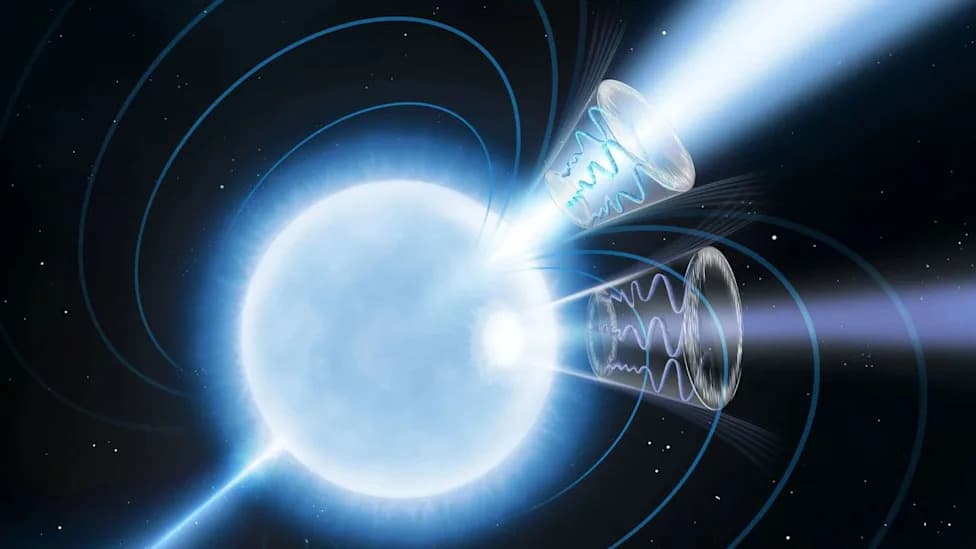
An illustration of a white star with two beams of different wavelengths shooting out toward the right side.
New X-ray and radio observations of a highly magnetic dead star provide the strongest evidence yet that empty space can change the way light travels. The result supports a nearly century-old quantum prediction that intense magnetic fields make the vacuum behave like a prism, aligning and polarizing passing light.
What was observed
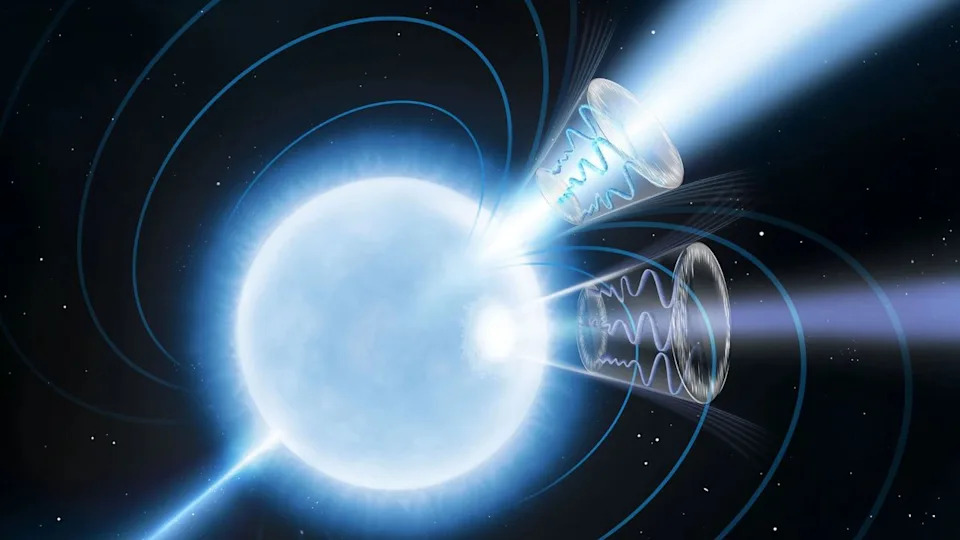
Observations of an intensely magnetic dead star provide the strongest evidence yet for a bizarre quantum effect that makes empty space alter the way light travels. . | Credit: NASA/Pablo Garcia
In March–April 2025 researchers used NASA's Imaging X-ray Polarimetry Explorer (IXPE), an X-ray instrument aboard the International Space Station, and radio telescopes in Australia and South Africa to study the magnetar 1E 1547-5408. The IXPE X-rays were nearly three times more polarized than expected from standard neutron-star surface models, and the polarization direction closely matched the star's magnetic geometry and its radio-wave polarization.
Why this matters
These two findings together — unusually strong X-ray polarization and alignment with the magnetar's magnetic field and radio signal — point to vacuum birefringence as the most consistent explanation. Vacuum birefringence was first predicted by Werner Heisenberg and Hans Euler in 1936: quantum fluctuations produce transient particle–antiparticle pairs that, in the presence of extremely strong magnetic fields, change how light propagates.
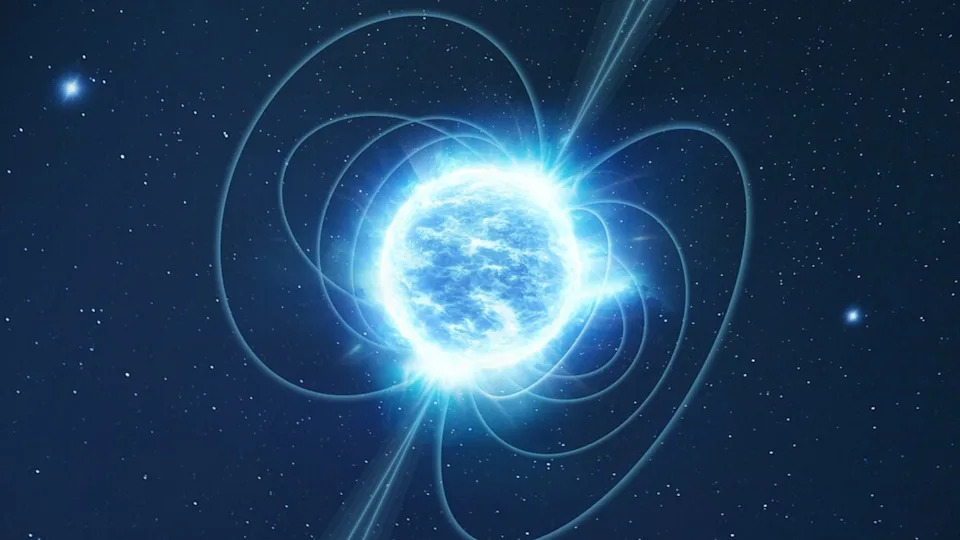
An illustration of a magnetar. | Credit: ESA
Detecting this effect requires magnetic fields far beyond anything we can create on Earth, said Marcus Lower of Swinburne University. Magnetars provide nature's only workable laboratories for such tests.
How the team reached the conclusion
The research team, led by graduate student Rachael Stewart of George Washington University, combined IXPE's polarized X-ray measurements with X-ray data from an ISS instrument and long-term radio monitoring from Australia's Murriyang telescope and the South African Radio Astronomy Observatory. The consistent orientation of X-ray and radio polarization, tied to the magnetar's known magnetic geometry, makes alternative explanations — such as unusual surface emission patterns alone — far less likely.
Co-author Michela Negro of Louisiana State University noted that astronomers are now using extreme astrophysical objects not just to study the cosmos but to probe fundamental physics under conditions impossible to reproduce in terrestrial labs.
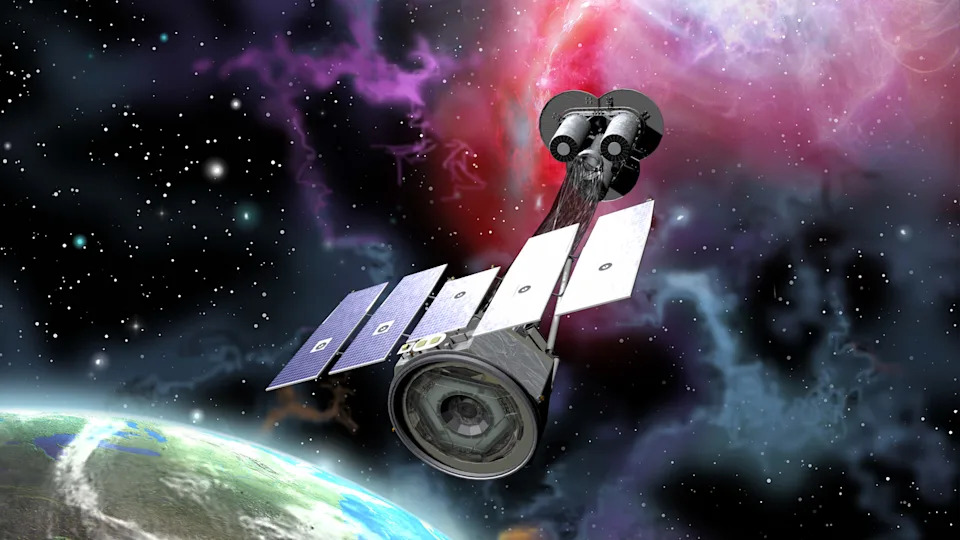
An artist's depiction of the IXPE observatory in space. | Credit: NASA
Context and next steps
Earlier optical hints of vacuum birefringence were reported in 2017 for a different neutron star, but those measurements remained ambiguous. IXPE's X-ray polarimetry capability, launched in 2021, has finally given the sensitivity needed for such tests around magnetars.
The team plans to consolidate and refine the result with future observations, improved simulations, and proposed polarimetry missions such as GoSOX (Globe Orbiting Soft X-ray Polarimeter). If confirmed, this detection would complete a quest started by Heisenberg and Euler nearly 90 years ago and provide a striking demonstration of quantum electrodynamics in extreme astrophysical environments.
Publication: The findings are described in a paper published Aug. 5 in the journal Nature.
Help us improve.