
Using JWST, astronomers have identified MoM-BH*-1, an extraordinary "black hole star": a roughly 100,000-solar-mass object cloaked in a dense hydrogen envelope and powered by an accreting black hole. The central black hole emits energy ~100 billion times that of ordinary stars and likely formed <700 million years after the Big Bang. Simulations show a thick gas shell can reproduce the observed spectral drop and hide X-rays, implying many of JWST's "little red dots" may be similar objects.
JWST Reveals a New Cosmic Creature: MoM-BH*-1, a ‘Black Hole Star’
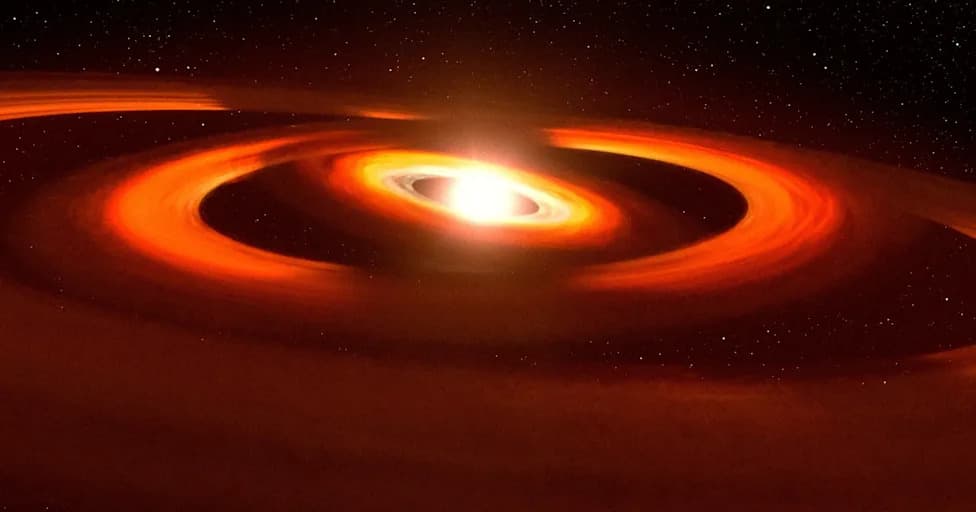
Shutterstock / Futurism
A team using the James Webb Space Telescope (JWST) has identified an object unlike anything previously catalogued — a so-called "black hole star." The luminous red source, named MoM-BH*-1, appears to be an ultra-massive object cloaked in a dense gaseous envelope and powered by an accreting black hole rather than by nuclear fusion.
MoM-BH*-1 contains roughly 100,000 times the mass of the Sun and is surrounded by a shell of gas so extensive that it resembles a star with the size scale of the entire Solar System. According to a study published in Nature, the black hole at the object's center emits energy at a level about 100 billion times greater than that of typical stars. The team estimates the object formed when the Universe was very young — less than 700 million years after the Big Bang.
Interest in such objects traces back nearly two decades to theoretical proposals for "quasi-stars," massive envelopes surrounding rapidly growing black holes. JWST's early observations beginning in 2022 revealed hundreds of unexplained crimson sources in the distant Universe, nicknamed "little red dots" (LRDs). These LRDs are more compact than galaxies but much larger and more massive than ordinary stars, challenging standard classifications.
One longstanding puzzle was the absence of strong X-ray signatures that would normally betray an active black hole. Many researchers suggested an ultra-dense gaseous envelope could trap high-energy radiation, allowing the source to appear primarily as a red, glowing object in infrared images.
In the new work, lead author Rohan Naidu (University of Hawai'i) and colleagues investigated a particular LRD whose spectrum shows a sharp drop in brightness below certain wavelengths. That feature can mimic the spectral imprint of dust in young stars, but the observations lacked the usual dust signatures. The team ran radiative-transfer simulations and found that a very dense hydrogen envelope surrounding a luminous central black hole can reproduce the observed spectral shape while suppressing expected X-ray escape.
"It is a very special thing to find an object with no comparison given the vast stores of data on billions of stars, galaxies, and black holes that we have in our archival databases," said Rohan Naidu. "MoM-BH*-1 is one in a billion!"
If this interpretation is confirmed, MoM-BH*-1 would be the clearest example yet of a black hole star and suggests that many of the JWST-discovered little red dots could belong to the same class. The discovery has important implications for how the first massive black holes and their host galaxies grew in the early Universe and for the formation channels of supermassive black hole seeds.
Caveats and next steps: The black hole–envelope model matches the current data, but confirmation requires additional observations — particularly deep X-ray data and higher-resolution spectroscopy — to detect signatures of accretion and to rule out alternative explanations. Future JWST observations and sensitive X-ray telescopes will be crucial to test the black hole star hypothesis across the LRD population.
Help us improve.





















