
Using JWST/NIRSpec and ALMA, astronomers have confirmed LID-1166 as two actively accreting supermassive black holes seen 1.3 billion years after the Big Bang. The nuclei lie roughly 4,900 light-years (1.5 kpc) apart inside a merging system and were first discovered as a bright X-ray source in the Chandra COSMOS Legacy Survey. JWST resolved two compact components with AGN-like spectral signatures; ALMA found cold gas reservoirs around each nucleus, supporting a merger-driven growth scenario. Further follow-up will verify the pair and refine how such mergers fuel rapid early black hole growth.
JWST and ALMA Confirm Closely Paired Supermassive Black Holes Just 1.3 Billion Years After the Big Bang
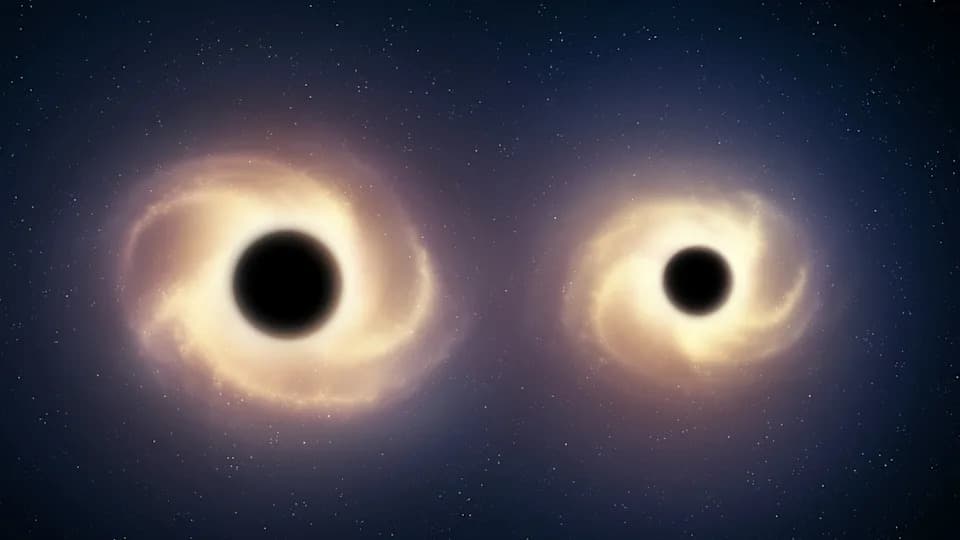
An illustration of a pair of black holes in deep space. | Credit: Nazarii Neshcherenskyi via Getty Images
Astronomers have confirmed a tightly separated pair of actively accreting supermassive black holes in the early universe. Cataloged as LID-1166, the two nuclei are observed as they were when the cosmos was roughly 1.3 billion years old and sit only about 4,900 light-years (1.5 kiloparsecs) apart inside a merging galactic system. This is the closest confirmed dual black hole system at such an early epoch, offering a rare window on how massive black holes and their host galaxies grow through mergers.
How the Discovery Was Made
LID-1166 was first flagged as a bright X-ray source in the Chandra COSMOS Legacy Survey — a hint of vigorous accretion. It was invisible in even the deepest Hubble Space Telescope images, so the team followed up with the James Webb Space Telescope's Near-Infrared Spectrograph (NIRSpec) and with ALMA (the Atacama Large Millimeter/submillimeter Array) in Chile.
JWST/NIRSpec resolved two compact, luminous components separated by ~4,900 light-years and revealed spectral signatures of fast-moving gas consistent with active galactic nuclei (AGNs). ALMA detected large reservoirs of cold gas around each nucleus, indicating each AGN occupies the center of its own galactic component and supporting the interpretation that two galaxies are on the verge of merging.
Why This Matters
Galaxy mergers are a major channel for funneling gas to galactic centers and feeding central black holes. Finding a closely obscured pair like LID-1166 provides direct observational evidence of this growth pathway in the early universe and helps explain how some supermassive black holes reached enormous masses very quickly.
"What makes that discovery special is that we may be seeing these two black holes growing and interacting in a system that is only about 1.3 billion years after the Big Bang," said Anna Trindade Falcão (NASA Goddard), who was not involved in the study. Co-author Roberto Decarli (INAF, Bologna) added that such observations are possible only thanks to the exquisite imaging and spectroscopic capabilities of JWST NIRSpec.
Caveats and Next Steps
Although multiple methods to subtract the host galaxy light show a persistent signal at the second component's position, independent confirmation is still valuable. Some researchers urge deeper follow-up analyses to decisively rule out alternative explanations, such as a single AGN with residual host-galaxy light mimicking a second source.
The discovery paper, led by Hyewon Suh (International Gemini Observatory/NSF NOIRLab) and collaborators, was submitted to the arXiv preprint server on July 21 and has been accepted for publication in Nature Astronomy. Continued JWST and ALMA observations, plus additional multiwavelength follow-up, will test whether LID-1166 is a canonical example of merger-driven black hole growth in the young universe.
Image credit: Nazarii Neshcherenskyi via Getty Images
Help us improve.





















