In 1504, stranded off Jamaica, Christopher Columbus used an astronomical almanac to predict a lunar eclipse on 29 February. He warned local Taíno leaders that the Moon would turn blood red as a sign of divine anger if they withheld food. When the eclipse occurred, the frightened islanders resumed provisioning Columbus and his crew; modern astronomers confirm the eclipse's visibility from Jamaica on that date.
How Columbus Used a Lunar Eclipse to Save His Crew in Jamaica (1504)
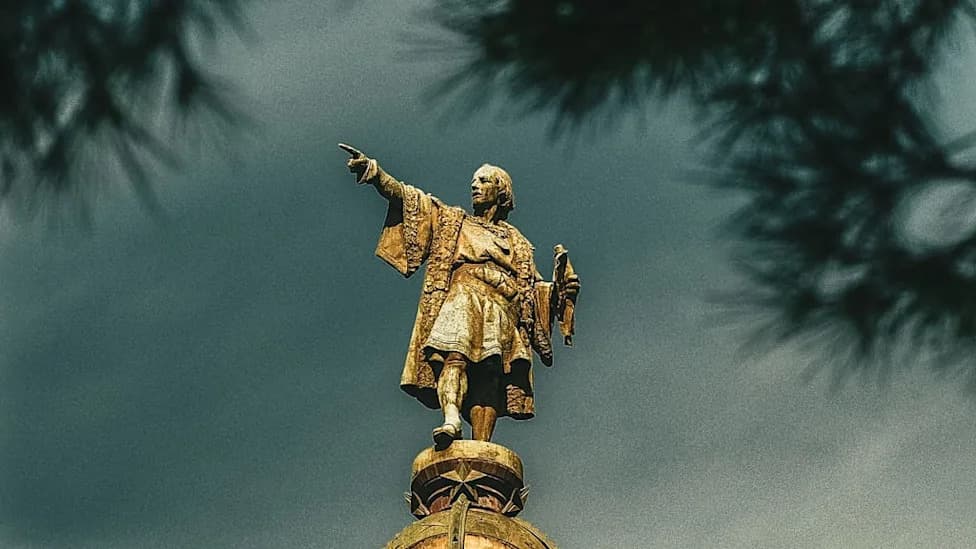
How Christopher Columbus used an eclipse to save his life in Jamaica
In 1504, during his fourth voyage to the New World, Christopher Columbus and his stranded crew were trapped on the island of Jamaica after their ships had run aground. Cut off from resupply and suffering dwindling provisions, the expedition faced starvation and rising tensions with the island's Taíno people, who called the island Xaymaca or Yamaya, meaning "land of wood and water."
Background
Diego Méndez, the voyage's chief scribe, paddled by canoe to La Española (now the Dominican Republic) to request help from Governor Nicolás de Ovando. Although Méndez reached Ovando after five days, the governor—distrustful of Columbus—delayed decisive assistance, leaving the castaways to survive on limited local supplies and trade.
The Astronomical Ruse
Desperate, Columbus consulted an almanac he carried, the Almanach Perpetuum compiled by the German astronomer Johann Müller (Regiomontanus). The calendar listed predicted lunar eclipses; Columbus found a crucial entry: a lunar eclipse would occur on 29 February 1504 and would be visible from Jamaica.
Three days before the event Columbus summoned the island's leaders and warned them that his Christian God was angry for having cut off the food supply. He told them that as a sign of divine wrath the Moon would disappear and turn blood red that night.
The Eclipse And Its Aftermath
On the night of 29 February 1504 the Moon darkened and took on a reddish hue consistent with a total lunar eclipse. Terrified, the islanders begged Columbus to intercede. According to the admiral's son Hernando, Columbus pretended to pray and then reappeared at the precise moment the eclipse began to wane, declaring that his God had forgiven them—on the condition that provisions resumed.
The tactic worked. The Taíno leaders restored food supplies until a rescue ship organized by Diego Méndez arrived to carry the survivors back to Spanish territory. Columbus returned to Spain and landed at Sanlúcar de Barrameda in November 1504; he died in Valladolid in May 1506.
Why This Story Matters
This incident is a well-documented example of how contemporary astronomical knowledge could be repurposed as a survival strategy. Modern astronomical reconstructions confirm a lunar eclipse was visible from Jamaica on 29 February 1504, matching descriptions in the historical sources. Columbus's use of the almanac demonstrates a calculated, not improvised, application of scientific tools in a high-stakes situation.
Note: The account comes primarily from contemporary chroniclers and Columbus's son Hernando; as with many historical narratives, descriptions combine observed events with interpretive detail from the sources.
Help us improve.