Taiwan’s 584th Armored Brigade practiced concealing and refueling M1A2T Abrams tanks in a cramped Taoyuan yard during the Han Kuang exercises, linking tanks to M978 fuel trucks and taking about 15 minutes per refuel. Analysts say the Abrams are best used for ambushes on roads into cities and at chokepoints rather than set-piece battles with PLA armor, especially if China gains air superiority. The 108-tank purchase sparked debate over suitability for island terrain, but the drills show efforts to adapt heavy armor to urban defense.
Taiwan Trains Abrams Crews To Conceal And Refuel M1A2Ts In Urban Areas
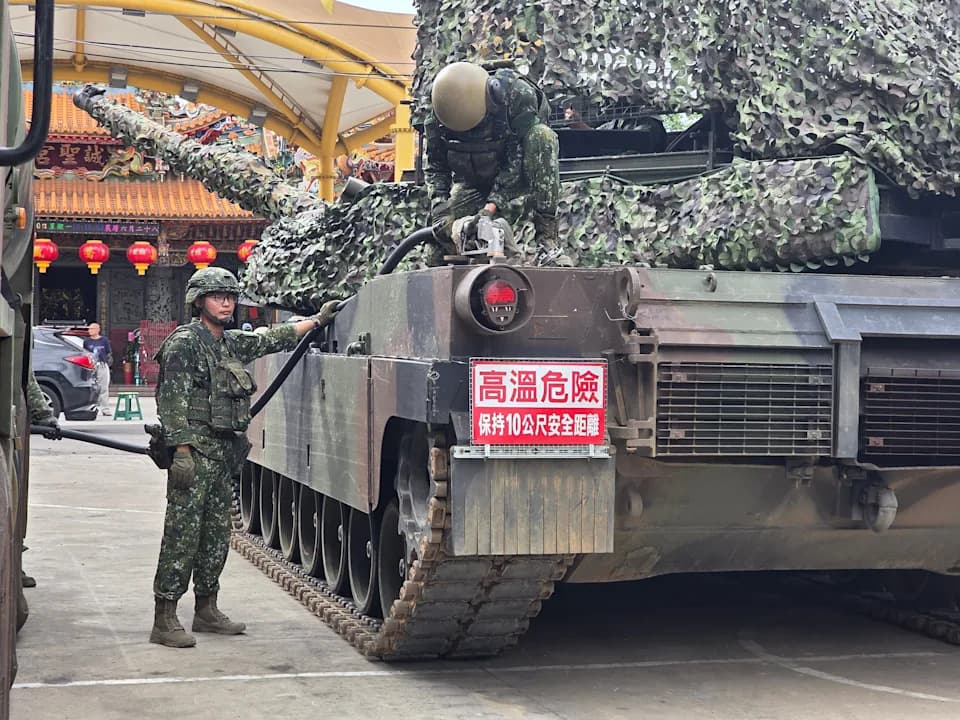
Taiwanese troops refueled the M1A2T just across from a Chinese temple.Matthew Loh for Business Insider
TAOYUAN, TAIWAN — As part of the annual Han Kuang military exercises this August, Taiwan’s 584th Armored Brigade practiced concealing and refueling newly delivered M1A2T Abrams tanks inside a cramped construction yard roughly a mile from the island’s main airport.
Urban Refueling Under Real-World Conditions
Crews linked an Abrams’ Honeywell AGT1500 gas-turbine engine to an M978 Heavy Expanded Mobility Tactical Truck (HEMTT) to top off fuel in sweltering heat. Civilian traffic passed nearby while soldiers completed the evolution, which took about 15 minutes per tank before the vehicles rolled back into concealed positions.
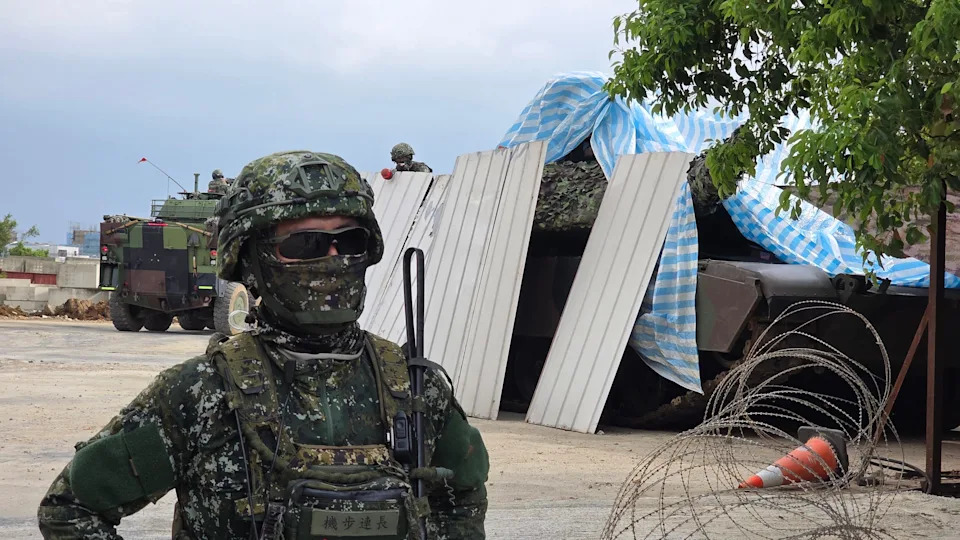
A Taiwanese soldier stands guard in front of a Clouded Leopard infantry fighting vehicle. An M1A2T covered by a tarp and scrap is pictured on the right.Matthew Loh for Business Insider
Tactical Purpose And Local Constraints
Taiwan received the final shipment of 108 M1A2T tanks in April, and the armored brigade’s drills emphasized mobility, concealment and rapid support in built-up areas — the locations where much of Taiwan’s population and critical infrastructure are concentrated. Space in the Taoyuan yard was tight: a temple with a large statue of Guan Yu, narrow village alleys and a metro station were all within walking distance.
“Going head-to-head with PLA tanks is not a good idea,” said Erich Shih, a Taiwanese military analyst who runs Military and Aviation News. He recommended ambushes on approaches into cities, flexible intercept points and frequent repositioning rather than fixed set-piece battles.
Why Urban And Chokepoint Warfare Matters
With more than two-thirds of Taiwan covered by mountains and other difficult terrain, and the remainder heavily urbanized, analysts expect heavy armor to be most useful in cities and around strategic chokepoints if a mainland ground assault occurs. The M1A2T’s weight and protection make it powerful in direct engagements, but Taiwan’s defenders must also account for the threat of Chinese airpower supporting armored advances.
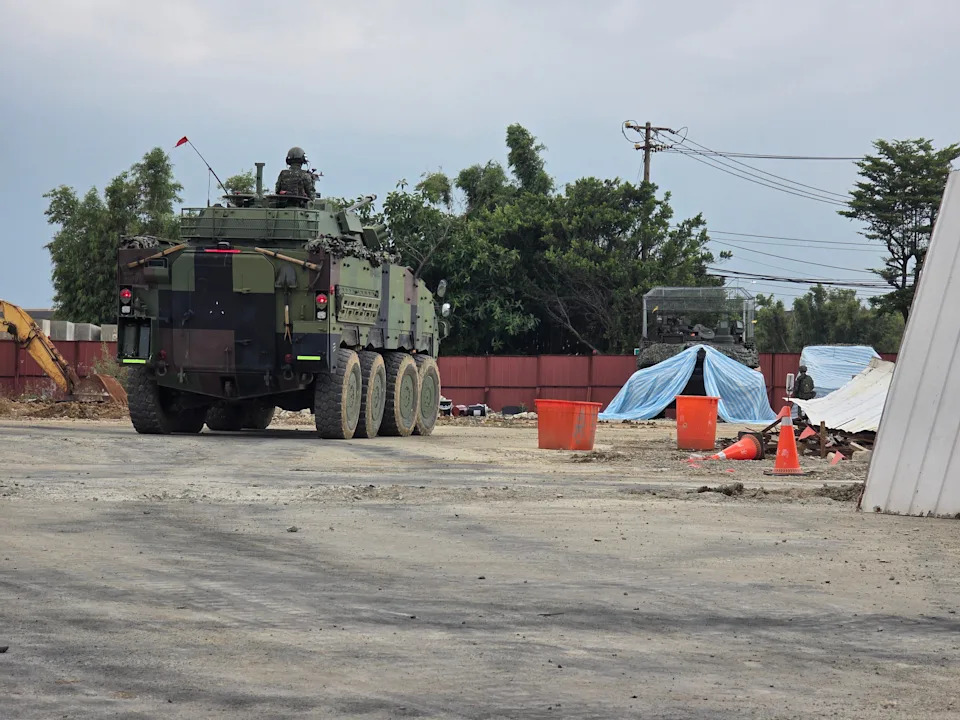
A Clouded Leopard infantry fighting vehicle stands guard next to another Abrams tank, pictured right, with a tarp covering its main gun.Matthew Loh for Business Insider
China fields thousands of armored vehicles: roughly 6,000 tanks in total, including about 2,200 Type 96s, 500 Type 15 light tanks, and more than 1,200 Type 99/99A third-generation tanks, plus over 1,000 Type 5 amphibious assault vehicles. While many of those platforms are lighter than the Abrams, combat outcomes depend on combined arms, air superiority and tactical context.
Controversy And Operational Value
Taiwan’s 2019 purchase of 108 M1A2Ts — part of an approximately $2.2 billion U.S. package that included Stinger missiles — drew debate over whether a 73-ton main battle tank suits island terrain and fragile rural bridges, or whether funds should prioritize asymmetric systems like drones. Supporters argue the Abrams restores crews’ confidence in their equipment and provides a modern, survivable platform for key defensive tasks.
The Han Kuang drills demonstrated practical steps Taiwan is taking to adapt heavy armor to confined urban environments: concealment, rapid refuel and integrated escorts of Clouded Leopard infantry fighting vehicles and Humvees with anti-tank launchers. Those adaptations aim to maximize the tactical value of the M1A2Ts while mitigating vulnerabilities that come with heavy armor in dense terrain.
Bottom line: Training in urban refueling and concealment enhances Taiwan’s ability to employ heavy armor where population centers and strategic chokepoints matter most, but commanders will likely favor ambush, mobility and combined-arms tactics over direct, head-to-head tank battles if the conflict escalates.
Help us improve.