China’s July test of a ballistic missile capable of carrying a nuclear warhead has intensified divisions among Pacific island states and undercut efforts to keep the region an "Ocean of Peace." The launch occurred hours after Fiji signed a defence pact with Australia, and Pacific foreign ministers failed to agree a joint condemnation, exposing divergent ties to China and the U.S. Leaders say security partnerships bring practical benefits but worry about rising militarisation and loss of control over territory and infrastructure.
China Missile Test Deepens Pacific Rift, Challenging 'Ocean of Peace' Aspiration
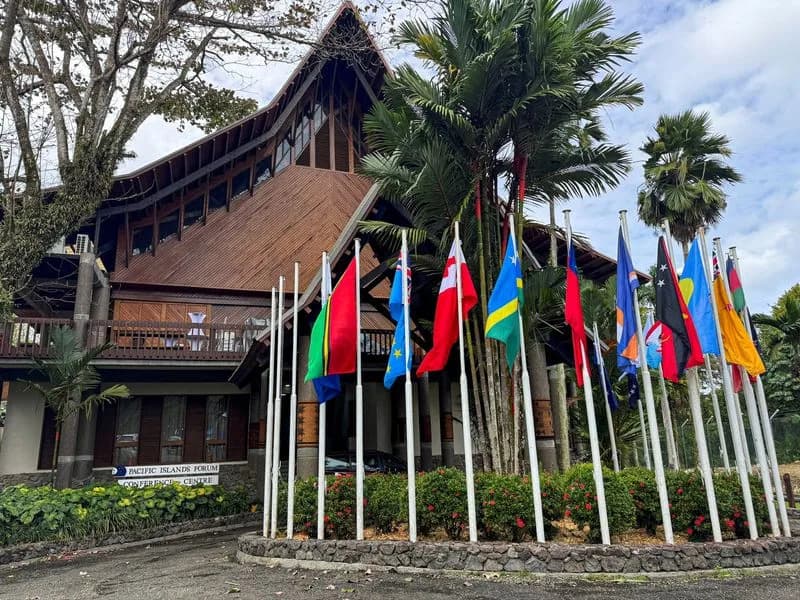
FILE PHOTO: The headquarters for the Pacific Islands Forum in Suva, Fiji, August 7, 2026. REUTERS/Lucy Craymer/File Photo
SUVA, Fiji, Aug 11 (Reuters) - China’s July test of a ballistic missile capable of carrying a nuclear warhead has widened divisions among Pacific island states and raised fresh doubts about the region’s bid to remain an "Ocean of Peace" free from great-power rivalry.
The launch — the first known Chinese ballistic missile fired into the Pacific since September 2024 — took place hours after Fiji and Australia signed a landmark defence pact, Fiji’s first formal military alliance. The timing drew alarm from several Pacific governments and highlighted competing security ties across the region.
More than a month after the test, foreign ministers from Pacific island states failed to agree a joint condemnation of the launch at a meeting in Suva, despite many leaders privately and publicly expressing concern about growing militarisation.
"The test was totally inappropriate," Papua New Guinea Foreign Minister Justin Tkatchenko told Reuters. He said PNG had received advance notice of the launch but not details about where the missile would land.
Chinese Foreign Ministry spokesperson Mao Ning insisted the test was conducted "safely" and urged other countries not to over-interpret the exercise.
Rising Tensions and Competing Partnerships
The missile firing capped a year of more visible military activity in the Pacific amid intense competition between the United States and China. Observers point to Chinese naval deployments and live-fire drills in areas such as the Tasman Sea, U.S.-allied exercises around Guam and Hawaii, and an increase in warship visits tied to expanding security partnerships.
The United States continues to maintain a significant military footprint across the region, including facilities in Hawaii, Guam and the Marshall Islands. At the same time, security initiatives such as AUKUS — the trilateral pact between Australia, the United Kingdom and the United States — have raised concerns among some island states about an accelerating militarisation.
Tuvalu permanent secretary Pasuna Tuaga, speaking in a personal capacity, said he was worried not only by the missile test but also by the growing number of external security arrangements that could pull the region into great-power rivalry.
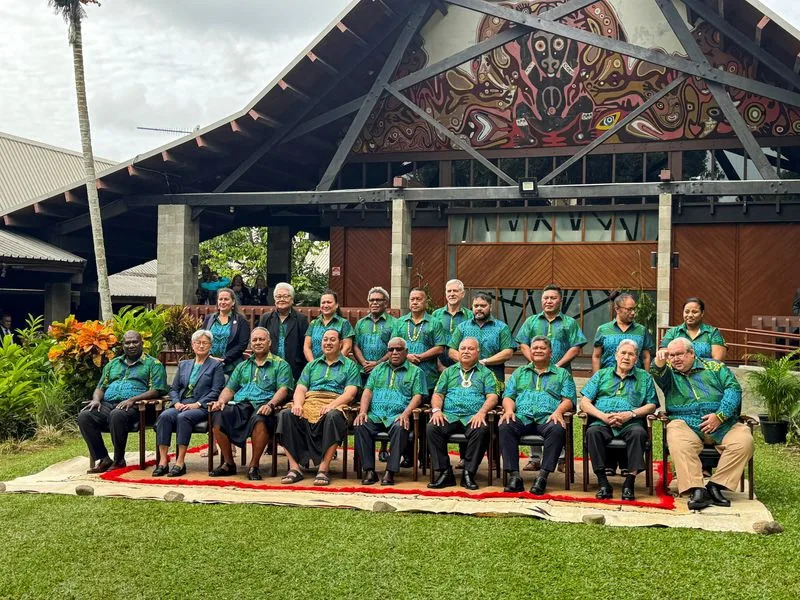
FILE PHOTO: Foreign ministers and representatives pose as they gather for the Pacific Islands Forum Foreign Ministers Meeting in Suva, Fiji, August 7, 2026. REUTERS/Lucy Craymer/File Photo
UNITED, BUT DIVIDED
In September 2025, Pacific leaders endorsed an "Ocean of Peace" declaration that pledged to protect the region and affirmed the right of peoples to peace. The initiative sought to put Pacific countries in charge of their own security agenda rather than allowing it to be defined by external Indo-Pacific strategies.
That declaration helped inspire the recent defence agreement between Australia and Fiji, dubbed the Ocean of Peace Alliance. Supporters say such partnerships bring tangible benefits: improved surveillance to curb illegal fishing, enhanced disaster response, policing support and access to equipment and training.
Critics warn, however, that a proliferation of bilateral security deals can limit Pacific states' control over how their land, waters and infrastructure are used — and can create pressure to take sides between competing powers.
Solomon Islands Foreign Minister Rick Houenipwela, who chaired the meeting in Suva, said the region’s agenda must remain "conceived by the Pacific, shaped by the Pacific and only by the Pacific." Yet consensus proved elusive: Kiribati and Nauru, which have deepened ties with Beijing after switching diplomatic recognition from Taiwan, did not back the proposed wording of a joint statement, an official said.
New Zealand Foreign Minister Winston Peters blamed foreign influence for the failure to reach consensus, without naming a specific country, underscoring how geopolitics has complicated regional unity.
Fiji Foreign Minister Sakiasi Ditoka acknowledged the tension Pacific governments face: nations want to avoid "war-making paraphernalia" while recognising that some security capabilities can help protect their people. Fiji also participated for the first time last month in the U.S.-led Rim of the Pacific (RIMPAC) exercises.
Pacific leaders will meet in Palau in three weeks for the Pacific Islands Forum leaders' meeting, where the missile test and the broader question of regional unity and militarisation are expected to return to the agenda.
(Reporting by Lucy Craymer; Editing by Praveen Menon and Sonali Paul)
Help us improve.